Want to be in the loop?
subscribe to
our notification
Business News
SMART PORT MODEL HELPS BOOST VIỆT NAM-CHINA BORDER TRADE
The Youyi Guan customs in Guangxi, China, has operated an intelligent quarantine system since 2023, enabling Việt Nam and China to digitalise the entire coordination process.
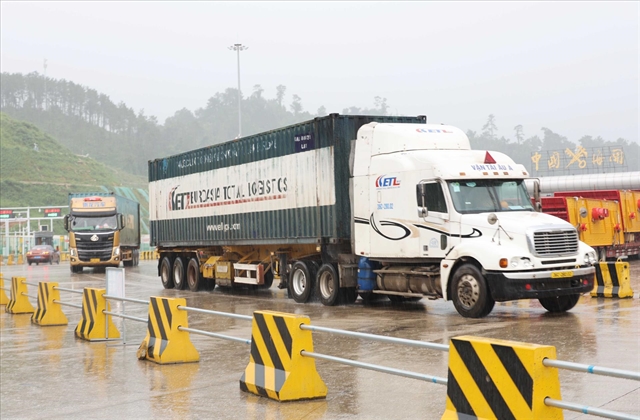
Container trucks carrying import and export goods are preparing to enter the loading and unloading area. — VNA/VNS Photo
HÀ NỘI — Cooperation between Việt Nam and China in building 'smart border gates' has become an important highlight in recent years, helping to remove bottlenecks in the flow of goods, especially agricultural products.
This is not only a practical step to promote bilateral trade but also demonstrates the determination of both countries to modernise border management, in line with the trend of comprehensive and extensive development.
As reported by Vietnam News Agency correspondent in China, a series of trucks carrying fruits and vegetables from Việt Nam were stuck at border gates from the end of 2021 to the beginning of 2022, causing significant losses for farmers.
In response to this situation, high-level leaders from both countries held numerous phone calls and direct exchanges to find solutions. Among the measures proposed, the development of smart border gates was one of the key steps put forward to resolve the issue.
Previously, it took three to five days for a truck to complete all procedures, but now the process only takes about 15 seconds.
The synchronised application of QR code scanning, facial recognition and fingerprint identification allows drivers to quickly finish entry procedures. In particular, fruits with short shelve lives, such as durian, a product highly popular in China, can now be transported cross the border without the risk of spoilage due to delays.
The Youyi Guan customs in Guangxi, China, has operated an intelligent quarantine system since 2023, enabling Việt Nam and China to digitalise the entire co-ordination process.
The average waiting time for each truck has been reduced by 3.5 hours, and the need for transshipment minimised.
The number of trucks clearing customs at the Việt Nam–China border gates reached a record of 3,300 per day within last year, double the figure of 2019.
Another highlight is the application of advanced science and technology. Driverless trucks, smart cranes, 5G technology, and the Beidou navigation satellite system have been deployed, making border gate operations largely automated and moving toward 24/7 operation. This is China’s first cross-border smart border gate model, which has delivered tangible results and is continuing to expand.
The joint efforts of the two countries to promote cooperation in reform and capacity building of border gate management not only shorten customs clearance times but also lay a solid foundation for stable and sustainable bilateral trade ties.
When fresh durian from Việt Nam was officially allowed for export to China since September 2022, the country quickly became a major supplier.
Nearly half of the 1.56 million tonnes of durian imported by China came from Việt Nam last year.
This clearly demonstrates the effectiveness of the smart border gate model in bringing Vietnamese agricultural products closer to Chinese consumers.
The establishment and operation of smart border gates not only addressed immediate challenges for farmers and import-export businesses but also carries strategic significance, opening up vast opportunities for Việt Nam-China border trade.
This achievement is a direct result of the close attention and guidance from the senior leaders of both parties and governments, reflecting the spirit of friendly, mutually beneficial, and shared development between the two neighbouring nations.
Zhu Houdong, deputy chief commander of the China–Việt Nam Friendship cargo transport corridor-smart port project, told the Vietnam News Agency that the purpose of building the smart port model was to achieve the goal of rapid customs clearance, ensuring goods can be transported from Nanning to Hà Nội and vice versa within 24 hours, maximising the stability of supply and production chains between the two countries.
In the coming period, based on the existing infrastructure, the current customs clearance capacity would be doubled, Zhu added. — VNS
Source: VNS
Related News

MEMBER CORNER / PROMOTIONS
AN ELECTRIFYING NIGHT WITH THE "QUEEN OF DANCE" THU MINH AT THE GRAND HO TRAM!
The stage at The Grand Ballroom is set to catch fire as Vietnam’s undisputed "Queen of Dance," Thu Minh, takes the spotlight. Renowned for her powerhouse vocals, magnetic stage presence, and sultry, high-energy performances, Thu Minh promises an evening of pure musical euphoria. The energy escalates with an exclusive appearance by special guest and The Voice champion, Vu Thao My.

HR / LABOUR/ EMPLOYMENT
HIGH-QUALITY HUMAN RESOURCES NEEDED TO ATTRACT NEW TECH INVESTMENT CAPITAL
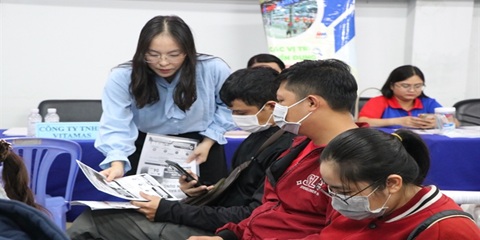
Besides infrastructure, Việt Nam must also rapidly develop a highly skilled workforce to attract investment in AI, semiconductors and advanced manufacturing, experts have said. Don Lam, CEO and co-founder of investment management company VinaCapital, said that global technology investors were increasingly looking at the readiness of the entire ecosystem, with high-quality human resources a decisive factor.
HR / LABOUR/ EMPLOYMENT
HIRING OUTLOOK STRENGTHENS IN Q4 AS SKILLS SHORTAGES PERSIST
Hiring intentions among employers in Việt Nam strengthened in the fourth quarter, with 52 per cent of surveyed companies planning to increase headcount between October and December, according to a ManpowerGroup survey released this week. Việt Nam's hiring outlook was stronger than the Asia Pacific and Middle East (APME) regional average of 33 per cent and the global average of 29 per cent, ranking third in the region and 11th globally among 42 markets surveyed.

BANKING / FINANCE / INSURANCE / TAX
LARGE BANKS FORECAST TO GAIN HIGHER PROFITABILITY IN H2 2026
The return on average assets (ROAA) of the banking sector will likely remain stable at around 1.5 per cent in the second half of 2026, but profitability divergence among banks will increase, with large banks outperforming peers on stronger margins and diversified earnings, analysts forecast. In a recent report on the banking sector, analysts from the Vietnam Investors Service Rating said the sector’s ROAA rose by 10 basis points quarter-on-quarter to 1.51 per cent in the first half of this year, driven by net interest margin (NIM) improvements at some State-owned banks and large private banks.
GARMENT / TEXTILE
VIỆT NAM'S FOOTWEAR, BAG EXPORTS TO US TOP $8 BILLION IN EIGHT MONTHS
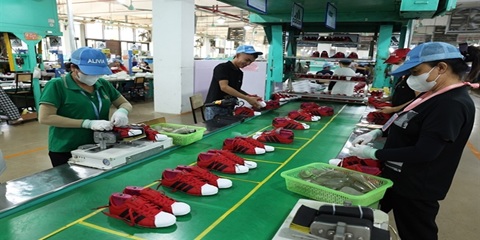
Việt Nam's exports of footwear and handbags to the US exceeded US$8 billion in the first eight months of 2026, as the US and EU remained the country's biggest markets despite sluggish growth in footwear shipments. Exports from Việt Nam's leather and footwear sector reached more than $2.45 billion in August, down 9 per cent from July but up 3 per cent from a year earlier, according to preliminary statistics.
VIETNAM ECONOMY INVESTMENT
LÂM ĐỒNG TARGETS DIGITAL ECONOMY TO ACCOUNT FOR 30 PER CENT OF GRDP BY 2030
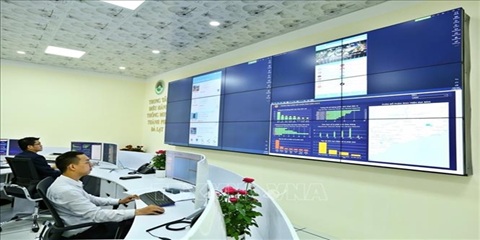
Lâm Đồng Province aims to raise the digital economy’s contribution to around 30 per cent of its gross regional domestic product (GRDP) by 2030, as part of a five-year plan to develop digital economy and society issued recently. Under Plan No. 15358/KH-UBND, the province targets more than 60 per cent of small- and medium-sized enterprises (SMEs) to adopt digital technologies by 2030 while increasing the value of cashless payments to 30 times its GRDP.
Events Sponsors






















