Want to be in the loop?
subscribe to
our notification
Business News
VIETNAM MANUFACTURING GAINS MOMENTUM ON STRONGER FDI
Vietnam’s manufacturing sector continued to improve in August 2026, with output growing at its fastest pace in more than two years and new orders recording their strongest increase since October 2025. This improvement came as foreign direct investment (FDI) inflows into manufacturing continued to grow strongly, showing that the industrial sector’s recovery is being supported by both short-term orders and long-term investment flows.
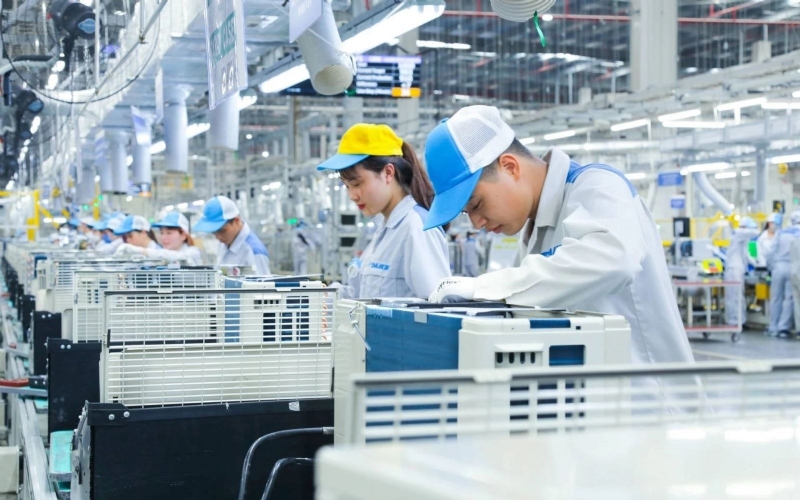
Vietnam has successfully attracted significant foreign investment in high-tech industries
Manufacturing Sector Shows Stronger Growth
According to S&P Global, Vietnam’s manufacturing Purchasing Managers’ Index (PMI) reached 53.3 points in August 2026, up from 52.9 points in July and its highest level since February. Output increased for the 16th consecutive month, recording its fastest growth in more than two years, while new orders rose at their strongest pace since October 2025.
Surveyed businesses attributed the improvement to the development and launch of new products, greater availability of raw materials and easing price pressures. As a result, manufacturers received more orders and increased production to meet demand.
Total new orders increased in August, but growth was driven mainly by the domestic market, while export orders declined slightly. This marked the first time in four months that new orders from overseas had returned to a downward trend.
Output increased, but employment in the sector continued to decline, marking the fifth contraction in the workforce in six months. Businesses attributed this mainly to resignations, retirements and reduced use of temporary contract workers. To meet higher production demand, manufacturers also increased purchasing activity in August. Finished goods inventories declined as products were delivered to customers, recording their sharpest decrease since April.
On the supply side, supplier delivery times continued to lengthen, but transportation disruptions became less severe in the middle of the third quarter. As a result, delivery times lengthened only slightly, remaining at a level similar to April 2025.
Andrew Harker, Economics Director at S&P Global Market Intelligence, said Vietnam’s manufacturing sector was strengthening in the middle of the third quarter of 2026. This shows that businesses have been able to improve operational efficiency and increase production without yet expanding their workforces.
Cost pressures remained as oil prices continued to push up fuel, plastics and transportation costs. However, the rate of increase in input costs slowed to its lowest level in 11 months, while selling prices also increased at a slower pace for the fourth consecutive month.
FDI Inflows Support Manufacturing Recovery
The positive development came as FDI inflows into Vietnam continued to increase. In the first eight months of 2026, total registered foreign investment reached US$40.63 billion, up 55.4% year on year, while disbursed FDI reached US$17.25 billion, up 12% and the highest level for the first eight months in five years. Capital continued to concentrate heavily in processing and manufacturing, with an increasing shift toward larger-scale projects with higher technology content.
According to an analysis by Savills Vietnam, the first half of 2026 saw a trend toward fewer new manufacturing projects but larger investment amounts. The computers, electronics and optical products sector accounted for a very large share of new manufacturing FDI. Savills also said Vietnam is attracting higher-value projects that are more closely linked to technology.
John Campbell, Director and Head of Industrial Services at Savills Vietnam, said Vietnam is currently attracting fewer new manufacturing projects, but these projects have higher investment values, greater technology content and a more important role in regional supply chains.
This trend is particularly evident in high-tech sectors. The market is also seeing an increasing number of very large-scale projects, including those by Samsung Semiconductor Asia Holdings, Samsung Electro-Mechanics Vietnam and LG Innotek Vietnam. While electronics and semiconductors are key growth drivers, the investment structure remains relatively diverse, with mechanical engineering, electrical equipment, metal products, rubber, plastics, food and automotive industries also attracting active investment.
“We are witnessing a shift from broad-based manufacturing expansion toward more specialized investments focused on technology, scale and production capabilities. Investors are not simply seeking factory locations but are building important links in their long-term supply chain strategies in Vietnam,” said Campbell.
Infrastructure and Industrial Real Estate Expand Capacity
The shift in manufacturing investment is also changing demand for industrial real estate. Alongside manufacturing, logistics is becoming an increasingly important part of the real estate ecosystem serving supply chains, as e-commerce, faster delivery requirements and increasingly complex production networks create additional demand for modern logistics facilities and locations connected to seaports, airports, expressways and consumer centers.
The shift toward high-tech sectors is also changing real estate requirements. Sectors such as electronics, semiconductors, data centers and high-tech manufacturing often require higher standards for power supply, data connectivity, technical infrastructure and operational capabilities, rather than simply larger industrial real estate areas.
Data centers are one example. According to Savills Vietnam’s Industrial Outlook 2026, the total operational design capacity of data centers in Vietnam reached approximately 524.7 MW in 2025 and could rise to 950 MW by 2030, an increase of about 81%.
The development of these sectors is taking place as Vietnam’s infrastructure network expands. Expressways, deep-water ports, airports and logistics networks are improving connectivity between production centers and consumer markets. In the North, Hai Phong, Bac Ninh, Hung Yen, Quang Ninh and surrounding areas are forming a more interconnected manufacturing and logistics network. In the South, the expanded Ho Chi Minh City, Dong Nai and areas around Long Thanh continue to benefit from large-scale infrastructure projects.
According to Matthew Powell, Director of Savills Hanoi, infrastructure development is creating more room for real estate supply while expanding the geographic scope of investment activity. “Vietnam now has the infrastructure in place, opening up large areas of land and connecting different provinces and cities by making full use of these infrastructure investments,” he said.
Source: VCCI
Related News

BANKING / FINANCE / INSURANCE / TAX
REMITTANCES TO HCM CITY RISE NEARLY 40% IN Q3
Remittances to HCM City reached more than US$2.83 billion in the third quarter of this year, up 39.5 per cent from the previous quarter and 3.6 per cent year-on-year. This was the first quarter showing positive annual growth this year, helping narrow the decline in remittance inflows over the first nine months. According to the State Bank of Vietnam (SBV)’s Regional Branch 2, remittances transferred to HCM City through credit institutions and economic organisations totalled $2.835 billion in Q3, an increase of more than $802 million from the previous quarter.

TECHNOLOGY
TECH SECTOR GROWTH OPENS UP OPPORTUNITIES FOR VIỆT NAM TO GO GLOBAL
The growth of the electronics, semiconductor and high-tech sectors worldwide is opening up a variety of opportunities for Vietnamese enterprises to integrate more deeply into the global supply chain. However, to become suppliers for these corporations, domestic enterprises must meet rigorous standards regarding quality, technology, productivity and order fulfilment capabilities.

VIETNAM ECONOMY INVESTMENT
FOREIGN INVESTORS SEEKING A SYNCHRONISED MANUFACTURING ECOSYSTEM
Instead of focusing only on land costs and incentives as usual, foreign investors are seeking a synchronised manufacturing ecosystem, from stable power supply and logistics to shared infrastructure and the convenience of completing residence procedures for experts to serve their long-term investment in the country.
MEMBER CORNER / PROMOTIONS
SENTRYSAFE FHW40200 – PROTECT YOUR VALUABLES, ENJOY PEACE OF MIND!
Looking for a reliable solution to protect your important documents, cash, and valuables from fire and water damage? Genuine SENTRYSAFE - Reliable protection for your valuables and peace of mind! Contact Sen Wai Vietnam for more information and personalized product recommendations.

PROPERTY / INDUSTRIAL ZONE
HCM CITY ATTRACTS US$5.7 BILLION INTO EXPORT PROCESSING AND INDUSTRIAL ZONES
HCM City attracted US$5.7 billion in domestic and foreign investment into its export processing and industrial zones during the first nine months of 2026. The figure exceeded the city's full-year target by 31 per cent, highlighting strong momentum in high-quality industrial investment under Resolution No.10-NQ/TW. Total investment reached 131 per cent of the 2026 target of $4.25 billion and represented a 29 per cent increase compared with the same period in 2025, according to the city's Export Processing and Industrial Zones Authority (HEPZA).

INFRASTRUCTURE / CONSTRUCTION / LOGISTIC / PORT
DONG THAP PROVINCE STEPS UP INDUSTRIAL EXPANSION AND INFRASTRUCTURE CONNECTIVITY
Accelerating public investment, strengthening inter-regional connectivity, and expanding industrial land are helping Dong Thap efficiently bolster competitiveness and drive economic growth. Following the 2025 merger of the former Dong Thap and Tien Giang provinces, the expanded Dong Thap province in the Mekong Delta faces mounting pressure to accelerate infrastructure development and strengthen connectivity among local economic zones, urban areas, industrial parks (IPs), and production centres.
Events Sponsors






















