Want to be in the loop?
subscribe to
our notification
Business News
VIỆT NAM TARGETS $48 BILLION IN TEXTILE-GARMENT EXPORTS
Experts said the US$48-billion target should also be viewed as an opportunity for Việt Nam's garment and textile industry to improve productivity and increase value added for more sustainable competitiveness.
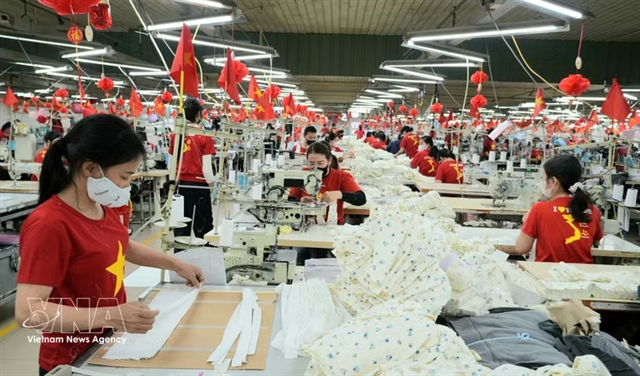
Workers at a textile and garment company. — VNA/VNS Photo
HÀ NỘI — Việt Nam’s textile and garment industry is facing both opportunities and challenges amid complex and unpredictable developments in the global market, prompting businesses to improve growth quality, optimise production costs and enhance adaptability in pursuit of an export turnover of about $48 billion this year.
The target is considered an important milestone that requires concerted efforts from management agencies and the business community. Companies are taking measures to retain existing orders, seek new partners and diversify export markets. Trương Văn Cẩm, vice chairman of the Vietnam Textile and Apparel Association (VITAS), said the industry is being significantly affected by changes in trade policies and tariff barriers in major consumer markets.
The US, Việt Nam’s largest textile and garment export market, currently imposes a 12.5 per cent tariff on Vietnamese textile and garment products, putting Vietnamese exporters at a disadvantage compared with some rivals subject to a 10 per cent rate.
Cam noted that the challenge goes beyond the 2.5 percentage-point tariff difference, as higher production and logistics costs could affect selling prices, order retention and export market share.
Businesses are also facing rising prices of raw materials, supplies and production equipment, along with higher transportation and logistics costs. Delays in the delivery of fabrics and other input materials have further disrupted production schedules and affected delivery deadlines.
Orders for the final months of the year have become increasingly differentiated. While some companies have secured orders through September or October, and some knitwear producers have sufficient orders to maintain production through the end of the year, many garment manufacturers have yet to finalise fourth-quarter orders as expected.
Against this backdrop, businesses are shifting from pursuing output volume to prioritising higher-value orders with suitable commercial terms and greater production efficiency.
Meanwhile, increasingly stringent technical and sustainability requirements in demanding markets such as the EU and the US, including those related to labour standards, traceability, ESG practices, green production, circular economy and carbon emissions reduction, are becoming important conditions for maintaining and securing orders.
VITAS statistics show that textile and garment exports reached nearly $31.7 billion in the first eight months of this year, up 2.9 per cent year-on-year.
To cope with market pressures, the industry is stepping up trade promotion, participating in major international trade fairs, accelerating digital transformation, improving product quality, strengthening control over input materials and increasing value added.
Trần Văn Quy, general director of Trung Quy Textile and Garment Co in HCM City, said the company has secured orders through the end of the year, adding that effective cost control combined with product quality will enable businesses to remain adaptable.
Experts said the $48-billion target should also be viewed as an opportunity for the industry to improve productivity and increase value added for more sustainable competitiveness. — VNA/VNS
Source: VNS
Related News

VIETNAM ECONOMY INVESTMENT
FOREIGN INVESTORS SEEKING A SYNCHRONISED MANUFACTURING ECOSYSTEM
Instead of focusing only on land costs and incentives as usual, foreign investors are seeking a synchronised manufacturing ecosystem, from stable power supply and logistics to shared infrastructure and the convenience of completing residence procedures for experts to serve their long-term investment in the country.

INFRASTRUCTURE / CONSTRUCTION / LOGISTIC / PORT
DONG THAP PROVINCE STEPS UP INDUSTRIAL EXPANSION AND INFRASTRUCTURE CONNECTIVITY
Accelerating public investment, strengthening inter-regional connectivity, and expanding industrial land are helping Dong Thap efficiently bolster competitiveness and drive economic growth. Following the 2025 merger of the former Dong Thap and Tien Giang provinces, the expanded Dong Thap province in the Mekong Delta faces mounting pressure to accelerate infrastructure development and strengthen connectivity among local economic zones, urban areas, industrial parks (IPs), and production centres.

PROPERTY / INDUSTRIAL ZONE
HCM CITY ATTRACTS US$5.7 BILLION INTO EXPORT PROCESSING AND INDUSTRIAL ZONES
HCM City attracted US$5.7 billion in domestic and foreign investment into its export processing and industrial zones during the first nine months of 2026. The figure exceeded the city's full-year target by 31 per cent, highlighting strong momentum in high-quality industrial investment under Resolution No.10-NQ/TW. Total investment reached 131 per cent of the 2026 target of $4.25 billion and represented a 29 per cent increase compared with the same period in 2025, according to the city's Export Processing and Industrial Zones Authority (HEPZA).

BANKING / FINANCE / INSURANCE / TAX
REMITTANCES TO HCM CITY RISE NEARLY 40% IN Q3
Remittances to HCM City reached more than US$2.83 billion in the third quarter of this year, up 39.5 per cent from the previous quarter and 3.6 per cent year-on-year. This was the first quarter showing positive annual growth this year, helping narrow the decline in remittance inflows over the first nine months. According to the State Bank of Vietnam (SBV)’s Regional Branch 2, remittances transferred to HCM City through credit institutions and economic organisations totalled $2.835 billion in Q3, an increase of more than $802 million from the previous quarter.

VIETNAM ECONOMY INVESTMENT
LOCALITIES REPORT BREAKTHROUGH RESULTS IN FDI IN FIRST NINE MONTHS
In Ho Chi Minh City, total registered capital reached $17.2 billion in the first nine months, up 4.2 times from the same period last year. The figure included more than $9.35 billion in newly registered capital and over $4.9 billion in additional capital for existing projects. Foreign investors also registered more than $2.9 billion through capital contributions and share purchases.

TECHNOLOGY
TECH SECTOR GROWTH OPENS UP OPPORTUNITIES FOR VIỆT NAM TO GO GLOBAL
The growth of the electronics, semiconductor and high-tech sectors worldwide is opening up a variety of opportunities for Vietnamese enterprises to integrate more deeply into the global supply chain. However, to become suppliers for these corporations, domestic enterprises must meet rigorous standards regarding quality, technology, productivity and order fulfilment capabilities.
Events Sponsors






















