Want to be in the loop?
subscribe to
our notification
Business News
VIETNAM EXPANDS INLAND CONTAINER DEPOT NETWORK TO 19
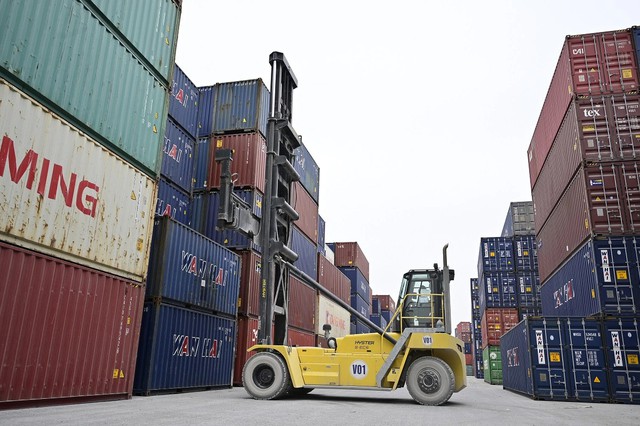
A forklift handles shipping containers at an inland container depot - PHOTO: VGP
HCMC – Vietnam now has a total of 19 inland container depots (ICDs), including two newly added facilities in HCMC and Tay Ninh, according to the Ministry of Construction’s latest list.
• HCMC needs an international maritime center
• HCMC to have new inland container depot
The two newly added ICDs are Cai Mep in HCMC and Tan Cang-Moc Bai (phase one) in Tay Ninh Province.
Cai Mep ICD, located in Cai Mep Industrial Park in Tan Phuoc Ward, HCMC and developed by Cai Mep International Logistics JSC, covers 9.15 hectares and has an annual handling capacity of about 133,000 TEUs, according to the Government news site (baochinhphu.vn).
The Tan Cang Moc Bai ICD, phase one, is located in the Moc Bai Border Gate Economic Zone along Road 6A in Ben Cau Commune, Tay Ninh Province, and is developed by Tan Cang Tay Ninh JSC.
ICDs are an integral part of the transport infrastructure system, serving as logistics hubs linked to seaports, airports, inland waterways, railway stations, and land border gates. They also function as customs clearance points for import and export goods.
According to the newly released list of ICDs in Vietnam, the country now has 19 ICDs, including Dong Pho Moi in Lao Cai, Hai Linh, and Km3+4 Mong Cai in Quang Ninh.
Others are Long Bien in Hanoi, Tan Cang-Moc Bai (phase one) in Tay Ninh, Tan Cang Ha Nam, and Phuc Loc-Ninh Binh.
Haiphong has four ICDs: Tan Cang Haiphong, Dinh Vu-Quang Binh, Hoang Thanh, and Nam Dinh Vu (phase one).
Bac Ninh has three ICDs: Tan Cang Que Vo, Tien Son, and Tan Chi (phase one). Dong Nai has two ICDs: Tan Cang Nhon Trach and Tan Cang Long Binh (phase one). HCMC has three ICDs: Phu My (phase one), Cai Mep, and Thanh Phuoc.
Source: The Saigon Times
Related News

BANKING / FINANCE / INSURANCE / TAX
REMITTANCES TO HCM CITY RISE NEARLY 40% IN Q3
Remittances to HCM City reached more than US$2.83 billion in the third quarter of this year, up 39.5 per cent from the previous quarter and 3.6 per cent year-on-year. This was the first quarter showing positive annual growth this year, helping narrow the decline in remittance inflows over the first nine months. According to the State Bank of Vietnam (SBV)’s Regional Branch 2, remittances transferred to HCM City through credit institutions and economic organisations totalled $2.835 billion in Q3, an increase of more than $802 million from the previous quarter.

TECHNOLOGY
TECH SECTOR GROWTH OPENS UP OPPORTUNITIES FOR VIỆT NAM TO GO GLOBAL
The growth of the electronics, semiconductor and high-tech sectors worldwide is opening up a variety of opportunities for Vietnamese enterprises to integrate more deeply into the global supply chain. However, to become suppliers for these corporations, domestic enterprises must meet rigorous standards regarding quality, technology, productivity and order fulfilment capabilities.

VIETNAM ECONOMY INVESTMENT
FOREIGN INVESTORS SEEKING A SYNCHRONISED MANUFACTURING ECOSYSTEM
Instead of focusing only on land costs and incentives as usual, foreign investors are seeking a synchronised manufacturing ecosystem, from stable power supply and logistics to shared infrastructure and the convenience of completing residence procedures for experts to serve their long-term investment in the country.

MEMBER CORNER / PROMOTIONS
SENTRYSAFE FHW40200 – PROTECT YOUR VALUABLES, ENJOY PEACE OF MIND!
Looking for a reliable solution to protect your important documents, cash, and valuables from fire and water damage? Genuine SENTRYSAFE - Reliable protection for your valuables and peace of mind! Contact Sen Wai Vietnam for more information and personalized product recommendations.

PROPERTY / INDUSTRIAL ZONE
HCM CITY ATTRACTS US$5.7 BILLION INTO EXPORT PROCESSING AND INDUSTRIAL ZONES
HCM City attracted US$5.7 billion in domestic and foreign investment into its export processing and industrial zones during the first nine months of 2026. The figure exceeded the city's full-year target by 31 per cent, highlighting strong momentum in high-quality industrial investment under Resolution No.10-NQ/TW. Total investment reached 131 per cent of the 2026 target of $4.25 billion and represented a 29 per cent increase compared with the same period in 2025, according to the city's Export Processing and Industrial Zones Authority (HEPZA).

INFRASTRUCTURE / CONSTRUCTION / LOGISTIC / PORT
DONG THAP PROVINCE STEPS UP INDUSTRIAL EXPANSION AND INFRASTRUCTURE CONNECTIVITY
Accelerating public investment, strengthening inter-regional connectivity, and expanding industrial land are helping Dong Thap efficiently bolster competitiveness and drive economic growth. Following the 2025 merger of the former Dong Thap and Tien Giang provinces, the expanded Dong Thap province in the Mekong Delta faces mounting pressure to accelerate infrastructure development and strengthen connectivity among local economic zones, urban areas, industrial parks (IPs), and production centres.
Events Sponsors






















