Want to be in the loop?
subscribe to
our notification
Business News
ASIA POWERS VIETNAM’S SHRIMP BOOM, LEAVING THE WEST BEHIND
In the first half of 2026, Vietnam's shrimp exports surpassed the US$2.3 billion mark, driven largely by booming demand from China and a lobster craze. But behind that growth figure lies a lopsided picture: Asia is carrying the load, while the U.S. and Europe have yet to break out.
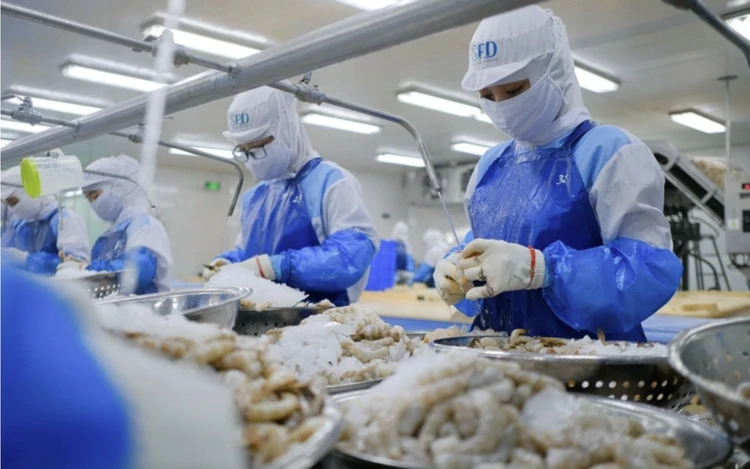
Workers processing seafood for export. Photo: C.QUOC - Tuoi Tre
These days, a container of frozen shrimp leaving a Ho Chi Minh City port is more likely to cross the East Vietnam Sea to Shanghai than the Pacific to Los Angeles.
In the first six months of 2026, China and Hong Kong alone bought $845 million worth of Vietnamese shrimp, more than a third of the country's total export value, while exports to the U.S. fell 15 percent year on year.
China and the lobster craze
If one market has defined Vietnam’s shrimp industry in the first half of 2026, it is China.
According to the Vietnam Association of Seafood Exporters and Producers (VASEP), in the first quarter of 2026, the country's shrimp exports reached $1.069 billion, up 17.5 percent year on year, with China and Hong Kong alone contributing $440.1 million, a jump of 57.2 percent, accounting for more than 41 percent of total export turnover.
By June, this growth momentum showed no signs of slowing: exports to China rose 47 percent over the six-month period, pushing the China - Hong Kong group's total to $845 million, equivalent to more than a third of the country's total shrimp exports.
Surprisingly, the driving force behind this figure came not from familiar shrimp varieties but from lobster, a product long regarded as a ‘luxury item’ on the seafood table.
VASEP reported that in the first quarter, the ‘other shrimp’category, which mainly comprises lobster, reached nearly $415 million, up 39.3 percent.
Lobster alone accounted for $345.5 million, a 57.4-percent increase, making it the industry’s single biggest growth driver.
And nearly all of that lobster flowed in one direction: China and Hong Kong received $341.6 million worth of lobster, or 77.6 percent of the total shrimp export value to those two markets.
VASEP attributed the trend to strong demand in these markets for fresh, high-value products, particularly in the run-up to and aftermath of the Lunar New Year, when demand for gifts and festive banquets surges.
Logistics are also tilting the playing field in Asia’s favor.
Shipping to China, Japan, and South Korea is cheaper and faster, allowing businesses to turn over capital more quickly, an advantage the distant U.S. market cannot match.
US, EU barriers remain intact
If China represents opportunity, the U.S. and the EU remain markets where barriers continue to hold Vietnam’s shrimp exports back.
Although shrimp exports to the U.S. in June reached about $62 million, up 32 percent year on year, the cumulative six-month total still fell 15 percent to roughly $290 million.
VASEP even warned that June's growth alone may be no more than a temporary blip, as enterprises and importers rushed to speed up shipments ahead of unpredictable changes in tariff policy, rather than reflecting a genuine recovery.
VASEP had already identified the root cause of this slowdown earlier in the year.
The results of the 19th administrative review by the U.S. Department of Commerce on frozen warm-water shrimp from Vietnam imposed a tariff of 25.76 percent on the two mandatory respondents, while 22 other companies received a separate rate of 4.58 percent.
On top of that, on February 20, the White House announced an additional 10 percent tariff under Section 122, lasting 150 days, which officially took effect on February 24.
At the same time, technical control requirements on antibiotics, Hazard Analysis and Critical Control Points (HACCP) standards, and traceability were also tightened starting in early March.
All of this combined, according to VASEP, has made U.S. importers far more cautious about finalizing new orders.
Europe, meanwhile, presents a different picture: stable, but not yet booming.
Tuoi Tre (Youth) online newspaper noticed that Vietnam’s shrimp exports to the EU rose only slightly in the first six months of the year, suggesting that demand in the market has yet to show a clear recovery.
Competitive pressure is also sparing no market.
According to Asemconnect, a business and information bridge linking Asian and European enterprises under the ASEM network, Vietnam's shrimp industry is facing fierce competition from major rivals such as Ecuador, India, and Indonesia, at a time when conflict in the Middle East is also pushing ocean shipping costs back up.
Source: Tuổi Trẻ News
Related News

BANKING / FINANCE / INSURANCE / TAX
REMITTANCES TO HCM CITY RISE NEARLY 40% IN Q3
Remittances to HCM City reached more than US$2.83 billion in the third quarter of this year, up 39.5 per cent from the previous quarter and 3.6 per cent year-on-year. This was the first quarter showing positive annual growth this year, helping narrow the decline in remittance inflows over the first nine months. According to the State Bank of Vietnam (SBV)’s Regional Branch 2, remittances transferred to HCM City through credit institutions and economic organisations totalled $2.835 billion in Q3, an increase of more than $802 million from the previous quarter.

TECHNOLOGY
TECH SECTOR GROWTH OPENS UP OPPORTUNITIES FOR VIỆT NAM TO GO GLOBAL
The growth of the electronics, semiconductor and high-tech sectors worldwide is opening up a variety of opportunities for Vietnamese enterprises to integrate more deeply into the global supply chain. However, to become suppliers for these corporations, domestic enterprises must meet rigorous standards regarding quality, technology, productivity and order fulfilment capabilities.

VIETNAM ECONOMY INVESTMENT
FOREIGN INVESTORS SEEKING A SYNCHRONISED MANUFACTURING ECOSYSTEM
Instead of focusing only on land costs and incentives as usual, foreign investors are seeking a synchronised manufacturing ecosystem, from stable power supply and logistics to shared infrastructure and the convenience of completing residence procedures for experts to serve their long-term investment in the country.

MEMBER CORNER / PROMOTIONS
SENTRYSAFE FHW40200 – PROTECT YOUR VALUABLES, ENJOY PEACE OF MIND!
Looking for a reliable solution to protect your important documents, cash, and valuables from fire and water damage? Genuine SENTRYSAFE - Reliable protection for your valuables and peace of mind! Contact Sen Wai Vietnam for more information and personalized product recommendations.

PROPERTY / INDUSTRIAL ZONE
HCM CITY ATTRACTS US$5.7 BILLION INTO EXPORT PROCESSING AND INDUSTRIAL ZONES
HCM City attracted US$5.7 billion in domestic and foreign investment into its export processing and industrial zones during the first nine months of 2026. The figure exceeded the city's full-year target by 31 per cent, highlighting strong momentum in high-quality industrial investment under Resolution No.10-NQ/TW. Total investment reached 131 per cent of the 2026 target of $4.25 billion and represented a 29 per cent increase compared with the same period in 2025, according to the city's Export Processing and Industrial Zones Authority (HEPZA).

INFRASTRUCTURE / CONSTRUCTION / LOGISTIC / PORT
DONG THAP PROVINCE STEPS UP INDUSTRIAL EXPANSION AND INFRASTRUCTURE CONNECTIVITY
Accelerating public investment, strengthening inter-regional connectivity, and expanding industrial land are helping Dong Thap efficiently bolster competitiveness and drive economic growth. Following the 2025 merger of the former Dong Thap and Tien Giang provinces, the expanded Dong Thap province in the Mekong Delta faces mounting pressure to accelerate infrastructure development and strengthen connectivity among local economic zones, urban areas, industrial parks (IPs), and production centres.
Events Sponsors






















