Want to be in the loop?
subscribe to
our notification
Business News
VIỆT NAM STEPS UP EXPORT TO ACHIEVE US$550-BILLION TARGET
Exports reached $266.52 billion in the first six months, meaning the economy needs to generate roughly $245 billion more during the remainder of the year to meet the annual goal.
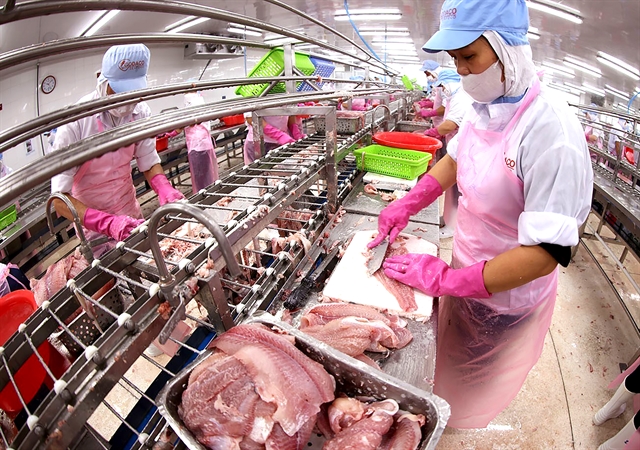
A tra (catfish) processing line at GODACO Seafood Joint Stock Company in the southern province of Đồng Tháp. Việt Nam' s total import-export turnover climbed 27.1 per cent year on year to nearly $550 billion. — VNA/VNS Photo
HÀ NỘI — Việt Nam is intensifying efforts to sustain export momentum in the second half of 2026 as the country works towards its target of US$550 billion in export revenue for the year, despite continuing uncertainties in global trade.
Statistics show that exports reached $266.5 billion in the first six months, meaning the economy needs to generate around $245.5 billion more during the remainder of the year to meet the annual goal.
Agriculture continues to provide an important cushion for Việt Nam's trade performance. The sector posted a trade surplus of more than $9 billion in the first half of the year, supported by strong exports of fruit and vegetables, seafood, coffee, rice, timber products and cashew nuts. Industry associations believe continued market expansion and higher-value processed products will help maintain growth and move the agricultural sector closer to its target of $100 billion in export turnover by 2027.
Trade deficit reflects stronger production demand
Although Việt Nam recorded a trade deficit of about $16.65 billion in the first half of 2026, experts say the figure should be viewed in the context of expanding production rather than weakening exports.
Total import-export turnover climbed 27.1 per cent year on year to nearly $550 billion. Exports rose 21 per cent to around $266.5 billion, while imports surged 33.4 per cent to $283.2 billion, reversing the trade surplus recorded during the same period last year.
Import growth has been driven largely by production-related goods rather than consumer products. Electronics, computers and components, together with machinery and equipment, accounted for around 51 per cent of total imports. Other major increases were recorded in steel, chemicals, plastics, textile and footwear materials, reflecting stronger manufacturing activity.
Deputy Director of the Ministry of Industry and Trade's Agency of Foreign Trade Trần Thanh Hải said the current import structure demonstrates that businesses are actively preparing for future production and exports. He noted that higher petroleum import values were also influenced by geopolitical tensions that pushed up global energy prices, making part of the increase a result of external factors rather than higher import volumes.
Economists share the view that the trade deficit is largely an investment in future export capacity. Võ Xuân Vinh, Director of the Institute of Business Research at the University of Economics Ho Chi Minh City, said much of the increase in imports came from foreign-invested manufacturers whose export orders are generally secured in advance.
He also pointed to rising imports of electronic components amid booming global demand for AI-related technologies, as well as greater imports of raw materials for biofuel production. Having sufficient inputs available, he said, will enable manufacturers to respond quickly to international demand in the coming months.
Many analysts have therefore described the first-half trade deficit as "working capital" for export production. The second half of the year traditionally marks the peak purchasing season in major markets such as the US, the EU, Japan and the South Korea. With total trade already approaching $550 billion after six months, Việt Nam is widely expected to surpass $1 trillion in combined import-export turnover for the first time in 2026.
Government and businesses expand export markets
Against a backdrop of persistent uncertainty in global commerce, the Government is implementing a broad range of measures to strengthen export growth during the remainder of the year.
These include expanding overseas markets through economic diplomacy, maximising the benefits of free trade agreements (FTAs), streamlining administrative procedures, reducing logistics costs, improving access to credit and helping businesses overcome trade barriers. Authorities are also encouraging deeper processing, official cross-border exports and greater market diversification to improve the competitiveness of Vietnamese products.
According to the Ministry of Industry and Trade, one priority is helping enterprises make fuller use of existing FTAs while accelerating the conclusion of new agreements. Việt Nam has recently completed negotiations on a free trade agreement with the European Free Trade Association (EFTA), which will become the country's 18th FTA once signed, opening additional opportunities for exporters.
Vietnamese businesses are also actively adjusting their market strategies. Đặng Quý Nhân, General Director of Nam Mekong Agricultural Products JSC (Somekco), said the company, which exports bananas and fresh coconuts, has shifted more shipments to China after exports to the Middle East encountered difficulties earlier this year.
While acknowledging that profit margins in China are relatively low because of price competition, he said the market's strong consumption helps maintain stable demand for farmers' produce. The company is now seeking to expand exports to Russia to diversify markets and improve returns.
Industry associations also remain optimistic. Đặng Phúc Nguyên, General Secretary of the Vietnam Fruit and Vegetable Association (Vinafruit), said fruit and vegetable exports are well positioned to approach the historic $10-billion milestone this year, driven by robust durian shipments and rapid growth in processed products such as canned juices and dried fruit.
He credited government efforts to resolve issues related to growing area codes, packaging standards and customs clearance, enabling exporters to better meet China's import requirements while continuing to expand sales to premium markets including the US, the EU, Japan, South Korea and Australia.
The cashew industry is also expecting a strong finish to the year. Bạch Khánh Nhựt, Vice Chairman of the Vietnam Cashew Association, said exports to the US rose more than 33 per cent in the first half of the year, while Europe and other markets together accounted for about 62 per cent of export turnover, providing a balanced market structure that reduces dependence on any single destination.
If current demand continues through the year-end consumption season in the US, Europe and China, he said Việt Nam remains on track to achieve its $5-billion cashew export target, reinforcing its position as the world's leading exporter of cashew kernels while creating further momentum for higher-value agricultural processing and broader international market expansion. — VNS
Source: VNS
Related News
BANKING / FINANCE / INSURANCE / TAX
REMITTANCES TO HCM CITY RISE NEARLY 40% IN Q3
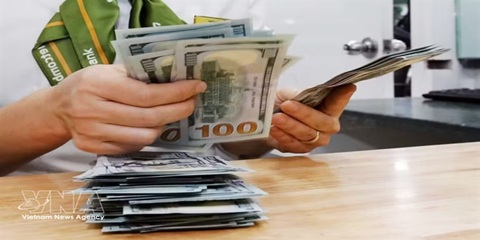
Remittances to HCM City reached more than US$2.83 billion in the third quarter of this year, up 39.5 per cent from the previous quarter and 3.6 per cent year-on-year. This was the first quarter showing positive annual growth this year, helping narrow the decline in remittance inflows over the first nine months. According to the State Bank of Vietnam (SBV)’s Regional Branch 2, remittances transferred to HCM City through credit institutions and economic organisations totalled $2.835 billion in Q3, an increase of more than $802 million from the previous quarter.
TECHNOLOGY
TECH SECTOR GROWTH OPENS UP OPPORTUNITIES FOR VIỆT NAM TO GO GLOBAL
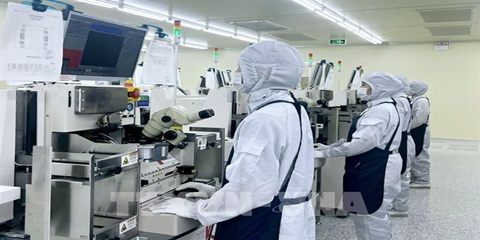
The growth of the electronics, semiconductor and high-tech sectors worldwide is opening up a variety of opportunities for Vietnamese enterprises to integrate more deeply into the global supply chain. However, to become suppliers for these corporations, domestic enterprises must meet rigorous standards regarding quality, technology, productivity and order fulfilment capabilities.
VIETNAM ECONOMY INVESTMENT
FOREIGN INVESTORS SEEKING A SYNCHRONISED MANUFACTURING ECOSYSTEM
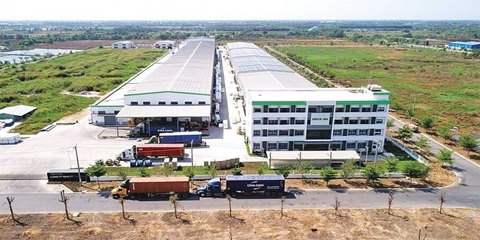
Instead of focusing only on land costs and incentives as usual, foreign investors are seeking a synchronised manufacturing ecosystem, from stable power supply and logistics to shared infrastructure and the convenience of completing residence procedures for experts to serve their long-term investment in the country.
MEMBER CORNER / PROMOTIONS
SENTRYSAFE FHW40200 – PROTECT YOUR VALUABLES, ENJOY PEACE OF MIND!
Looking for a reliable solution to protect your important documents, cash, and valuables from fire and water damage? Genuine SENTRYSAFE - Reliable protection for your valuables and peace of mind! Contact Sen Wai Vietnam for more information and personalized product recommendations.
PROPERTY / INDUSTRIAL ZONE
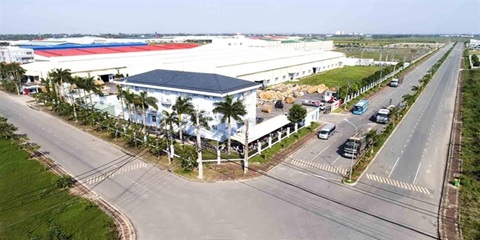
HCM CITY ATTRACTS US$5.7 BILLION INTO EXPORT PROCESSING AND INDUSTRIAL ZONES
HCM City attracted US$5.7 billion in domestic and foreign investment into its export processing and industrial zones during the first nine months of 2026. The figure exceeded the city's full-year target by 31 per cent, highlighting strong momentum in high-quality industrial investment under Resolution No.10-NQ/TW. Total investment reached 131 per cent of the 2026 target of $4.25 billion and represented a 29 per cent increase compared with the same period in 2025, according to the city's Export Processing and Industrial Zones Authority (HEPZA).
INFRASTRUCTURE / CONSTRUCTION / LOGISTIC / PORT
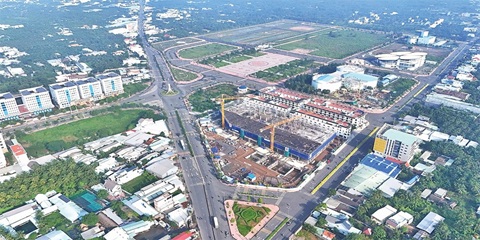
DONG THAP PROVINCE STEPS UP INDUSTRIAL EXPANSION AND INFRASTRUCTURE CONNECTIVITY
Accelerating public investment, strengthening inter-regional connectivity, and expanding industrial land are helping Dong Thap efficiently bolster competitiveness and drive economic growth. Following the 2025 merger of the former Dong Thap and Tien Giang provinces, the expanded Dong Thap province in the Mekong Delta faces mounting pressure to accelerate infrastructure development and strengthen connectivity among local economic zones, urban areas, industrial parks (IPs), and production centres.
Events Sponsors






















