Want to be in the loop?
subscribe to
our notification
Business News
VIỆT NAM’S INDUSTRIAL PRODUCTION SEES MODEST GROWTH IN JANUARY
The 9.2 per cent month-on-month decline was attributed to fewer working days in January due to the Lunar New Year (Tết) holiday
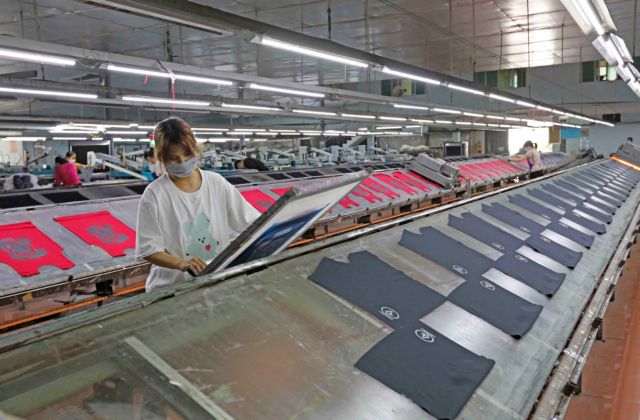
A garment production company in Hưng Yên. — VNA/VNS Photo Trần Việt
HÀ NỘI — Việt Nam’s Index of Industrial Production (IIP) recorded a slight increase of 0.6 per cent year-on-year in January, although showing a significant 9.2 per cent month-on-month decline, according to the General Statistics Office (GSO).
The fall was attributed to fewer working days in January due to the Lunar New Year (Tết) holiday, GSO reported.
Breaking down sector performance, the manufacturing and processing sector saw a 1.6 per cent year-on-year rise, while electricity production and distribution increased by 0.4 per cent. Notably, the water supply and wastewater treatment sector posted an impressive 9.2 per cent growth.
By contrast, the mining sector was the only industry to experience a downturn, plummeting 10.4 per cent compared to the same period last year.
Several industries recorded strong IIP growth, including vehicle production (34 per cent), furniture (11 per cent), leather and leather products (10.3 per cent), and electronics, optical products and computers (3.8 per cent).
However, some sectors reported significant declines, such as coal mining (down 20 per cent), crude oil and natural gas extraction (6.5 per cent), pharmaceuticals (29 per cent), electrical equipment (12 per cent), and chemicals and chemical products (8.2 per cent).
A total of 47 out of 63 centrally-run cities and provinces recorded an increase in IIP, while 16 reported declines.
Some localities saw particularly strong growth due to a surge in processing and manufacturing activities in January, including Nam Định (30 per cent), Bắc Kạn (28 per cent), Bến Tre (24 per cent) and Hải Phòng (16 per cent).
Counter to that several key industrial hubs posted a negative growth in the month, including such as Bắc Ninh, down 16 per cent, Bình Dương (14 per cent),HCM City (9 per cent), Hà Nội (8.3 per cent) and Đồng Nai (6 per cent).
The number of workers employed in industrial enterprises as of January 1, 2025, rose 0.2 per cent from the previous month and 4.5 per cent year-on-year, signaling a steady recovery in the sector.
Output falls for first time in four months
The S&P Global Vietnam Manufacturing Purchasing Managers' Index (PMI) dropped to 48.9 in January, down from 49.8 in December and remaining below the 50 no-change threshold for the second consecutive month.
According to S&P Global, the decline in operating conditions was modest, but slightly more pronounced than in the previous survey period.
For the first time in four months, new orders fell in January, with businesses citing weak customer demand. The decline in total new business was partially due to a continued drop in export orders, which have now decreased for three consecutive months.
This decline in demand led to a fall in production, also for the first time in four months. However, the rate of output contraction remained slight, mirroring the trend in new business.
As new orders slowed, manufacturing firms found themselves with spare capacity, leading to a depletion of backlogs of work for the first time in eight months.
Economics Director at S&P Global Market Intelligence, Andrew Harker, described the start of 2025 as disappointing for Vietnamese manufacturers, with subdued demand resulting in lower orders, reduced output and a more significant cut in employment.
However, there was some relief on the pricing front, as slower cost inflation allowed firms to lower selling prices to stimulate demand.
Despite the weak start, manufacturers were more optimistic compared to late 2024. S&P Global Market Intelligence forecasts 4.6 percent growth in industrial production for 2025, suggesting potential improvements in the months ahead. — VNS
Source: VNS
Related News

BANKING / FINANCE / INSURANCE / TAX
REMITTANCES TO HCM CITY RISE NEARLY 40% IN Q3
Remittances to HCM City reached more than US$2.83 billion in the third quarter of this year, up 39.5 per cent from the previous quarter and 3.6 per cent year-on-year. This was the first quarter showing positive annual growth this year, helping narrow the decline in remittance inflows over the first nine months. According to the State Bank of Vietnam (SBV)’s Regional Branch 2, remittances transferred to HCM City through credit institutions and economic organisations totalled $2.835 billion in Q3, an increase of more than $802 million from the previous quarter.

TECHNOLOGY
TECH SECTOR GROWTH OPENS UP OPPORTUNITIES FOR VIỆT NAM TO GO GLOBAL
The growth of the electronics, semiconductor and high-tech sectors worldwide is opening up a variety of opportunities for Vietnamese enterprises to integrate more deeply into the global supply chain. However, to become suppliers for these corporations, domestic enterprises must meet rigorous standards regarding quality, technology, productivity and order fulfilment capabilities.

VIETNAM ECONOMY INVESTMENT
FOREIGN INVESTORS SEEKING A SYNCHRONISED MANUFACTURING ECOSYSTEM
Instead of focusing only on land costs and incentives as usual, foreign investors are seeking a synchronised manufacturing ecosystem, from stable power supply and logistics to shared infrastructure and the convenience of completing residence procedures for experts to serve their long-term investment in the country.

MEMBER CORNER / PROMOTIONS
SENTRYSAFE FHW40200 – PROTECT YOUR VALUABLES, ENJOY PEACE OF MIND!
Looking for a reliable solution to protect your important documents, cash, and valuables from fire and water damage? Genuine SENTRYSAFE - Reliable protection for your valuables and peace of mind! Contact Sen Wai Vietnam for more information and personalized product recommendations.

PROPERTY / INDUSTRIAL ZONE
HCM CITY ATTRACTS US$5.7 BILLION INTO EXPORT PROCESSING AND INDUSTRIAL ZONES
HCM City attracted US$5.7 billion in domestic and foreign investment into its export processing and industrial zones during the first nine months of 2026. The figure exceeded the city's full-year target by 31 per cent, highlighting strong momentum in high-quality industrial investment under Resolution No.10-NQ/TW. Total investment reached 131 per cent of the 2026 target of $4.25 billion and represented a 29 per cent increase compared with the same period in 2025, according to the city's Export Processing and Industrial Zones Authority (HEPZA).

INFRASTRUCTURE / CONSTRUCTION / LOGISTIC / PORT
DONG THAP PROVINCE STEPS UP INDUSTRIAL EXPANSION AND INFRASTRUCTURE CONNECTIVITY
Accelerating public investment, strengthening inter-regional connectivity, and expanding industrial land are helping Dong Thap efficiently bolster competitiveness and drive economic growth. Following the 2025 merger of the former Dong Thap and Tien Giang provinces, the expanded Dong Thap province in the Mekong Delta faces mounting pressure to accelerate infrastructure development and strengthen connectivity among local economic zones, urban areas, industrial parks (IPs), and production centres.
Events Sponsors






















