Want to be in the loop?
subscribe to
our notification
Business News
TEXTILE, GARMENT FIRMS REFORM TO MEET CPTPP ORIGIN RULES
More than seven years after its implementation, the Comprehensive and Progressive Agreement for Trans-Pacific Partnership has become an important driver of Việt Nam's export growth.
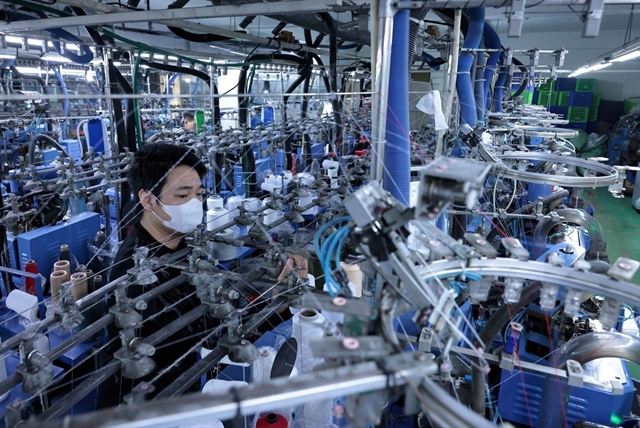
A production line producing socks for Japan, one of the CPTPP markets. Despite positive growth in total trade between Việt Nam and CPTPP members, Vietnamese goods account for just over 1 per cent of the bloc's total imports. — VNA/VNS Photo
HÀ NỘI — Vietnamese textile and garment manufacturers are aggressively restructuring their supply chains and diversifying material sources to unlock untapped tariff benefits.
To capitalise on the Comprehensive and Progressive Agreement for Trans-Pacific Partnership (CPTPP), companies are racing to align with the pact's strict "yarn-forward" rules — a task made difficult by a shortage of raw materials within the trade bloc.
More than seven years after its implementation, the CPTPP has become an important driver of Việt Nam's export growth. However, textile and garment companies have yet to fully capitalise on tariff preferences under the agreement, largely due to difficulties in meeting rules of origin, particularly for fabric production.
Before the CPTPP took effect, TNG Investment and Trading JSC selected material suppliers mainly on three criteria: cost, quality and delivery schedules. The introduction of the agreement's "yarn-forward" rule has since made origin compliance a key requirement in its supplier selection process.
Trần Minh Hiếu, TNG's general director, said the company had reviewed and reclassified its entire supplier portfolio, prioritising long-term partnerships with suppliers that meet origin requirements while establishing strategic partnerships with domestic fabric producers.
From the design and sample-making stages, TNG's order management team worked directly with customers to assess whether products could meet the agreement's rules of origin.
The company had also developed its own software system to manage origin-related data. Each batch of imported materials entering its warehouses would be assigned a QR code or enterprise resource planning (ERP) code linked to relevant documents, invoices and contracts to ensure transparency and facilitate traceability.
According to Trương Văn Cẩm, vice chairman and general secretary of the Việt Nam Textile and Apparel Association (VITAS), the CPTPP, which came into force in January 2019, opened up access to 12 member markets. Việt Nam's textile and garment exports to these markets rose from US$6.27 billion in 2018 to $8.3 billion in 2025.
Origin challenges
However, meeting the "yarn-forward" rule remains a major challenge for the sector. Domestic yarn production is largely sufficient to meet local demand, but weaving, dyeing and fabric finishing remain key bottlenecks.
Expanding imports of materials from CPTPP member countries is also difficult, as these economies are not the industry's main sources of supply.
Despite positive growth in total trade between Việt Nam and CPTPP members, Vietnamese goods account for just over 1 per cent of the bloc's total imports.
The share of exports using CPTPP preferential certificates of origin (C/Os) remains below 10 per cent, although it has quadrupled since the agreement first took effect.
Experts attribute the limited uptake of tariff preferences partly to the difficulties businesses face in complying with the "yarn-forward" rule.
Under this rule, the production stages of textile and garment products, from yarn spinning and fabric weaving and dyeing to cutting and sewing, must be carried out within CPTPP member economies.
Việt Nam's textile and garment industry currently sources around 50 per cent of its raw materials and accessories domestically. Domestic fabric production meets only about 36 per cent of demand.
The sector imported $11.6 billion worth of fabric in the first nine months of 2026, while fabric imports totalled $15.2 billion for the whole of 2025.
Meanwhile, imports of raw materials and accessories from CPTPP members showed virtually no growth between 2018 and 2025, remaining at around $1.58 billion to $1.59 billion.
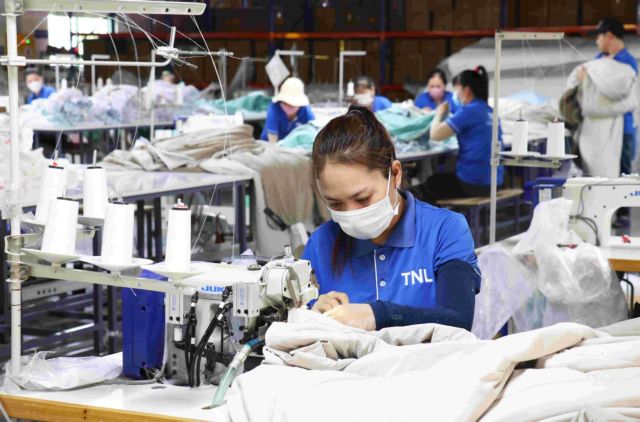
A workshop producing garments for export in Tây Ninh Province. Việt Nam has implemented 17 free trade agreements (FTAs) with nearly 70 partners worldwide. VNA/VNS Photo
Supply chain strategy
Ngô Chung Khanh, deputy director of the Ministry of Industry and Trade's Department of Foreign Market Development and Multilateral Trade Policy, said businesses should develop supply chain maps to identify suppliers, alternative sources and potential weak links that could disrupt production.
Việt Nam had implemented 17 free trade agreements (FTAs) with nearly 70 partners worldwide. Khanh said businesses should make more flexible use of these agreements to diversify supply sources and strengthen their ability to withstand trade disruptions.
He also said the CPTPP should be viewed not only as an export market but also as an important source of raw materials.
Trade promotion activities should therefore shift towards strengthening supply chain links, with rules of origin serving not merely as compliance requirements but also as a basis for designing supply chains from the input stage, he said.
The shift in focus from "Made in Vietnam" to "Made in CPTPP", according to Khanh, would create a foundation for businesses across member economies to jointly generate added value and improve efficiency throughout the supply chain.
To gradually secure greater control over material supplies, experts recommend that businesses conduct comprehensive assessments of their supply chains and classify materials according to their substitutability.
These should be divided into materials that can immediately be sourced from domestic or CPTPP suppliers, those requiring more time for technological development, and those requiring new investment.
For materials that cannot yet be supplied domestically, businesses could consider partnerships or joint ventures with manufacturers in markets with strong fabric production technologies, including China, Chinese Taipei and South Korea, to establish production facilities in Việt Nam. VNS
Source: VNS
Related News
INFRASTRUCTURE / CONSTRUCTION / LOGISTIC / PORT
HCM CITY ACCELERATES POWER INFRASTRUCTURE INVESTMENT TO ATTRACT HIGH-TECH CAPITAL
High-tech projects, particularly data centres, are not confined to SHTP but are also expanding into export processing zones and industrial parks across HCM City, driving up electricity demand. Proactively developing power infrastructure, diversifying energy supplies and expanding access to green energy are becoming essential for HCM City to maintain its competitive edge in attracting high-tech foreign direct investment (FDI).
TECHNOLOGY
ĐÀ NẴNG SEEKS TO BUILD HIGH-TECH AGRICULTURE, INTEGRATED VALUE CHAINS
Đà Nẵng is seeking to transform its agricultural sector from a supplier of raw materials into a technology-driven, market-oriented economy, with investment opportunities spanning concentrated production areas, deep processing, logistics and agricultural product distribution. The city aims to shift from traditional agricultural production towards agricultural economic development, organising value chains and increasing the technological content and added value of products through closer links between production and processing.
TECHNOLOGY
VIỆT NAM'S DIGITAL TECHNOLOGY INDUSTRY REVENUE SURGES 53% TO $254.6B
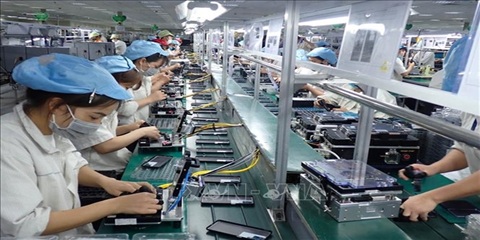
Việt Nam's digital technology industry generated an estimated US$254.6 billion in revenue in the first 10 months of 2026, up 53 per cent from a year earlier, while exports rose 46.2 per cent to $212 billion, the Ministry of Science and Technology said in its latest report. According to the report, hardware and electronics exports reached an estimated $30.681 billion in October, up 108 per cent from the same month last year.

MEMBER CORNER / PROMOTIONS
COSMOPARK ECO INDUSTRIAL ZONE – LONG-TERM ADVANTAGES FOR INDUSTRIAL INVESTORS IN VIETNAM
Spanning 322.3 hectares, with a project operational term extending to 2095 and plans for large-scale power infrastructure, COSMOPARK Eco Industrial Zone offers a strong foundation for manufacturing, high-tech industries, and international supply chain development. As global supply chains continue to evolve, Vietnam is strengthening its position as a strategic destination for international businesses seeking to diversify their manufacturing operations.
VIETNAM ECONOMY INVESTMENT
VIETNAMESE SEAFOOD EXPORTS CLOSE IN ON $12 BLN RECORD
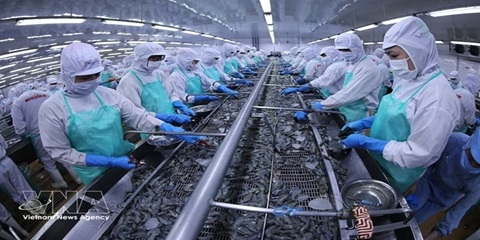
Việt Nam remains well placed, with seafood sold in most countries and accepted in premium markets on the back of deep-processing capacity and a broad product mix. Việt Nam’s seafood exports kept up double-digit growth in the first 10 months of 2026, reaching nearly US$10.5 billion, up more than 12 per cent from a year earlier. That gives the sector new momentum into year-end when holiday demand climbs in western and Asian markets.

CHARITY / EXHIBITION / OTHER EVENTS
BOCHK ‧ HKPC FUTURE VIETNAM: HANOI BUSINESS DELEGATION ON DIGITAL TRANSFORMATION AND INDUSTRIAL INNOVATION
Interested in exploring Vietnam’s latest developments in digital transformation, technology adoption and industrial innovation? Organised by the Hong Kong Productivity Council (HKPC) and fully supported by Bank of China (Hong Kong) Limited, the "Future Vietnam: Hanoi Business Delegation on Digital Transformation and Industrial Innovation” will feature visits to leading high-tech enterprises across Vietnam and engage with local chambers of commerce, industry organisations and associations. Join us to expand your high-value business network and seize emerging opportunities in the ASEAN market!
Events Sponsors