Want to be in the loop?
subscribe to
our notification
Business News
FDI FUELS VIETNAM’S MOMENTUM TO REACH DOUBLE-DIGIT ECONOMIC GROWTH
According to the General Statistics Office (GSO), Vietnam secured 38.23 billion USD in FDI last year, positioning itself among the top 15 developing countries for FDI inflows. Notably, the disbursement of FDI capital hit a record high of 25.35 billion USD, up 9.4 per cent from the previous year. The influx has contributed significantly to Vietnam's position as a regional leader in economic growth.
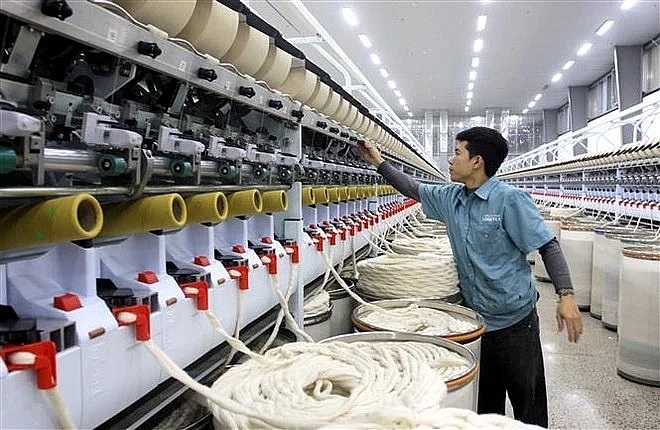
Yarn production at the Logitex Co. Ltd in the Vu Ninh Industrial Cluster, Thai Binh province (Photo: VNA)
Hanoi - Vietnam's impressive economic growth in 2024 was fueled by contributions from various sectors, with foreign direct investment (FDI) playing a pivotal role. As the country aims to achieve a growth rate of at least 8 per cent in 2025 and double-digit growth in subsequent years, the contributions from the FDI sector need to be amplified.
Vietnam in top 15 destinations for FDI
According to the General Statistics Office (GSO), Vietnam secured 38.23 billion USD in FDI last year, positioning itself among the top 15 developing countries for FDI inflows. Notably, the disbursement of FDI capital hit a record high of 25.35 billion USD, up 9.4 per cent from the previous year. The influx has contributed significantly to Vietnam's position as a regional leader in economic growth.
Deputy Prime Minister Nguyen Chi Dung said the FDI sector has left a significant milestone in bolstering Vietnam’s collaboration with global tech giants such as NVIDIA in R&D activities, technology transfer, and high-quality human resources development to capitalise on semiconductor and AI’s potential, helping deliver on the country’s targets in the new era.
FDI has shared the investment burden in a context where state budget resources remain limited and spread across various priorities. Besides generating millions of jobs, the sector has boosted exports, expanded international economic relations, and enhanced Vietnam's competitiveness in global economic integration. It currently accounts for over 70 per cent of the country's total export turnover.
The sector has actually emerged as one of the main drivers of Vietnam's economic growth, with its influence extending deeply into the country's socio-economic landscape. Against the backdrop, it is necessary to identify strengths and weaknesses to enhance the sector’s effectiveness and contributions.
With a view to realising the target of luring some 150-200 billion USD in FDI for 2021-2025, and 200-300 billion USD for 2026-2030, measures need to be taken to settle several existing issues within the FDI sector, including cases of non-compliance with Vietnamese laws, violations of environmental protection regulations, labour and wage infractions, and tax evasion.
Besides, transfer pricing has become increasingly sophisticated, raising questions about why some FDI enterprises report losses while simultaneously proposing expansion of their investments in Vietnam. Although regulatory authorities have identified and penalised many companies, combating transfer pricing remains challenging.
Improvements for enhanced attractiveness
Experts proposed several ways to enhance FDI's impact on Vietnam's economic growth, laying stress on the significance of maintaining preferential policies to lure the capital and making them more transparent, attractive, and competitive. They held that FDI policies should be selective, with priority given to quality, efficiency, technology, and environmental protection. Furthermore, administrative reforms should enhance support for the FDI sector while management should be tightened with proactive post-inspection measures, creating conditions for investors to shorten preparation and implementation time of projects.
They also suggested that Vietnam should prioritise projects featuring advanced and clean technologies, modern governance, high added value, spillover effects, and global connectivity between production and supply chains. Additionally, the country should continue negotiating and signing free trade agreements to create a favourable environment for foreign trade, thereby attracting FDI to launch production for export in Vietnam.
Vietnam is gradually shifting towards enhancing FDI quality by focusing on selective, proactive attraction of high-tech, environmentally friendly projects in spearhead sectors. Notably, in recent years, Vietnam has identified semiconductors and AI as two strategic industries to drive national development.
Deputy Director of the National Innovation Centre (NIC) Vo Xuan Hoai said that Vietnam has proactively developed a domestic semiconductor ecosystem and created a favourable legal corridor to welcome global enterprises.
He said Vietnam has made impressive progress in semiconductor cooperation with the US, the Republic of Korea (RoK), Japan, Taiwan (China), and Europe. Last year, the NIC announced its partnership with NVIDIA, a major chip and AI corporation, to set up an AI R&D Centre and an AI Data Centre.
The Vietnamese Government is planning to train some 50,000 semiconductor engineers by 2030 to meet the increasing demand of this strategic sector.
To enhance the capacity for genuine and effective evaluation and control of the FDI sector's contribution to the economy, the Prime Minister recently issued a decision establishing criteria for evaluating the effectiveness of foreign investment in Vietnam. Notable among these are 29 economic indicators measuring important factors such as budget contributions, profit before tax, profit margins, and linkages between FDI enterprises and domestic companies.
In another move, the Government issued a decree on the establishment, management, and use of the Investment Support Fund, affirming its commitment to to promoting high-tech enterprises, particularly in semiconductors and AI. This initiative not only serves as an important driver for enhancing competitiveness but also helps Vietnam integrate more deeply into the international market.
Director General of the RoK-based Hana Micron, Inc. Lee Dong-Chul said that Vietnam has become an attractive destination for high-tech enterprises on the back of the Government’s strong support, sound infrastructure, and high-quality human resources at rational costs.
Source: VIR
Related News

BANKING / FINANCE / INSURANCE / TAX
REMITTANCES TO HCM CITY RISE NEARLY 40% IN Q3
Remittances to HCM City reached more than US$2.83 billion in the third quarter of this year, up 39.5 per cent from the previous quarter and 3.6 per cent year-on-year. This was the first quarter showing positive annual growth this year, helping narrow the decline in remittance inflows over the first nine months. According to the State Bank of Vietnam (SBV)’s Regional Branch 2, remittances transferred to HCM City through credit institutions and economic organisations totalled $2.835 billion in Q3, an increase of more than $802 million from the previous quarter.

TECHNOLOGY
TECH SECTOR GROWTH OPENS UP OPPORTUNITIES FOR VIỆT NAM TO GO GLOBAL
The growth of the electronics, semiconductor and high-tech sectors worldwide is opening up a variety of opportunities for Vietnamese enterprises to integrate more deeply into the global supply chain. However, to become suppliers for these corporations, domestic enterprises must meet rigorous standards regarding quality, technology, productivity and order fulfilment capabilities.

VIETNAM ECONOMY INVESTMENT
FOREIGN INVESTORS SEEKING A SYNCHRONISED MANUFACTURING ECOSYSTEM
Instead of focusing only on land costs and incentives as usual, foreign investors are seeking a synchronised manufacturing ecosystem, from stable power supply and logistics to shared infrastructure and the convenience of completing residence procedures for experts to serve their long-term investment in the country.

MEMBER CORNER / PROMOTIONS
SENTRYSAFE FHW40200 – PROTECT YOUR VALUABLES, ENJOY PEACE OF MIND!
Looking for a reliable solution to protect your important documents, cash, and valuables from fire and water damage? Genuine SENTRYSAFE - Reliable protection for your valuables and peace of mind! Contact Sen Wai Vietnam for more information and personalized product recommendations.

PROPERTY / INDUSTRIAL ZONE
HCM CITY ATTRACTS US$5.7 BILLION INTO EXPORT PROCESSING AND INDUSTRIAL ZONES
HCM City attracted US$5.7 billion in domestic and foreign investment into its export processing and industrial zones during the first nine months of 2026. The figure exceeded the city's full-year target by 31 per cent, highlighting strong momentum in high-quality industrial investment under Resolution No.10-NQ/TW. Total investment reached 131 per cent of the 2026 target of $4.25 billion and represented a 29 per cent increase compared with the same period in 2025, according to the city's Export Processing and Industrial Zones Authority (HEPZA).

INFRASTRUCTURE / CONSTRUCTION / LOGISTIC / PORT
DONG THAP PROVINCE STEPS UP INDUSTRIAL EXPANSION AND INFRASTRUCTURE CONNECTIVITY
Accelerating public investment, strengthening inter-regional connectivity, and expanding industrial land are helping Dong Thap efficiently bolster competitiveness and drive economic growth. Following the 2025 merger of the former Dong Thap and Tien Giang provinces, the expanded Dong Thap province in the Mekong Delta faces mounting pressure to accelerate infrastructure development and strengthen connectivity among local economic zones, urban areas, industrial parks (IPs), and production centres.
Events Sponsors






















