Want to be in the loop?
subscribe to
our notification
Business News
CUSTOMS SECTOR FOCUSES ON CPTPP IMPLEMENTATION
Việt Nam’s customs sector will help businesses carry out procedures while implementing the Comprehensive and Progressive Agreement for Trans-Pacific Partnership (CPTPP), said a leader of General Department of Vietnam Customs.
Speaking at a workshop in HCM City yesterday, General Director of Vietnam Customs Nguyễn Dương Thái said the sector would reform administrative procedures, modernise customs, improve the business environment and enhance national competitiveness.
Thái said the Ministry of Finance had recently submitted to the Government a draft decree on preferential export tariffs and special preferential import tariffs under the CPTPP agreement for 2019-22.
“Our department is also finalising amendments and supplements to Circular 38/2018/TT-BTC on inspection and identification of goods origin, which is expected to be completed in June this year and will be submitted to the finance ministry for approval,” Thái added.
Thái said there were some notable issues brought by the deal, including the fact CPTPP members committed to eliminating 97 per cent to 100 per cent of tariff lines for goods imported from Việt Nam.
“In contrast, Việt Nam also pledged to eliminate tariffs on 86.5 per cent of tariff lines on imported goods from member countries within three years, but still maintains tariff quotas on some items such as sugar, eggs, salt and used cars,” Thái said.
He said the CPTPP inherited its advanced rules of origin and origin procedure from the Trans-Pacific Partnership, encouraging the integration of member countries and aiming to form a complete supply chain.
Meanwhile, Thái said the procedure for certification of origin would be simplified, as the deal allows the origin of goods to be certified by manufacturers, exporter or importers.
Traditionally, the certificate of origin must be issued by the competent authority of the exporting country or the manufacturing country, Thái said.
At the workshop, experts discussed tax policies and customs procedures as well as rules of origin of goods in the CPTPP.
Director of the finance ministry’s International Cooperation Department Vũ Như Thăng said that when Việt Nam joins the CPTPP, its exports to the 10 ten member countries would enjoy import tax incentives.
“This is a good condition for Vietnamese enterprises to access new markets, especially its advantageous products such as seafood, textiles, footwear and agricultural products. However, opportunities also come with challenges as businesses have to compete with goods of importing countries in Việt Nam,” Thăng said.
Trần Văn Công, Deputy Director of the Ministry of Agriculture and Rural Development’s Agro Processing and Market Development Authority, said Việt Nam needed to step up the building of a national standards and regulations system, trademarks and national brands.
Authorities needed to have a plan for the cuts of import and export taxes of members in CPTPP for Vietnamese goods so that enterprises could have timely response plans, Công said.
The CPTPP agreement gathers 11 member countries, namely Australia, Brunei, Canada, Chile, Japan, Malaysia, Mexico, New Zealand, Peru, Singapore and Việt Nam.
The deal took effect from December 30, 2018, while Việt Nam ratified the agreement on January 14, 2019.
Under the trade pact, Việt Nam’s GDP is expected to increase by 1.32 per cent annually, while export turnover may increase 4.04 per cent and import turnover by 3.8 per cent.
Source: VNS
Related News
MEMBER CORNER / PROMOTIONS
SENTRYSAFE CHW20201 - EFFECTIVE WATER RESISTANCE, MAXIMUM PROTECTION
In unexpected flooding situations, the most important thing is to keep your valuables dry and intact. SentrySafe CHW20201 is specially designed with superior water-resistant capabilities, helping protect documents, cash, and important belongings even when fully submerged. Proven in real testing: After water submersion, the documents inside remain dry - undamaged.

MEMBER CORNER / PROMOTIONS
AN ELECTRIFYING NIGHT WITH THE "QUEEN OF DANCE" THU MINH AT THE GRAND HO TRAM!
The stage at The Grand Ballroom is set to catch fire as Vietnam’s undisputed "Queen of Dance," Thu Minh, takes the spotlight. Renowned for her powerhouse vocals, magnetic stage presence, and sultry, high-energy performances, Thu Minh promises an evening of pure musical euphoria. The energy escalates with an exclusive appearance by special guest and The Voice champion, Vu Thao My.

HR / LABOUR/ EMPLOYMENT
HIGH-QUALITY HUMAN RESOURCES NEEDED TO ATTRACT NEW TECH INVESTMENT CAPITAL
Besides infrastructure, Việt Nam must also rapidly develop a highly skilled workforce to attract investment in AI, semiconductors and advanced manufacturing, experts have said. Don Lam, CEO and co-founder of investment management company VinaCapital, said that global technology investors were increasingly looking at the readiness of the entire ecosystem, with high-quality human resources a decisive factor.
HR / LABOUR/ EMPLOYMENT
HIRING OUTLOOK STRENGTHENS IN Q4 AS SKILLS SHORTAGES PERSIST
Hiring intentions among employers in Việt Nam strengthened in the fourth quarter, with 52 per cent of surveyed companies planning to increase headcount between October and December, according to a ManpowerGroup survey released this week. Việt Nam's hiring outlook was stronger than the Asia Pacific and Middle East (APME) regional average of 33 per cent and the global average of 29 per cent, ranking third in the region and 11th globally among 42 markets surveyed.

BANKING / FINANCE / INSURANCE / TAX
LARGE BANKS FORECAST TO GAIN HIGHER PROFITABILITY IN H2 2026
The return on average assets (ROAA) of the banking sector will likely remain stable at around 1.5 per cent in the second half of 2026, but profitability divergence among banks will increase, with large banks outperforming peers on stronger margins and diversified earnings, analysts forecast. In a recent report on the banking sector, analysts from the Vietnam Investors Service Rating said the sector’s ROAA rose by 10 basis points quarter-on-quarter to 1.51 per cent in the first half of this year, driven by net interest margin (NIM) improvements at some State-owned banks and large private banks.
GARMENT / TEXTILE
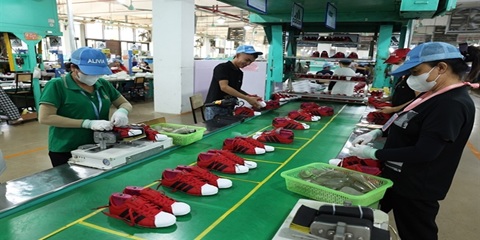
VIỆT NAM'S FOOTWEAR, BAG EXPORTS TO US TOP $8 BILLION IN EIGHT MONTHS
Việt Nam's exports of footwear and handbags to the US exceeded US$8 billion in the first eight months of 2026, as the US and EU remained the country's biggest markets despite sluggish growth in footwear shipments. Exports from Việt Nam's leather and footwear sector reached more than $2.45 billion in August, down 9 per cent from July but up 3 per cent from a year earlier, according to preliminary statistics.
Events Sponsors