Want to be in the loop?
subscribe to
our notification
Business News
WOOD INDUSTRY EXPANDS MARKETS TO SUSTAIN GROWTH MOMENTUM
With an export value of nearly US$10 billion in the first seven months of this year, the sector not only ranks among the country's top five largest export industries but also leads in the agriculture–forestry–fishery group.
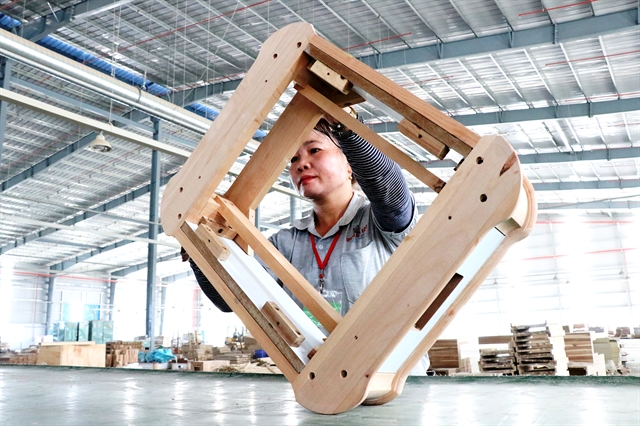
A worker checks wooden product before packaging for export in a wood processing company. — VNA/VNS Photo
HÀ NỘI — The wood and wood products industry holds a prominent position in Việt Nam’s export landscape, but to maintain and accelerate growth, the sector must swiftly expand into new markets and avoid overreliance on a few key destinations.
With an export value of nearly US$10 billion in the first seven months of this year, the sector not only ranks among the country's top five largest export industries but also leads in the agriculture–forestry–fishery group.
According to Deputy Minister of Agriculture and Environment Nguyễn Quốc Trị, the wood industry is a pillar of agricultural exports.
Its success lies not only in export figures but also in promoting the Vietnamese brand internationally.
To ensure long-term sustainability, the industry must move beyond dependence on a limited number of markets.
The US, the EU, Japan and South Korea currently account for over 80 per cent of Việt Nam’s wood exports, with the US alone making up more than 50 per cent of total export value.
This heavy dependence exposes businesses to significant risks, especially when these countries tighten trade policies or impose new technical barriers.
Both the US and EU were increasingly demanding traceability, sustainable forest certifications, and even carbon footprint calculations, noted Nguyễn Thị Thu Trang, Director of the Centre for WTO and International Trade under the Vietnam Chamber of Commerce and Industry (VCCI).
Without early preparation, wood enterprises risked losing competitiveness, even with lower prices, she said.
Many businesses are also expressing concern. The Thời báo Ngân hàng (The Banking Times) quoted Lê Minh Tấn, director of a furniture company in Bình Dương, who shared that his company primarily provided outsourcing services for American and Japanese partners.
When orders dropped, his factory was forced to operate at minimal capacity, he said.
Market diversification
Experts have suggested the wood industry must pursue two key strategies, which are market diversification and product value chains upgrading.
In addition to traditional markets, Việt Nam has strong potential in regions such as the Middle East, South Asia, South America and Eastern Europe.
These areas are undergoing rapid urbanisation with rising demand for housing and interior furnishings.
For example, Saudi Arabia and the UAE are developing massive urban projects, creating multi-billion-dollar demand for furniture annually.
Furthermore, the industry must move beyond low-cost segments or purely outsourcing. Investment should be channelled into smart furniture, custom designs and eco-friendly products, and others, according to the experts.
These high-value segments enhance order value, improve profit margins, and help build long-term brand equity.
Trần Quốc Mạnh, vice chairman of the Vietnam Handicraft Exporters Association, said that Việt Nam’s furniture industry must aim for Net Zero with eco-friendly products.
This was not only a global trend but also a strict requirement from major markets like the EU, US, Japan and the Middle East, he said.
In addition to diverse designs, most import markets now demanded green and sustainable products, he added.
These factors offered long-term competitive advantages. Wood enterprises also needed to accelerate digital transformation and restructure operations to improve competitiveness and reduce production costs, especially as order volumes and prices showed signs of decline.
Leveraging trade agreements
One major advantage for the industry is its ability to leverage next-generation FTAs such as the EVFTA, CPTPP and UKVFTA.
These agreements grant Vietnamese wood products preferential tariffs in markets like the EU, Canada, the UK, and CPTPP countries.
However, opportunities come with challenges. The EU has begun to implement the EU Deforestation Regulation (EUDR), which requires proof that wood products are not linked to deforestation.
Đỗ Xuân Lập, chairman of the Vietnam Timber and Forest Products Association (VIFORES), emphasised the importance of proactively developing legal and transparent raw material zones.
Once producers met the highest standards, wood products could confidently conquer even the most demanding markets, he said.
Many wood enterprises had already begun restructuring their operations to adapt, said Lập.
Some major companies were investing in custom designs and building domestic furniture brands alongside exports. Others were shifting to outdoor wood products and composite wood to tap into new consumption trends, he added. — VNS
Source: VNS
Related News

BANKING / FINANCE / INSURANCE / TAX
REMITTANCES TO HCM CITY RISE NEARLY 40% IN Q3
Remittances to HCM City reached more than US$2.83 billion in the third quarter of this year, up 39.5 per cent from the previous quarter and 3.6 per cent year-on-year. This was the first quarter showing positive annual growth this year, helping narrow the decline in remittance inflows over the first nine months. According to the State Bank of Vietnam (SBV)’s Regional Branch 2, remittances transferred to HCM City through credit institutions and economic organisations totalled $2.835 billion in Q3, an increase of more than $802 million from the previous quarter.

TECHNOLOGY
TECH SECTOR GROWTH OPENS UP OPPORTUNITIES FOR VIỆT NAM TO GO GLOBAL
The growth of the electronics, semiconductor and high-tech sectors worldwide is opening up a variety of opportunities for Vietnamese enterprises to integrate more deeply into the global supply chain. However, to become suppliers for these corporations, domestic enterprises must meet rigorous standards regarding quality, technology, productivity and order fulfilment capabilities.
VIETNAM ECONOMY INVESTMENT
FOREIGN INVESTORS SEEKING A SYNCHRONISED MANUFACTURING ECOSYSTEM
Instead of focusing only on land costs and incentives as usual, foreign investors are seeking a synchronised manufacturing ecosystem, from stable power supply and logistics to shared infrastructure and the convenience of completing residence procedures for experts to serve their long-term investment in the country.
MEMBER CORNER / PROMOTIONS
SENTRYSAFE FHW40200 – PROTECT YOUR VALUABLES, ENJOY PEACE OF MIND!
Looking for a reliable solution to protect your important documents, cash, and valuables from fire and water damage? Genuine SENTRYSAFE - Reliable protection for your valuables and peace of mind! Contact Sen Wai Vietnam for more information and personalized product recommendations.
PROPERTY / INDUSTRIAL ZONE
HCM CITY ATTRACTS US$5.7 BILLION INTO EXPORT PROCESSING AND INDUSTRIAL ZONES
HCM City attracted US$5.7 billion in domestic and foreign investment into its export processing and industrial zones during the first nine months of 2026. The figure exceeded the city's full-year target by 31 per cent, highlighting strong momentum in high-quality industrial investment under Resolution No.10-NQ/TW. Total investment reached 131 per cent of the 2026 target of $4.25 billion and represented a 29 per cent increase compared with the same period in 2025, according to the city's Export Processing and Industrial Zones Authority (HEPZA).
INFRASTRUCTURE / CONSTRUCTION / LOGISTIC / PORT
DONG THAP PROVINCE STEPS UP INDUSTRIAL EXPANSION AND INFRASTRUCTURE CONNECTIVITY
Accelerating public investment, strengthening inter-regional connectivity, and expanding industrial land are helping Dong Thap efficiently bolster competitiveness and drive economic growth. Following the 2025 merger of the former Dong Thap and Tien Giang provinces, the expanded Dong Thap province in the Mekong Delta faces mounting pressure to accelerate infrastructure development and strengthen connectivity among local economic zones, urban areas, industrial parks (IPs), and production centres.
Events Sponsors






















