Want to be in the loop?
subscribe to
our notification
Business News
WOOD AND WOOD PRODUCT EXPORTS CONTINUE TO GROW AMID TARIFF UNCERTAINTY
In the face of global trade turbulence caused by sudden tariff changes in the US and shifts in global supply chains, Việt Nam’s wood and wood product exports have managed to maintain positive momentum.
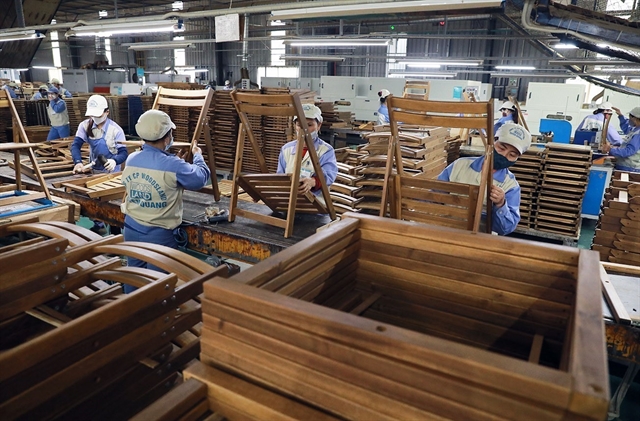
Wooden furniture products are being finalised for export to key markets such as the US and EU. VNA/VNS Photo
HCM CITY — In the face of global trade turbulence caused by sudden tariff changes in the US and shifts in global supply chains, Việt Nam’s wood and wood product exports have managed to maintain positive momentum.
However, the industry is still confronting mounting challenges that demand adaptability and proactive efforts to build domestic resilience.
According to the Ministry of Agriculture and Environment, the export value of wood and wood products in the first six months of 2025 reached US$8.21 billion, representing an increase of 8.9 per cent compared to the same period in 2024.
The US remained Việt Nam’s largest export market, accounting for 55.6 per cent of the total export turnover.
Japan and China followed with market shares of 12.6 per cent and 10.4 per cent, respectively.
Despite the persistent pressure of tariffs in its key market, the sector continued to demonstrate its strength, remaining among the top five agricultural groups with the largest trade surplus.
The trade surplus for wood and wood products reached VNĐ169.5 trillion ($6.69 billion), a rise of 6.7 per cent year-on-year.
US market adapts
Phùng Quốc Mẫn, Chairman of the Members’ Council of Bảo Hưng Co., Ltd. and President of the Handicraft and Wood Industry Association of HCM City, said that although the US market was affected by new minimum and countervailing tax regimes, Việt Nam’s export performance in the first half of 2025 exceeded expectations.
Exports to the US still managed to grow by roughly 6 per cent, partly due to clients boosting inventory levels ahead of expected tax enforcement.
Mẫn noted that the countervailing tax policy imposed by the US, though unexpected, was applied broadly to many exporting nations, not exclusively Việt Nam.
As a result, even though the cost of goods increased, US importers were compelled to continue placing orders to maintain their supply chains and meet demand from loyal customers.
In response, many Vietnamese exporters worked closely with their clients to temporarily share increased costs, ensuring continuity across the supply chain and maintaining mutually beneficial relationships.
To mitigate the impact of tariffs, several businesses have shifted towards market diversification and e-commerce.
Trần Lam Sơn, Deputy General Director of Thiên Minh Co., shared that e-commerce provides the shortest path from producer to consumer.
While traditional Business-to-Business (B2B) transactions are significantly affected by cumulative cost increases due to tariffs, direct-to-consumer sales via online platforms remain less price sensitive.
Interior furniture products sold online typically carry lower value and post-tax price differences that remain within acceptable levels for end-users.
This has resulted in a growing and stable stream of online orders.
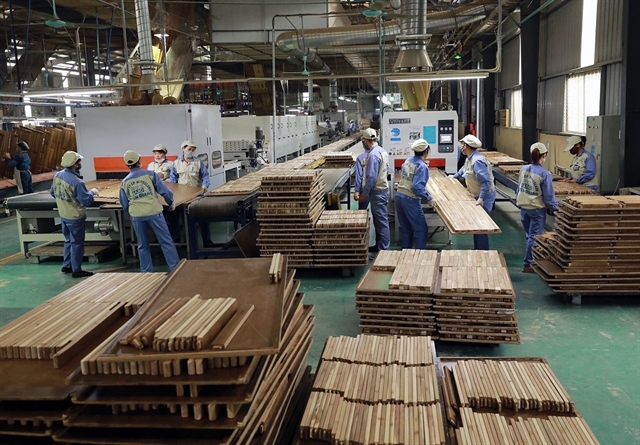
The US remains the key export market for Việt Nam’s wood and wood products. VNA/VNS Photo
New risks emerge
Yet, behind the positive export figures lies a growing list of challenges threatening the sustainable development of the sector.
Trần Việt Tiến, Director of Gia Long Co., warned that the wood processing industry now faces increasingly stringent trade barriers.
In the US, the most pressing concern is the countervailing tax, which undermines the competitive advantage of Vietnamese wooden goods.
Additionally, Vietnamese exporters are grappling with anti-dumping investigations and accusations of origin fraud.
In the European Union, the upcoming EU Deforestation Regulation (EUDR), scheduled to take effect at the end of 2025, will require all wood products to prove legal origin and show no link to deforestation—raising the compliance bar even higher for exporters.
The evolving global supply chain landscape presents both opportunities and risks.
Leading multinational corporations from the US, EU, and Japan are shifting sourcing strategies, preferring supply chains located nearer to end-markets to reduce logistical risks and transportation costs.
This new direction is fragmenting the once-globalised structure into a multipolar system.
Without transparent operations and added value, Vietnamese wood exporters risk being excluded from these emerging supply chains.
Tiến stressed that a complete and modernised domestic ecosystem for wooden furniture must include sustainably sourced raw materials, advanced processing technologies, large-scale manufacturing capacity, creative product design, competitive branding, extensive distribution networks, and professional logistics systems.
Việt Nam already has a solid base: over 2 million hectares of planted forests, a skilled workforce, and strong production capacity.
However, gaps remain in supporting industries such as precision mechanics and component manufacturing, flexible product design to meet diverse market needs, and global distribution systems.
Most notably, there is still no Vietnamese furniture brand with regional or global recognition.
“Actively controlling a sustainable and transparent domestic supply chain offers dual benefits,” Tiến explained. “It reduces dependence on imported raw materials and fulfils traceability requirements in export markets. These attributes act as a passport for Vietnamese products to confidently access the world’s most demanding markets.”
Experts agree that Việt Nam’s wood processing and furniture sector must move beyond its longstanding role as the “world’s workshop.”
To thrive in the new global context, the industry must evolve into a production hub with a distinct identity, built on design innovation, brand development, and a resilient domestic ecosystem.
For this transformation to take root, a long-term vision and strategic alignment across the industry is vital.
Enterprises must take the initiative in investing in modern technology, creative design, and transparent supply chains.
At the same time, each business must take full responsibility for preventing transshipment and origin fraud.
Failing to do so could jeopardise the sector’s hard-won reputation and trigger prolonged trade sanctions, ultimately leading to a loss of global market share. — VNS
Source: VNS
Related News

BANKING / FINANCE / INSURANCE / TAX
REMITTANCES TO HCM CITY RISE NEARLY 40% IN Q3
Remittances to HCM City reached more than US$2.83 billion in the third quarter of this year, up 39.5 per cent from the previous quarter and 3.6 per cent year-on-year. This was the first quarter showing positive annual growth this year, helping narrow the decline in remittance inflows over the first nine months. According to the State Bank of Vietnam (SBV)’s Regional Branch 2, remittances transferred to HCM City through credit institutions and economic organisations totalled $2.835 billion in Q3, an increase of more than $802 million from the previous quarter.

TECHNOLOGY
TECH SECTOR GROWTH OPENS UP OPPORTUNITIES FOR VIỆT NAM TO GO GLOBAL
The growth of the electronics, semiconductor and high-tech sectors worldwide is opening up a variety of opportunities for Vietnamese enterprises to integrate more deeply into the global supply chain. However, to become suppliers for these corporations, domestic enterprises must meet rigorous standards regarding quality, technology, productivity and order fulfilment capabilities.
VIETNAM ECONOMY INVESTMENT
FOREIGN INVESTORS SEEKING A SYNCHRONISED MANUFACTURING ECOSYSTEM
Instead of focusing only on land costs and incentives as usual, foreign investors are seeking a synchronised manufacturing ecosystem, from stable power supply and logistics to shared infrastructure and the convenience of completing residence procedures for experts to serve their long-term investment in the country.

MEMBER CORNER / PROMOTIONS
SENTRYSAFE FHW40200 – PROTECT YOUR VALUABLES, ENJOY PEACE OF MIND!
Looking for a reliable solution to protect your important documents, cash, and valuables from fire and water damage? Genuine SENTRYSAFE - Reliable protection for your valuables and peace of mind! Contact Sen Wai Vietnam for more information and personalized product recommendations.
PROPERTY / INDUSTRIAL ZONE
HCM CITY ATTRACTS US$5.7 BILLION INTO EXPORT PROCESSING AND INDUSTRIAL ZONES
HCM City attracted US$5.7 billion in domestic and foreign investment into its export processing and industrial zones during the first nine months of 2026. The figure exceeded the city's full-year target by 31 per cent, highlighting strong momentum in high-quality industrial investment under Resolution No.10-NQ/TW. Total investment reached 131 per cent of the 2026 target of $4.25 billion and represented a 29 per cent increase compared with the same period in 2025, according to the city's Export Processing and Industrial Zones Authority (HEPZA).
INFRASTRUCTURE / CONSTRUCTION / LOGISTIC / PORT
DONG THAP PROVINCE STEPS UP INDUSTRIAL EXPANSION AND INFRASTRUCTURE CONNECTIVITY
Accelerating public investment, strengthening inter-regional connectivity, and expanding industrial land are helping Dong Thap efficiently bolster competitiveness and drive economic growth. Following the 2025 merger of the former Dong Thap and Tien Giang provinces, the expanded Dong Thap province in the Mekong Delta faces mounting pressure to accelerate infrastructure development and strengthen connectivity among local economic zones, urban areas, industrial parks (IPs), and production centres.
Events Sponsors






















