Want to be in the loop?
subscribe to
our notification
Business News
VIETNAMESE FIRMS TACKLE US TARIFFS WITH SMART STRATEGIES AND GROWTH
The United States recently imposed a 20 per cent countervailing tax on goods from Việt Nam, prompting many firms to proactively restructure operations, standardise production, and diversify export markets to maintain growth momentum.
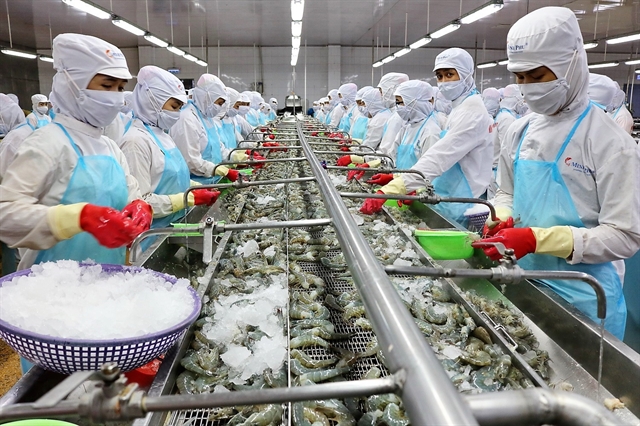
Shrimp processing line for export of Minh Phú Group. — Photo baovephapluat.vn
HÀ NỘI — The United States recently imposed a 20 per cent countervailing tax on goods originating from Việt Nam, a level that presents challenges but remains manageable for domestic enterprises.
Many Vietnamese firms are responding proactively by restructuring operations, standardising production and diversifying export markets to maintain growth momentum amid these new trade barriers.
Nguyễn Phương Lam, director of the Việt Nam Chamber of Commerce and Industry’s Mekong Delta branch, noted that the 20 per cent tariff is a significant reduction from the previous 46 per cent. He added that the gap between Việt Nam and other Southeast Asian nations is now only around one percentage point.
“Compared with regional countries, a 20 per cent tax is not excessively high and can be considered acceptable. More importantly, Việt Nam’s exports to the US have exceeded US$119 billion, far surpassing many Southeast Asian nations which only reach $30–40 billion,” Lam emphasised.
Experts agree this outcome reflects the Government’s effective negotiation efforts. However, enterprises must now adopt both short-term and long-term adaptation strategies to remain competitive.
Many businesses have already taken steps. Minh Phú Seafood Corporation – Hậu Giang, which exports shrimp to 50 countries, reported that the US accounted for only 14.7 per cent of its sales, with Japan leading at 24.1 per cent.
General director Lê Thị Minh Phú said, “We hope the Government will continue negotiations for further tax reductions. At the same time, we have expanded into other potential markets to maintain stable growth.”
In agriculture, Cửu Long Orchard JSC general director Lê Văn Đồng said: “The US market values quality over quantity. The decisive factor is not the tariff rate but competitiveness through product quality. We are targeting the premium segment, where customers prioritise health and branding.”
Technology companies are also adapting swiftly. Deputy director of VNPT Technology’s business centre Trần Đức Hòa outlined four solutions: optimising supply chains, boosting localisation, diversifying markets and developing high-tech products to ease pricing pressures.
Principal country economist of the Asian Development Bank in Việt Nam Nguyễn Bá Hùng highlighted that domestic reforms—ranging from institutional improvements to business environment upgrades—could be undertaken immediately to enhance competitiveness.
From an investment perspective, he added that the current tariff gap gives Việt Nam an advantage over China, making it a more attractive destination for international capital flows.— VNS
Source: VNS
Related News

BANKING / FINANCE / INSURANCE / TAX
REMITTANCES TO HCM CITY RISE NEARLY 40% IN Q3
Remittances to HCM City reached more than US$2.83 billion in the third quarter of this year, up 39.5 per cent from the previous quarter and 3.6 per cent year-on-year. This was the first quarter showing positive annual growth this year, helping narrow the decline in remittance inflows over the first nine months. According to the State Bank of Vietnam (SBV)’s Regional Branch 2, remittances transferred to HCM City through credit institutions and economic organisations totalled $2.835 billion in Q3, an increase of more than $802 million from the previous quarter.

TECHNOLOGY
TECH SECTOR GROWTH OPENS UP OPPORTUNITIES FOR VIỆT NAM TO GO GLOBAL
The growth of the electronics, semiconductor and high-tech sectors worldwide is opening up a variety of opportunities for Vietnamese enterprises to integrate more deeply into the global supply chain. However, to become suppliers for these corporations, domestic enterprises must meet rigorous standards regarding quality, technology, productivity and order fulfilment capabilities.

VIETNAM ECONOMY INVESTMENT
FOREIGN INVESTORS SEEKING A SYNCHRONISED MANUFACTURING ECOSYSTEM
Instead of focusing only on land costs and incentives as usual, foreign investors are seeking a synchronised manufacturing ecosystem, from stable power supply and logistics to shared infrastructure and the convenience of completing residence procedures for experts to serve their long-term investment in the country.
MEMBER CORNER / PROMOTIONS
SENTRYSAFE FHW40200 – PROTECT YOUR VALUABLES, ENJOY PEACE OF MIND!
Looking for a reliable solution to protect your important documents, cash, and valuables from fire and water damage? Genuine SENTRYSAFE - Reliable protection for your valuables and peace of mind! Contact Sen Wai Vietnam for more information and personalized product recommendations.

PROPERTY / INDUSTRIAL ZONE
HCM CITY ATTRACTS US$5.7 BILLION INTO EXPORT PROCESSING AND INDUSTRIAL ZONES
HCM City attracted US$5.7 billion in domestic and foreign investment into its export processing and industrial zones during the first nine months of 2026. The figure exceeded the city's full-year target by 31 per cent, highlighting strong momentum in high-quality industrial investment under Resolution No.10-NQ/TW. Total investment reached 131 per cent of the 2026 target of $4.25 billion and represented a 29 per cent increase compared with the same period in 2025, according to the city's Export Processing and Industrial Zones Authority (HEPZA).

INFRASTRUCTURE / CONSTRUCTION / LOGISTIC / PORT
DONG THAP PROVINCE STEPS UP INDUSTRIAL EXPANSION AND INFRASTRUCTURE CONNECTIVITY
Accelerating public investment, strengthening inter-regional connectivity, and expanding industrial land are helping Dong Thap efficiently bolster competitiveness and drive economic growth. Following the 2025 merger of the former Dong Thap and Tien Giang provinces, the expanded Dong Thap province in the Mekong Delta faces mounting pressure to accelerate infrastructure development and strengthen connectivity among local economic zones, urban areas, industrial parks (IPs), and production centres.
Events Sponsors






















