Want to be in the loop?
subscribe to
our notification
Business News
VIETNAM SETS MINIMUM EQUITY REQUIREMENTS FOR FOREIGN OFFSHORE WIND INVESTORS
The Vietnamese government has issued Decree No. 272, providing detailed guidance for the implementation of the National Assembly’s Resolution No. 253 on special mechanisms and policies to support national energy development during the 2026-30 period, introducing financial and ownership requirements to both domestic and foreign investors seeking to develop offshore wind power projects.
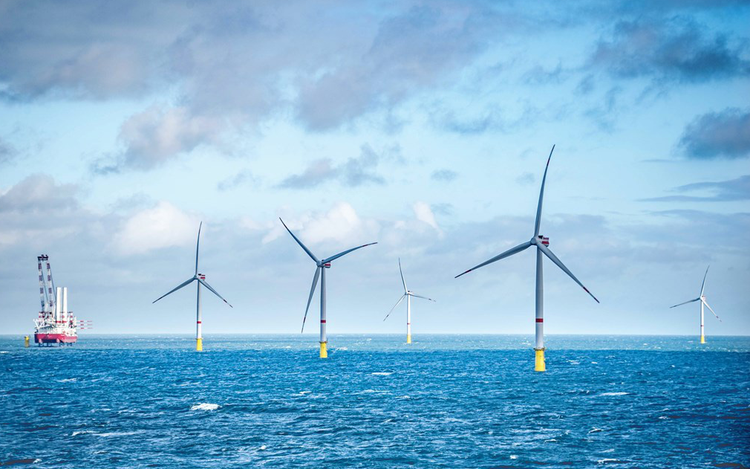
An offshore wind power project in Vietnam. Photo: Tuoi Tre
Under the decree, foreign investors and foreign-invested enterprises must hold a minimum 15-percent equity stake in an offshore wind power project that they will develop.
These offshore wind projects will sell electricity to the national grid under the national power development plan and are scheduled to begin operations during the 2025-30 or 2031-35 periods.
Also, developers are required to contribute equity equivalent to at least 20 percent of the project’s total investment capital.
In addition, investors must secure loan commitments from banks or other credit institutions to finance the remaining capital needed for the project.
The decree also requires foreign investors to ensure the participation of Vietnamese companies.
Domestic enterprises must collectively hold at least five percent of the charter capital or voting shares in the project company.
Foreign-invested developers must be further committed to using domestic labor, goods, and services during the investment, construction, and operational phases of offshore wind projects, provided that local suppliers meet requirements on price competitiveness, quality, project schedules, and availability.
For wholly Vietnamese-owned companies, they must contribute at least five percent equity to an offshore wind power project.
The decree took effect on July 4 and will remain in force until December 31, 2030.
Survey requirements for offshore wind projects
Decree No. 272 also introduces financial requirements for companies conducting offshore wind project surveys.
Survey contractors must have a minimum equity of VND1 billion (US$38,020) for every megawatt (MW) of offshore wind capacity.
Companies applying to survey multiple offshore wind projects must demonstrate sufficient equity based on the combined generating capacity of all proposed projects.
Survey firms are also required to commit that they will not seek reimbursement of survey costs under any circumstances.
The only exception applies to state-owned enterprises that have been officially assigned survey tasks by competent authorities.
To demonstrate financial capability, survey companies must submit audited financial statements for the two most recent years, financial support commitments from parent companies where applicable, or other documents proving adequate financial resources.
The decree further stipulates that survey costs and expenses related to preparing investment approval dossiers for projects surveyed by wholly state-owned enterprises under the Electricity Law for subsequent investor bidding must be audited before implementation.
Source: Tuổi Trẻ News
Related News

BANKING / FINANCE / INSURANCE / TAX
REMITTANCES TO HCM CITY RISE NEARLY 40% IN Q3
Remittances to HCM City reached more than US$2.83 billion in the third quarter of this year, up 39.5 per cent from the previous quarter and 3.6 per cent year-on-year. This was the first quarter showing positive annual growth this year, helping narrow the decline in remittance inflows over the first nine months. According to the State Bank of Vietnam (SBV)’s Regional Branch 2, remittances transferred to HCM City through credit institutions and economic organisations totalled $2.835 billion in Q3, an increase of more than $802 million from the previous quarter.

TECHNOLOGY
TECH SECTOR GROWTH OPENS UP OPPORTUNITIES FOR VIỆT NAM TO GO GLOBAL
The growth of the electronics, semiconductor and high-tech sectors worldwide is opening up a variety of opportunities for Vietnamese enterprises to integrate more deeply into the global supply chain. However, to become suppliers for these corporations, domestic enterprises must meet rigorous standards regarding quality, technology, productivity and order fulfilment capabilities.

VIETNAM ECONOMY INVESTMENT
FOREIGN INVESTORS SEEKING A SYNCHRONISED MANUFACTURING ECOSYSTEM
Instead of focusing only on land costs and incentives as usual, foreign investors are seeking a synchronised manufacturing ecosystem, from stable power supply and logistics to shared infrastructure and the convenience of completing residence procedures for experts to serve their long-term investment in the country.
MEMBER CORNER / PROMOTIONS
SENTRYSAFE FHW40200 – PROTECT YOUR VALUABLES, ENJOY PEACE OF MIND!
Looking for a reliable solution to protect your important documents, cash, and valuables from fire and water damage? Genuine SENTRYSAFE - Reliable protection for your valuables and peace of mind! Contact Sen Wai Vietnam for more information and personalized product recommendations.

PROPERTY / INDUSTRIAL ZONE
HCM CITY ATTRACTS US$5.7 BILLION INTO EXPORT PROCESSING AND INDUSTRIAL ZONES
HCM City attracted US$5.7 billion in domestic and foreign investment into its export processing and industrial zones during the first nine months of 2026. The figure exceeded the city's full-year target by 31 per cent, highlighting strong momentum in high-quality industrial investment under Resolution No.10-NQ/TW. Total investment reached 131 per cent of the 2026 target of $4.25 billion and represented a 29 per cent increase compared with the same period in 2025, according to the city's Export Processing and Industrial Zones Authority (HEPZA).

INFRASTRUCTURE / CONSTRUCTION / LOGISTIC / PORT
DONG THAP PROVINCE STEPS UP INDUSTRIAL EXPANSION AND INFRASTRUCTURE CONNECTIVITY
Accelerating public investment, strengthening inter-regional connectivity, and expanding industrial land are helping Dong Thap efficiently bolster competitiveness and drive economic growth. Following the 2025 merger of the former Dong Thap and Tien Giang provinces, the expanded Dong Thap province in the Mekong Delta faces mounting pressure to accelerate infrastructure development and strengthen connectivity among local economic zones, urban areas, industrial parks (IPs), and production centres.
Events Sponsors






















