Want to be in the loop?
subscribe to
our notification
Business News
VIETNAM’S TRADE TURNOVER SURPASSES $1 TRILLION FOR THE FIRST TIME
Vietnam's merchandise trade has crossed the trillion-dollar mark for the first time, with imports growing faster than exports and pushing the country into a trade deficit.
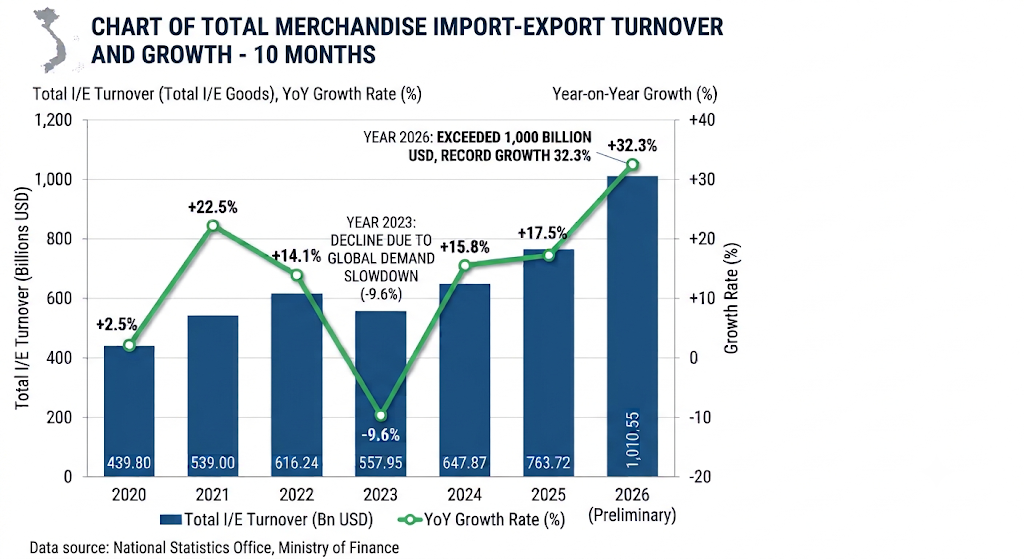
Data source: NSO
Total merchandise trade reached more than $1 trillion in the first 10 months of 2026, up 32.3 per cent on-year, according to the National Statistics Office under the Ministry of Finance. Exports hit $499.24 billion, up 27.5 per cent, while imports totalled $511.3 billion, up 37.4 per cent. With imports outpacing exports, Vietnam posted a merchandise trade deficit of $12.07 billion, compared with a surplus of about $19.5 billion a year earlier.
In October alone, total merchandise trade amounted to $122 billion, up 3.7 per cent from the previous month and 47.4 per cent on-year. Of this, exports reached $64.67 billion, up 8.7 per cent month on month, while imports stood at $57.36 billion, down 1.4 per cent.
Vietnam posted a trade surplus of $7.3 billion in October, following a surplus of $1.3 billion in September. This marked the second consecutive month of trade surplus in 2026.
Regarding exports, the domestic economic sector recorded $93.9 billion in the first 10 months, up 8.2 per cent and accounting for 18.8 per cent of total export turnover. Meanwhile, the foreign-invested sector, including crude oil, generated $405.3 billion, up 33 per cent and representing 81.2 per cent of the total.
Export composition remained heavily concentrated in the manufacturing and processing industry, which generated $452.74 billion, accounting for 90.7 per cent of total exports. Agricultural and forestry products contributed nearly $33.5 billion, or 6.7 per cent, while seafood exports reached $10.36 billion, equivalent to 2.1 per cent. Fuels and minerals accounted for the remaining $2.66 billion, or 0.5 per cent. During the period, 37 export items recorded turnover exceeding $1 billion, including eight that surpassed $10 billion.
On the import side, the domestic economic sector recorded $131.76 billion, up 23 per cent, while imports by the foreign-invested sector reached $379.55 billion, up 43.2 per cent.
Imports of production inputs totalled $481 billion, accounting for 94.1 per cent of total import turnover. Of this, machinery, equipment, tools and spare parts represented 58.5 per cent, while raw materials, fuels and other inputs accounted for 35.6 per cent. Consumer goods imports stood at about $30.3 billion, or 5.9 per cent. A total of 47 imported products recorded values exceeding $1 billion, including eight with import values of more than $10 billion.
In terms of trading partners, the United States remained Vietnam’s largest export market, with export turnover reaching $159.4 billion, while China was the country's largest import market, with imports totalling $212.46 billion.
During the 10-month period, trade surpluses with the European Union and Japan reached $40.84 billion and $3.4 billion, respectively, increasing by 26.8 per cent and 110.4 per cent.
Conversely, Vietnam recorded trade deficits of $134.94 billion with China, up 43.2 per cent; $48.63 billion with the Republic of Korea, up 91 per cent; and $16.93 billion with ASEAN, up 46 per cent.
By economic sector, the domestic sector recorded a trade deficit of $37.83 billion, while foreign-invested enterprises, including crude oil, posted a trade surplus of $25.76 billion.
Source: VIR
Related News

INFRASTRUCTURE / CONSTRUCTION / LOGISTIC / PORT
VIỆT NAM TO DEVELOP A NATIONAL PROGRAMME TO BOOST MARITIME INDUSTRY
Việt Nam will develop a national programme for the maritime and marine engineering industries through 2035 as part of the effort to strengthen domestic industrial capacity and build a modern, competitive and self-reliant maritime industry. Under Decision 2089/QĐ-TTg, signed by Permanent Deputy Prime Minister Phạm Gia Túc, the Government seeks to address existing difficulties and bottlenecks, mobilise resources and make more effective use of the industry's existing capabilities.

VIETNAM ECONOMY INVESTMENT
VIỆT NAM TARGETS 80 PER CENT SHARE FOR LOCAL GOODS IN SUPERMARKETS BY 2030
Việt Nam aims to ensure Vietnamese products account for more than 80 per cent of goods displayed in domestic supermarkets and shopping centres and 60 per cent in traditional markets by 2030, under a new government programme to boost local consumption and strengthen the position of local brands. The target is part of the “Vietnamese goods for Vietnamese” programme for the 2026–30 period, approved under Decision No. 2069/QĐ-TTg signed by Deputy Prime Minister Phạm Gia Túc late last month.
VIETNAM ECONOMY INVESTMENT
AVERAGE STARTUP CAPITAL PER NEW BUSINESS DOUBLED TO $800,000
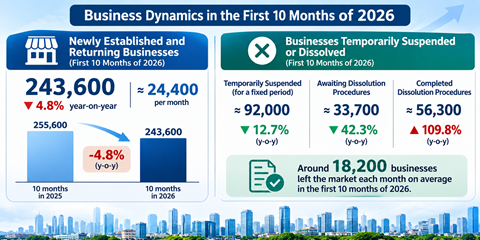
More than 243,600 businesses were newly established or resumed operations in the first 10 months of 2026, averaging 24,400 a month, according to the National Statistics Office under the Ministry of Finance. Total additional registered capital reached nearly VND5.8 quadrillion ($227 billion), up 11.6 per cent on-year.
VIETNAM ECONOMY INVESTMENT
VIỆT NAM SEEKS NEW GROWTH DRIVERS TO ACHIEVE DOUBLE-DIGIT EXPANSION IN 2027
The target, approved by the National Assembly (NA) on November 7, comes amid encouraging economic performance in the first 10 months of 2026. However, sustaining high growth will require more than increased investment and credit. Improving productivity, strengthening the private sector, promoting industrial development and accelerating science and technology adoption will be crucial to turning the ambitious target into reality.

TECHNOLOGY
TECHNOLOGY ADDRESSES SOLUTIONS TO COST CHALLENGES IN FOOD INDUSTRY
Vietnam’s food processing sector grew by 11 per cent in 2025, reaching a scale of $88 billion, according to an annual report published by the US Department of Agriculture in early 2026. Meanwhile, the Vietnam’s food processing and handling equipment market was estimated at $1.2 billion last year, according to 6Wresearch.
VIETNAM ECONOMY INVESTMENT
INNOVATION BECOMES CORE SURVIVAL DRIVE FOR VIỆT NAM’S SMES
To survive and break through, innovation has become a core competitive tool for Việt Nam’s small and medium-sized enterprises (SMEs), which account for more than 97 per cent of all domestic enterprises. As traditional competitive advantages like cheap labour and raw resource extraction reach their limits, competing primarily through financial muscle is no longer a viable strategy.
Events Sponsors