Want to be in the loop?
subscribe to
our notification
Business News
VIỆT NAM TARGETS 80 PER CENT SHARE FOR LOCAL GOODS IN SUPERMARKETS BY 2030
The programme aims to develop a competitive ecosystem of quality Vietnamese products, build strong domestic brands trusted by consumers and encourage greater use of locally made goods to contribute to the country's ambition of achieving double-digit economic growth.
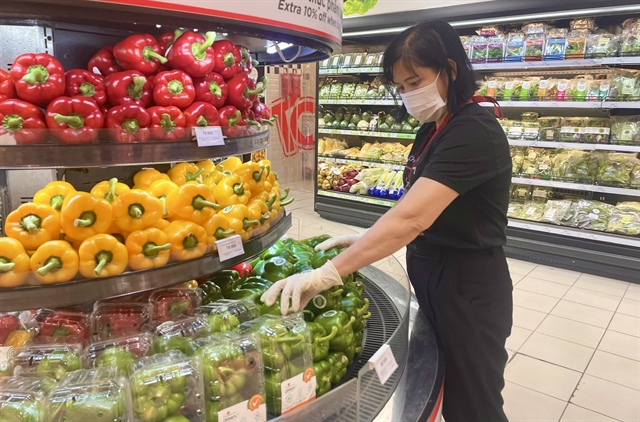
Local fruits and vegetables on shelves of a supermarket in HCM City. Việt Nam has launched a programme to develop a competitive ecosystem of quality Vietnamese products, boost local consumption and strengthen the position of local brands. — VNA/VNS Photo Hương Giang
HÀ NỘI — Việt Nam aims to ensure Vietnamese products account for more than 80 per cent of goods displayed in domestic supermarkets and shopping centres and 60 per cent in traditional markets by 2030, under a new government programme to boost local consumption and strengthen the position of local brands.
The target is part of the “Vietnamese goods for Vietnamese” programme for the 2026–30 period, approved under Decision No. 2069/QĐ-TTg signed by Deputy Prime Minister Phạm Gia Túc late last month.
Under the programme, the domestic retail market is expected to reach VNĐ13.5-14 quadrillion (US$513-532 billion) by 2030 with average annual growth of 14-15 per cent in total retail sales of goods and consumer services during the period.
The programme aims to develop a competitive ecosystem of quality Vietnamese products, build strong domestic brands trusted by consumers and encourage greater use of locally made goods to contribute to the country's ambition of achieving double-digit economic growth.
Digital transformation and modern distribution channels will play a key role in expanding the domestic market.
More than 70 per cent of small- and medium-sized enterprises (SMEs) producing consumer goods are expected to adopt e-commerce, while 45 per cent of SMEs operating in trading are targeted to join major domestic and international e-commerce platforms.
E-commerce sales are projected to grow by 23-25 per cent annually, reaching $93-97 billion by 2030, equivalent to 18-19 per cent of total retail sales of goods and consumer services.
The Government plans to establish at least five specialised online stores for Vietnamese products on major e-commerce platforms.
A unified national identification system will be introduced for Vietnamese products meeting the programme's criteria, alongside a product traceability system to help consumers verify origins and product information.
The identification system will be applied consistently across product packaging, retail outlets, e-commerce stores, promotional materials and communication campaigns to help consumers easily recognise eligible Vietnamese products.
The programme also calls for stronger links between domestic manufacturers, suppliers and distribution networks, while encouraging foreign-invested enterprises to prioritise Vietnamese suppliers that meet quality requirements.
To promote local consumption, the Government will launch a national communications campaign highlighting Vietnamese products, brands, quality and origins through traditional media, social networks and major shopping events.
Measures will also be taken to expand Vietnamese goods distribution through tourism, including display and retail outlets at airports, seaports, border gates and tourist destinations.
Inspections will be enhanced against counterfeit, substandard and smuggled goods, as well as origin fraud, across both traditional and online markets. Digital technologies and artificial intelligence will be used to help detect violations.
The programme also seeks to improve the legal framework for domestic trade, product quality standards, distribution, e-commerce and consumer protection, while supporting the development of commercial infrastructure, particularly in rural and disadvantaged areas. — VNS
Source: VNS
Related News

INFRASTRUCTURE / CONSTRUCTION / LOGISTIC / PORT
VIỆT NAM TO DEVELOP A NATIONAL PROGRAMME TO BOOST MARITIME INDUSTRY
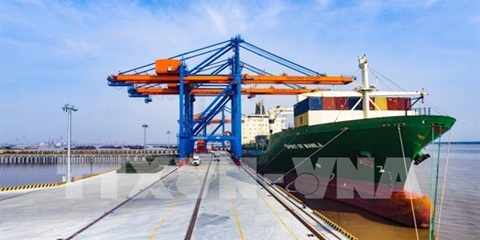
Việt Nam will develop a national programme for the maritime and marine engineering industries through 2035 as part of the effort to strengthen domestic industrial capacity and build a modern, competitive and self-reliant maritime industry. Under Decision 2089/QĐ-TTg, signed by Permanent Deputy Prime Minister Phạm Gia Túc, the Government seeks to address existing difficulties and bottlenecks, mobilise resources and make more effective use of the industry's existing capabilities.
VIETNAM ECONOMY INVESTMENT
AVERAGE STARTUP CAPITAL PER NEW BUSINESS DOUBLED TO $800,000
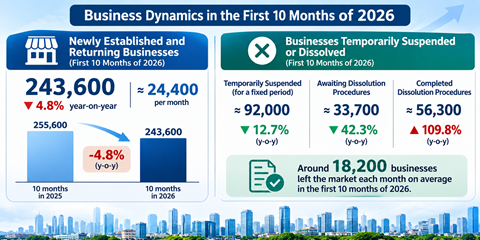
More than 243,600 businesses were newly established or resumed operations in the first 10 months of 2026, averaging 24,400 a month, according to the National Statistics Office under the Ministry of Finance. Total additional registered capital reached nearly VND5.8 quadrillion ($227 billion), up 11.6 per cent on-year.
VIETNAM ECONOMY INVESTMENT
VIETNAM’S TRADE TURNOVER SURPASSES $1 TRILLION FOR THE FIRST TIME
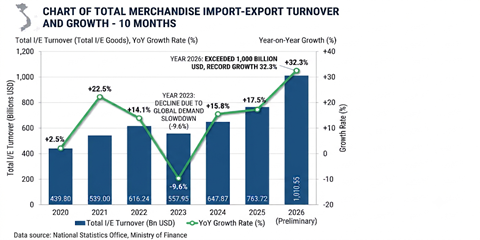
Total merchandise trade reached more than $1 trillion in the first 10 months of 2026, up 32.3 per cent on-year, according to the National Statistics Office under the Ministry of Finance. Exports hit $499.24 billion, up 27.5 per cent, while imports totalled $511.3 billion, up 37.4 per cent. With imports outpacing exports, Vietnam posted a merchandise trade deficit of $12.07 billion, compared with a surplus of about $19.5 billion a year earlier.
VIETNAM ECONOMY INVESTMENT
VIỆT NAM SEEKS NEW GROWTH DRIVERS TO ACHIEVE DOUBLE-DIGIT EXPANSION IN 2027
The target, approved by the National Assembly (NA) on November 7, comes amid encouraging economic performance in the first 10 months of 2026. However, sustaining high growth will require more than increased investment and credit. Improving productivity, strengthening the private sector, promoting industrial development and accelerating science and technology adoption will be crucial to turning the ambitious target into reality.

TECHNOLOGY
TECHNOLOGY ADDRESSES SOLUTIONS TO COST CHALLENGES IN FOOD INDUSTRY
Vietnam’s food processing sector grew by 11 per cent in 2025, reaching a scale of $88 billion, according to an annual report published by the US Department of Agriculture in early 2026. Meanwhile, the Vietnam’s food processing and handling equipment market was estimated at $1.2 billion last year, according to 6Wresearch.
VIETNAM ECONOMY INVESTMENT
INNOVATION BECOMES CORE SURVIVAL DRIVE FOR VIỆT NAM’S SMES
To survive and break through, innovation has become a core competitive tool for Việt Nam’s small and medium-sized enterprises (SMEs), which account for more than 97 per cent of all domestic enterprises. As traditional competitive advantages like cheap labour and raw resource extraction reach their limits, competing primarily through financial muscle is no longer a viable strategy.
Events Sponsors