Want to be in the loop?
subscribe to
our notification
Business News
VIỆT NAM POSTS STRONGEST FIRST-HALF GDP GROWTH IN OVER A DECADE
Breaking down the GDP by sectors, agro-forestry-fishery expanded by 3.84 per cent, industry and construction by 8.33 per cent, and the services sector by 8.14 per cent, contributing 5.59 per cent, 42.4 per cent, and 52.21 per cent, respectively, to the overall growth.
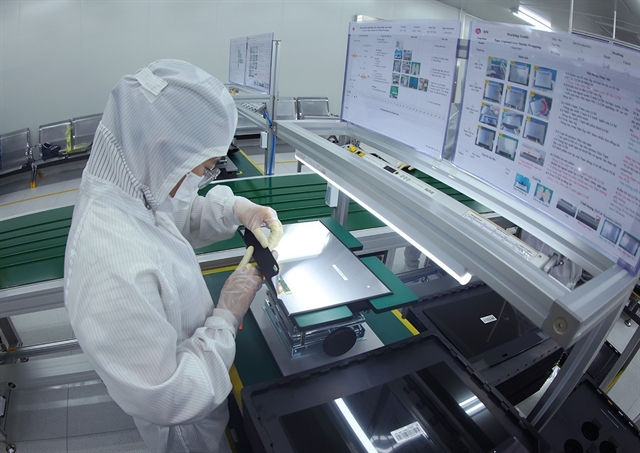
Assembling laptops at the factory of Heesung Electronics Vietnam Co., Ltd., at Tràng Duệ Industrial Park, the northern city of Hải Phòng. — VNA/VNS Photo Vũ Sinh
HÀ NỘI — The Vietnamese economy achieved its strongest performance in over a decade, with gross domestic product (GDP) rising by 7.52 per cent in the first half of the year, the highest since 2011, according to the Ministry of Finance’s National Statistics Office of Việt Nam (NSO).
At a press conference in Hà Nội, NSO Director Nguyễn Thị Hương highlighted that this was a positive result, reflecting the whole political system’s determination, concerted efforts, and drastic actions in managing and implementing socio-economic development tasks amidst regional and global volatility.
Breaking down the GDP by sectors, agro-forestry-fishery expanded by 3.84 per cent, industry and construction by 8.33 per cent, and the services sector by 8.14 per cent, contributing 5.59 per cent, 42.4 per cent, and 52.21 per cent, respectively, to the overall growth.
Farming activities maintained stable growth, meeting both domestic consumption and export demands. Agricultural value-added increased 3.51 per cent compared to the same period last year, while that of the forestry sector rose 7.42 per cent but with minimal impact due to its smaller share, and the fisheries sector 4.21 per cent.
The industrial and construction sector saw notable gains, with the overall industrial index rising 8.07 per cent against the same time last year. In the meantime, the processing and manufacturing industry was the motive of the economy, posting a 10.11 per cent growth.
The electricity production and distribution sector grew by 4.2 per cent, while water supply and waste management services expanded by 7.3 per cent. The construction industry delivered exceptional performance with 9.62 per cent growth, the highest rate compared to the same period from 2011 to 2025. In stark contrast, the mining sector contracted 4.25 per cent.
Several service industries showed impressive performance across the board. Wholesale and retail trade increased by 7.03 per cent, transportation and warehousing 9.82 per cent, and financial, banking, and insurance activities 6.53 per cent. The hospitality and catering sector experienced strong growth of 10.46 per cent.
Public service sectors also recorded significant expansion as part of the country's organisational restructuring, with administrative and support services activities growing by 14.58 per cent, while activities of the Party, socio-political organisations, state management, national security and defence, and mandatory social security rising by 13.09 per cent.
The economic structure in the first half saw agriculture, forestry, and fisheries accounting for 11.28 per cent of GDP, industry and construction representing 36.96 per cent, services comprising 43.40 per cent, and taxes less subsidies on products making up 8.36 per cent. — VNA/VNS
Source: VNS
Related News

BANKING / FINANCE / INSURANCE / TAX
REMITTANCES TO HCM CITY RISE NEARLY 40% IN Q3
Remittances to HCM City reached more than US$2.83 billion in the third quarter of this year, up 39.5 per cent from the previous quarter and 3.6 per cent year-on-year. This was the first quarter showing positive annual growth this year, helping narrow the decline in remittance inflows over the first nine months. According to the State Bank of Vietnam (SBV)’s Regional Branch 2, remittances transferred to HCM City through credit institutions and economic organisations totalled $2.835 billion in Q3, an increase of more than $802 million from the previous quarter.

TECHNOLOGY
TECH SECTOR GROWTH OPENS UP OPPORTUNITIES FOR VIỆT NAM TO GO GLOBAL
The growth of the electronics, semiconductor and high-tech sectors worldwide is opening up a variety of opportunities for Vietnamese enterprises to integrate more deeply into the global supply chain. However, to become suppliers for these corporations, domestic enterprises must meet rigorous standards regarding quality, technology, productivity and order fulfilment capabilities.

VIETNAM ECONOMY INVESTMENT
FOREIGN INVESTORS SEEKING A SYNCHRONISED MANUFACTURING ECOSYSTEM
Instead of focusing only on land costs and incentives as usual, foreign investors are seeking a synchronised manufacturing ecosystem, from stable power supply and logistics to shared infrastructure and the convenience of completing residence procedures for experts to serve their long-term investment in the country.
MEMBER CORNER / PROMOTIONS
SENTRYSAFE FHW40200 – PROTECT YOUR VALUABLES, ENJOY PEACE OF MIND!
Looking for a reliable solution to protect your important documents, cash, and valuables from fire and water damage? Genuine SENTRYSAFE - Reliable protection for your valuables and peace of mind! Contact Sen Wai Vietnam for more information and personalized product recommendations.

PROPERTY / INDUSTRIAL ZONE
HCM CITY ATTRACTS US$5.7 BILLION INTO EXPORT PROCESSING AND INDUSTRIAL ZONES
HCM City attracted US$5.7 billion in domestic and foreign investment into its export processing and industrial zones during the first nine months of 2026. The figure exceeded the city's full-year target by 31 per cent, highlighting strong momentum in high-quality industrial investment under Resolution No.10-NQ/TW. Total investment reached 131 per cent of the 2026 target of $4.25 billion and represented a 29 per cent increase compared with the same period in 2025, according to the city's Export Processing and Industrial Zones Authority (HEPZA).

INFRASTRUCTURE / CONSTRUCTION / LOGISTIC / PORT
DONG THAP PROVINCE STEPS UP INDUSTRIAL EXPANSION AND INFRASTRUCTURE CONNECTIVITY
Accelerating public investment, strengthening inter-regional connectivity, and expanding industrial land are helping Dong Thap efficiently bolster competitiveness and drive economic growth. Following the 2025 merger of the former Dong Thap and Tien Giang provinces, the expanded Dong Thap province in the Mekong Delta faces mounting pressure to accelerate infrastructure development and strengthen connectivity among local economic zones, urban areas, industrial parks (IPs), and production centres.
Events Sponsors






















