Want to be in the loop?
subscribe to
our notification
Business News
VIỆT NAM EYES US$18 BILLION A YEAR FOR POWER PLAN THROUGH 2035
Việt Nam targets being among the top four ASEAN countries for electricity reliability and in the top three for ease of electricity access.
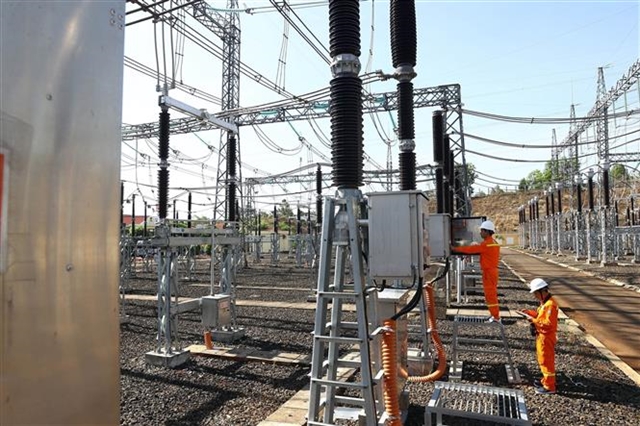
Đăk Nông Power Transmission staff inspect equipment at the 500kV Đăk Nông substation. — VNA/VNS Photo Huy Hùng
HÀ NỘI — Việt Nam will require an annual investment of around US$16–18 billion from now until 2035 to implement its revised National Power Development Plan (PDP VIII), according to the Ministry of Industry and Trade.
This amount will rise to approximately $20 billion per year thereafter.
The updated plan, approved under Decision No. 768/QĐ-TTg dated April 15, outlines ambitious targets to ensure national energy security and meet economic growth demands.
The country aims to supply sufficient electricity to support average GDP growth of 10 per cent per year between 2026 and 2030, and 7.5 per cent per year from 2031 to 2050.
By 2030, commercial electricity consumption is expected to reach 500.4–557.8 billion kWh, rising to 1,237.7–1,375.1 billion kWh by 2050. The total power generation and imports are projected at 560.4–624.6 billion kWh by 2030, with a 2050 forecast of 1,360.1–1,511.1 billion kWh.
Peak load capacity is forecast to hit 89,655–99,934MW by 2030 and 205,732–228,570MW by 2050.
The plan also places strong emphasis on reliability and resilience. It sets the goal of achieving N-1 reliability standards for critical load areas and N-2 for highly critical zones and nuclear power facilities by 2030.
N-1 means the power grid can handle the failure of one component without disruption, while N-2 ensures reliability even if two critical elements fail.
Việt Nam is aiming to be among the top four ASEAN countries for electricity reliability and in the top three for ease of electricity access.
To support the plan’s rollout, Minister of Industry and Trade Nguyễn Hồng Diên has called on EVN and relevant agencies to review pricing regulations and adopt market-based electricity pricing mechanisms to attract investors. Local departments are tasked with updating local power projects in line with increased capacity projections in the revised PDP VIII.
The minister also urged stronger communication efforts to build public consensus around the plan and called for more frequent inspections of power generation and grid projects, to ensure timely implementation.
Authorities have been instructed to address project delays by replacing stalled developments with more feasible alternatives.
Việt Nam is also pushing for increased rooftop solar adoption, aiming for 50 per cent of office buildings and residential homes to use self-produced, self-consumed solar power by 2030 – without feeding back into the national grid. — VNS
Source: VNS
Related News

BANKING / FINANCE / INSURANCE / TAX
REMITTANCES TO HCM CITY RISE NEARLY 40% IN Q3
Remittances to HCM City reached more than US$2.83 billion in the third quarter of this year, up 39.5 per cent from the previous quarter and 3.6 per cent year-on-year. This was the first quarter showing positive annual growth this year, helping narrow the decline in remittance inflows over the first nine months. According to the State Bank of Vietnam (SBV)’s Regional Branch 2, remittances transferred to HCM City through credit institutions and economic organisations totalled $2.835 billion in Q3, an increase of more than $802 million from the previous quarter.

TECHNOLOGY
TECH SECTOR GROWTH OPENS UP OPPORTUNITIES FOR VIỆT NAM TO GO GLOBAL
The growth of the electronics, semiconductor and high-tech sectors worldwide is opening up a variety of opportunities for Vietnamese enterprises to integrate more deeply into the global supply chain. However, to become suppliers for these corporations, domestic enterprises must meet rigorous standards regarding quality, technology, productivity and order fulfilment capabilities.

VIETNAM ECONOMY INVESTMENT
FOREIGN INVESTORS SEEKING A SYNCHRONISED MANUFACTURING ECOSYSTEM
Instead of focusing only on land costs and incentives as usual, foreign investors are seeking a synchronised manufacturing ecosystem, from stable power supply and logistics to shared infrastructure and the convenience of completing residence procedures for experts to serve their long-term investment in the country.

MEMBER CORNER / PROMOTIONS
SENTRYSAFE FHW40200 – PROTECT YOUR VALUABLES, ENJOY PEACE OF MIND!
Looking for a reliable solution to protect your important documents, cash, and valuables from fire and water damage? Genuine SENTRYSAFE - Reliable protection for your valuables and peace of mind! Contact Sen Wai Vietnam for more information and personalized product recommendations.

PROPERTY / INDUSTRIAL ZONE
HCM CITY ATTRACTS US$5.7 BILLION INTO EXPORT PROCESSING AND INDUSTRIAL ZONES
HCM City attracted US$5.7 billion in domestic and foreign investment into its export processing and industrial zones during the first nine months of 2026. The figure exceeded the city's full-year target by 31 per cent, highlighting strong momentum in high-quality industrial investment under Resolution No.10-NQ/TW. Total investment reached 131 per cent of the 2026 target of $4.25 billion and represented a 29 per cent increase compared with the same period in 2025, according to the city's Export Processing and Industrial Zones Authority (HEPZA).

INFRASTRUCTURE / CONSTRUCTION / LOGISTIC / PORT
DONG THAP PROVINCE STEPS UP INDUSTRIAL EXPANSION AND INFRASTRUCTURE CONNECTIVITY
Accelerating public investment, strengthening inter-regional connectivity, and expanding industrial land are helping Dong Thap efficiently bolster competitiveness and drive economic growth. Following the 2025 merger of the former Dong Thap and Tien Giang provinces, the expanded Dong Thap province in the Mekong Delta faces mounting pressure to accelerate infrastructure development and strengthen connectivity among local economic zones, urban areas, industrial parks (IPs), and production centres.
Events Sponsors






















