Want to be in the loop?
subscribe to
our notification
Business News
INT’L FINANCIAL INSTITUTIONS SHOW POSITIVE VIEWS ON VIỆT NAM'S GROWTH PROSPECTS
The Vietnamese government is demonstrating a high determination in promoting public investment, focusing on numerous strategic infrastructure projects that connect economic centres. This will serve as an important launching pad for Vietnam to enter a new era – the era of the nation’s rise, according to HSBC.
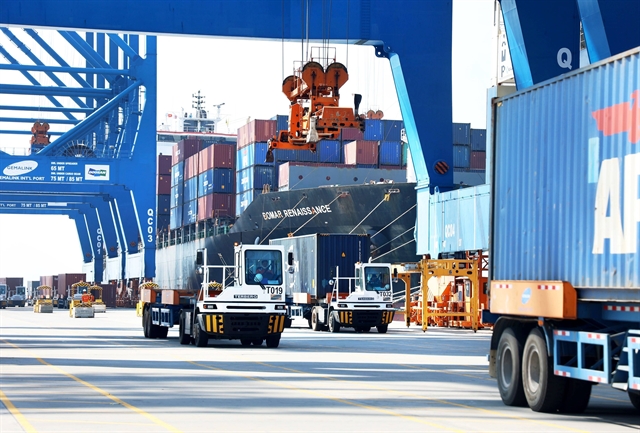
Export goods containers at Cái Mép - Thị Vải seaport complex.Việt Nam is largely dependent on international trade, with exports accounting for 90 per cent of the country’s GDP. —VNA/VNS Photo
HCM CITY — Việt Nam is likely to secure high annual growth of 8 per cent, or even double-digit rates after recording a 7 per cent expansion last year, according to Suan Teck Kin, executive director of Global Economics and Markets Research at Singapore-based United Overseas Bank (UOB).
The National Assembly (NA)’s recent decision to raise Việt Nam’s GDP growth target to at least 8 per cent in 2025 and double-digit rates in the 2026-2030 period shows a high level of consensus across the political system for the country's new development goals, despite many challenges facing the economy.
Suan Teck Kin said that achieving these targets will be a significant challenge. Among the risks, the US tariff policies could impact one of Việt Nam's key growth drivers, which is international trade.
He pointed out that Việt Nam is largely dependent on international trade, with exports accounting for 90 per cent of the country’s GDP, the second highest in ASEAN after Singapore with 174 per cent.
In addition, the US is Việt Nam’s largest export market, making up 30 per cent of its total export turnover. Therefore, if the US imposes tariffs on Vietnamese goods, the manufacturing and service sectors would be significantly affected.
Export demand may decline due to a slowdown in global economic activity, thus impacting GDP growth. The semiconductor cycle is also weakening, affecting the country’s high-tech exports. FDI inflows may slow down, as investors consider shifting to countries less likely to face US tariffs.
According to experts from UOB Bank, there are several sectors Việt Nam can focus on to increase the chances of achieving a high growth rate of 8 per cent in 2025 or even double digits in the next five years. However, the growth rate needs to remain stable to avoid overheating and resource waste.
Suan Teck Kin suggested that Việt Nam boost public investment to support growth and cushion declines in export and manufacturing activities.
He noted that the country faces a significant infrastructure gap, while capital formation expenditure accounts for only 30 per cent of GDP, much lower than China’s 41 per cent.
The Government is advised to increase public spending instead of being overly cautious about reducing the public debt-to-GDP ratio (currently 35 per cent, targeted to drop to 31 per cent by 2029).
Another solution, according to the economist, is to accelerate public investment disbursement.
He stated that it’s encouraging news that the National Assembly has recently approved a US$8-billion railway project connecting China and Việt Nam and fast-tracked the North-South Expressway expansion. However, he also highlighted the importance of investing in artificial intelligence (AI), data, energy and water resources to support sustainable long-term growth.
Tim Leelahaphan, senior economist for Việt Nam and Thailand at Standard Chartered, said that Việt Nam's economic growth will be driven by the continued expansion of business in 2025 and the following years, with foreign investment playing a crucial role in boosting growth.
The drivers of Việt Nam's economic growth include the positive growth of FDI, the strong development of retail sales and industrial production, sustainable export activities, and recovering tourism.
Meanwhile, HSBC experts suggest that accelerating the dual transition - green transition and digital transformation - will help Việt Nam simultaneously come closer to sustainable development and digitalisation goals, thus creating a strong growth impetus.
Moreover, focusing on infrastructure investment will be a key foundation for economic growth and attracting quality FDI into Việt Nam.
The Vietnamese government is demonstrating a high determination to promote public investment, focusing on numerous strategic infrastructure projects that connect economic centres. This will serve as an important launching pad for Việt Nam to enter a new era – the era of the nation’s rise, HSBC stated. — VNS
Source: VNS
Related News

BANKING / FINANCE / INSURANCE / TAX
REMITTANCES TO HCM CITY RISE NEARLY 40% IN Q3
Remittances to HCM City reached more than US$2.83 billion in the third quarter of this year, up 39.5 per cent from the previous quarter and 3.6 per cent year-on-year. This was the first quarter showing positive annual growth this year, helping narrow the decline in remittance inflows over the first nine months. According to the State Bank of Vietnam (SBV)’s Regional Branch 2, remittances transferred to HCM City through credit institutions and economic organisations totalled $2.835 billion in Q3, an increase of more than $802 million from the previous quarter.

TECHNOLOGY
TECH SECTOR GROWTH OPENS UP OPPORTUNITIES FOR VIỆT NAM TO GO GLOBAL
The growth of the electronics, semiconductor and high-tech sectors worldwide is opening up a variety of opportunities for Vietnamese enterprises to integrate more deeply into the global supply chain. However, to become suppliers for these corporations, domestic enterprises must meet rigorous standards regarding quality, technology, productivity and order fulfilment capabilities.

VIETNAM ECONOMY INVESTMENT
FOREIGN INVESTORS SEEKING A SYNCHRONISED MANUFACTURING ECOSYSTEM
Instead of focusing only on land costs and incentives as usual, foreign investors are seeking a synchronised manufacturing ecosystem, from stable power supply and logistics to shared infrastructure and the convenience of completing residence procedures for experts to serve their long-term investment in the country.

MEMBER CORNER / PROMOTIONS
SENTRYSAFE FHW40200 – PROTECT YOUR VALUABLES, ENJOY PEACE OF MIND!
Looking for a reliable solution to protect your important documents, cash, and valuables from fire and water damage? Genuine SENTRYSAFE - Reliable protection for your valuables and peace of mind! Contact Sen Wai Vietnam for more information and personalized product recommendations.

PROPERTY / INDUSTRIAL ZONE
HCM CITY ATTRACTS US$5.7 BILLION INTO EXPORT PROCESSING AND INDUSTRIAL ZONES
HCM City attracted US$5.7 billion in domestic and foreign investment into its export processing and industrial zones during the first nine months of 2026. The figure exceeded the city's full-year target by 31 per cent, highlighting strong momentum in high-quality industrial investment under Resolution No.10-NQ/TW. Total investment reached 131 per cent of the 2026 target of $4.25 billion and represented a 29 per cent increase compared with the same period in 2025, according to the city's Export Processing and Industrial Zones Authority (HEPZA).

INFRASTRUCTURE / CONSTRUCTION / LOGISTIC / PORT
DONG THAP PROVINCE STEPS UP INDUSTRIAL EXPANSION AND INFRASTRUCTURE CONNECTIVITY
Accelerating public investment, strengthening inter-regional connectivity, and expanding industrial land are helping Dong Thap efficiently bolster competitiveness and drive economic growth. Following the 2025 merger of the former Dong Thap and Tien Giang provinces, the expanded Dong Thap province in the Mekong Delta faces mounting pressure to accelerate infrastructure development and strengthen connectivity among local economic zones, urban areas, industrial parks (IPs), and production centres.
Events Sponsors






















