Want to be in the loop?
subscribe to
our notification
Business News
INDUSTRIAL RECOVERY POWERS ECONOMIC GROWTH
This growth significantly outpaces earlier forecasts and marks a sharp turnaround from the downturn in 2023, when global uncertainties, falling orders and rising input costs hampered industrial performance.
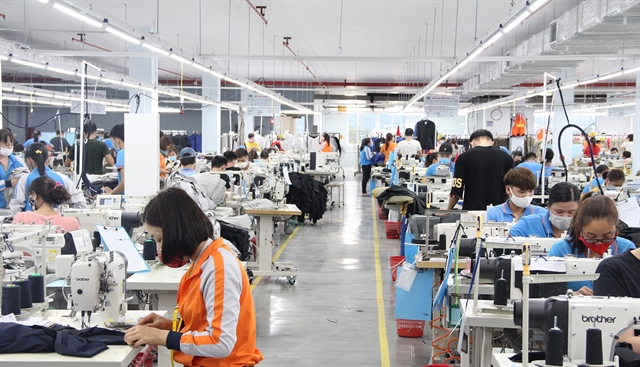
A garment company at an industrial park in Bắc Giang Province. — Photo baochinhphu.vn
HÀ NỘI — Việt Nam’s industrial sector has shown impressive signs of revival, driving growth in trade, consumption and exports to reinforce the foundations for sustainable economic development.
According to the Ministry of Industry and Trade’s report, Index of Industrial Production (IIP) in the second quarter increased by 8.8 per cent compared to the same period in 2024.
This growth significantly outpaces earlier forecasts and marks a sharp turnaround from the downturn in 2023, when global uncertainties, falling orders, and rising input costs hampered industrial performance.
This recovery has focused on the processing and manufacturing sector with a robust growth rate of 10.8 per cent. As a key contributor to the GDP and a major employer, this sector has not only delivered high value-added output but also drove export earnings.
“The recovery also reflects the tireless efforts of the business community and the Government's adaptive and determined economic management,” said Mai Thu Hiền, deputy director of the Department of Planning and Finance under the Ministry of Industry and Trade.
Several industrial sub-sectors have posted growth performances, including motor vehicle manufacturing (34.3 per cent), leather and related products (16.8 per cent), rubber and plastic products (16.1 per cent), garment production (15.7 per cent), transport equipment (14.1 per cent), and food processing (8.8 per cent)
Key products' output followed suit such as automobile (up by 70.3 per cent), television (25.6 per cent), leather footwear (11.5 per cent), and rolled steel (13.8 per cent).
This industrial boom has not been confined to traditional manufacturing hubs like HCM City, Bình Dương, or Bắc Ninh.
Other provinces have emerged as new industrial growth centres, including Phú Thọ (up 46.7 per cent), Nam Định (29.6 per cent), Bắc Giang (28.1 per cent), Bắc Kạn (23.6 per cent), and Hà Nam (22.5 per cent).
This geographic spread of growth helps reduce pressure on urban centres, while fostering inclusive economic development across the country.
Additionally, the industrial revival is closely tied to effective government policies. Stimulus packages, interest rate cuts, streamlined administrative procedures, and increased public investment have improved the business climate, enabling companies to overcome headwinds.
Efforts to ease credit access and enhance logistics infrastructure have reduced costs for businesses and boosted competitiveness. Meanwhile, many firms have accelerated their shift toward green, digital, and automated production models.
The adoption of technologies such as AI, automation, and smart supply chain systems has not only raised productivity but also reduced dependence on imported raw materials. It has also helped Vietnamese companies capitalise on new-generation free trade agreements (FTAs) like the European Union-Việt Nam FTA (EVFTA) and the Comprehensive and Progressive Agreement for Trans-Pacific Partnership (CPTPP).
In the first five months of 2025, total import-export turnover hit US$355.79 billion, a 15.7 per cent increase over the same period last year. Of which, exports of processed industrial goods alone accounted for nearly 85 per cent of this figure. Retail sales of goods and services also rose by 7.9 per cent, pointing to a sustained rebound in domestic demand.
These figures confirmed that market demand is recovering steadily, helping to create a new growth cycle between production, consumption and exports.
However, the industry still faces external risks. Deputy Minister of Industry and Trade Nguyễn Sinh Nhật Tân cautioned about potential disruptions from US trade policy shifts, EU technical and environmental standards and geopolitical instability, including tensions in Ukraine and the Middle East, which may affect global supply chains and input costs.
To tackle these challenges, the Government has been leveraging the advantages of FTAs and implementing a series of strategic resolutions - namely Resolutions 57, 59, 66, and 68 - focusing on industrial development, institutional reform, science and technology advancement, and strengthening the private sector.
The ministry is also collaborating with local authorities to develop eco-industrial parks and encouraging investment in renewable energy and clean technologies.
“Eco-industrial parks will help businesses meet international standards and create long-term added value,” said Tân. “This will enhance the global competitiveness of Việt Nam's industry sector.”
With current momentum, Việt Nam’s ambitious target of 8 per cent GDP growth in 2025 appears within reach. — VNS
Source: VNS
Related News

BANKING / FINANCE / INSURANCE / TAX
REMITTANCES TO HCM CITY RISE NEARLY 40% IN Q3
Remittances to HCM City reached more than US$2.83 billion in the third quarter of this year, up 39.5 per cent from the previous quarter and 3.6 per cent year-on-year. This was the first quarter showing positive annual growth this year, helping narrow the decline in remittance inflows over the first nine months. According to the State Bank of Vietnam (SBV)’s Regional Branch 2, remittances transferred to HCM City through credit institutions and economic organisations totalled $2.835 billion in Q3, an increase of more than $802 million from the previous quarter.

TECHNOLOGY
TECH SECTOR GROWTH OPENS UP OPPORTUNITIES FOR VIỆT NAM TO GO GLOBAL
The growth of the electronics, semiconductor and high-tech sectors worldwide is opening up a variety of opportunities for Vietnamese enterprises to integrate more deeply into the global supply chain. However, to become suppliers for these corporations, domestic enterprises must meet rigorous standards regarding quality, technology, productivity and order fulfilment capabilities.

VIETNAM ECONOMY INVESTMENT
FOREIGN INVESTORS SEEKING A SYNCHRONISED MANUFACTURING ECOSYSTEM
Instead of focusing only on land costs and incentives as usual, foreign investors are seeking a synchronised manufacturing ecosystem, from stable power supply and logistics to shared infrastructure and the convenience of completing residence procedures for experts to serve their long-term investment in the country.
MEMBER CORNER / PROMOTIONS
SENTRYSAFE FHW40200 – PROTECT YOUR VALUABLES, ENJOY PEACE OF MIND!
Looking for a reliable solution to protect your important documents, cash, and valuables from fire and water damage? Genuine SENTRYSAFE - Reliable protection for your valuables and peace of mind! Contact Sen Wai Vietnam for more information and personalized product recommendations.

PROPERTY / INDUSTRIAL ZONE
HCM CITY ATTRACTS US$5.7 BILLION INTO EXPORT PROCESSING AND INDUSTRIAL ZONES
HCM City attracted US$5.7 billion in domestic and foreign investment into its export processing and industrial zones during the first nine months of 2026. The figure exceeded the city's full-year target by 31 per cent, highlighting strong momentum in high-quality industrial investment under Resolution No.10-NQ/TW. Total investment reached 131 per cent of the 2026 target of $4.25 billion and represented a 29 per cent increase compared with the same period in 2025, according to the city's Export Processing and Industrial Zones Authority (HEPZA).

INFRASTRUCTURE / CONSTRUCTION / LOGISTIC / PORT
DONG THAP PROVINCE STEPS UP INDUSTRIAL EXPANSION AND INFRASTRUCTURE CONNECTIVITY
Accelerating public investment, strengthening inter-regional connectivity, and expanding industrial land are helping Dong Thap efficiently bolster competitiveness and drive economic growth. Following the 2025 merger of the former Dong Thap and Tien Giang provinces, the expanded Dong Thap province in the Mekong Delta faces mounting pressure to accelerate infrastructure development and strengthen connectivity among local economic zones, urban areas, industrial parks (IPs), and production centres.
Events Sponsors






















