Want to be in the loop?
subscribe to
our notification
Business News
INDUSTRIAL PROPERTY MARKET DRAWS FRESH WAVE OF FOREIGN INVESTMENT
Việt Nam’s industrial property market is heating up as foreign investors pour billions of dollars into factories, warehouses and ready-built facilities, driven by accelerating supply chain shifts and a new surge of global capital.
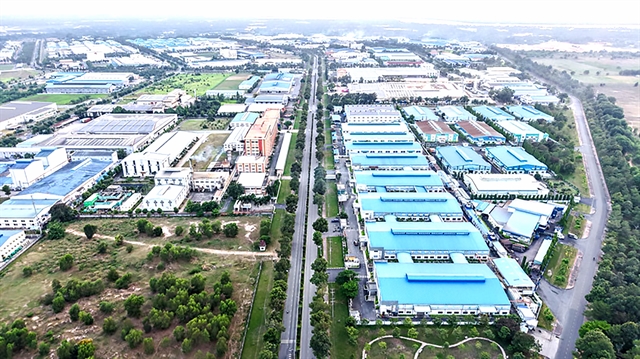
An industrial park in Đồng Nai Province in southern Việt Nam. The province hosts 31 operational parks as foreign investors ramp up spending on factories, warehouses and ready-built facilities. — VNA/VNS Photo
HCM CITY — Việt Nam’s industrial property market is heating up as foreign investors pour billions of dollars into factories, warehouses and ready-built facilities, driven by accelerating supply chain shifts and a new surge of global capital.
Foreign direct investment (FDI) into Việt Nam hit US$26.1 billion in the first eight months, up more than 27 per cent from a year earlier, according to the General Statistics Office.
Manufacturing dominated the inflows, attracting nearly $12 billion, with many companies opting for ready-built factories to slash costs and shorten production timelines.
In HCM City, Avery Dennison Worldon Vietnam, a venture between US labeling giant Avery Dennison and China’s Shenzhou Group, inaugurated a $4.7 million plant in June, its third in Việt Nam.
Đà Nẵng has also emerged as a magnet, signing agreements with Amata Vietnam, Green i-Park, GuogGuoguang Electric and European Plastic to explore projects in its free-trade zones.
GuogGuoguang Electric, a Chinese electronics supplier, is set to break ground on a component plant in Liên Chiểu before year-end.
Dutch developer CTP is committing 1 billion euros ($1.1 billion) to new industrial zones across Hưng Yên, Gia Lai and other provinces, underscoring confidence in Việt Nam’s role as a regional hub.
Race for ready-built space
The supply of ready-built factories has ballooned to 11 million square metres nationwide, with occupancy topping 85 per cent, Cushman & Wakefield estimates.
Hubs such as HCM City, Đồng Nai, Bắc Ninh and Hải Phòng are leading the charge.
Rents run $4-6 per square metre in the North and $5-7 in the South – attractive compared with building plants from scratch, which can cost $3-6 million upfront.
“Speed and flexibility are decisive in global supply chains,” said Trang Bùi, general director of Cushman & Wakefield Vietnam. “Ready-built factories allow firms to ramp up production immediately without being tied to long-term assets.”
Infrastructure momentum
The Government is pushing ahead with big-ticket infrastructure, including new bridges in Hà Nội, the proposed Gia Bình International Airport in Bắc Ninh, and a high-speed rail line linking Lào Cai, Hà Nội, Hải Phòng and Quảng Ninh.
Administrative reforms are also cutting red tape. “These changes are making Việt Nam a priority destination for global manufacturers and logistics groups,” said Michael Piro, CEO of Indochina Capital.
His firm’s joint venture, Indochina Kajima, has launched six Core5 ready-built factory projects across Quảng Ninh, Hưng Yên and Hải Phòng in just three years.
The influx of foreign capital is driving up industrial land rents. CBRE reports average rates in Hà Nội, Bắc Ninh and Hưng Yên rose nearly 4 per cent year-on-year to $139 per square metre.
In the South, Cushman & Wakefield pegged average rents at $179.
Investors are also demanding greener, higher-standard facilities. Core5’s LEED- and ESG-certified projects in Quảng Ninh and Hưng Yên achieved near-full occupancy within months. Japanese investor Hulic has joined forces with Core5 to expand further.
Trade shifts
The wave comes as Việt Nam cements its position in the “China+1” strategy.
A new US tariff regime on Asian exports that took effect in August imposed duties of 20 per cent – lower than initially feared – boosting confidence in Việt Nam as an alternative base.
Tech and consumer giants including Samsung, Intel, LG, Foxconn, Amkor, NVIDIA, Toyota, Unilever and Procter & Gamble are already entrenched in the country.
Contract manufacturers for Nike, Adidas and Puma have also scaled up operations, creating tens of thousands of jobs and deepening supporting industries from packaging to precision engineering.
“Việt Nam is steadily consolidating its position as a global industrial hub,” said Matthew Powell, director at Savills Hanoi. “Strategic location, competitive costs and modern facilities are proving irresistible for foreign investors.” — VNS
Source: VNS
Related News

MEMBER CORNER / PROMOTIONS
AN ELECTRIFYING NIGHT WITH THE "QUEEN OF DANCE" THU MINH AT THE GRAND HO TRAM!
The stage at The Grand Ballroom is set to catch fire as Vietnam’s undisputed "Queen of Dance," Thu Minh, takes the spotlight. Renowned for her powerhouse vocals, magnetic stage presence, and sultry, high-energy performances, Thu Minh promises an evening of pure musical euphoria. The energy escalates with an exclusive appearance by special guest and The Voice champion, Vu Thao My.
HR / LABOUR/ EMPLOYMENT
HIGH-QUALITY HUMAN RESOURCES NEEDED TO ATTRACT NEW TECH INVESTMENT CAPITAL
Besides infrastructure, Việt Nam must also rapidly develop a highly skilled workforce to attract investment in AI, semiconductors and advanced manufacturing, experts have said. Don Lam, CEO and co-founder of investment management company VinaCapital, said that global technology investors were increasingly looking at the readiness of the entire ecosystem, with high-quality human resources a decisive factor.

HR / LABOUR/ EMPLOYMENT
HIRING OUTLOOK STRENGTHENS IN Q4 AS SKILLS SHORTAGES PERSIST
Hiring intentions among employers in Việt Nam strengthened in the fourth quarter, with 52 per cent of surveyed companies planning to increase headcount between October and December, according to a ManpowerGroup survey released this week. Việt Nam's hiring outlook was stronger than the Asia Pacific and Middle East (APME) regional average of 33 per cent and the global average of 29 per cent, ranking third in the region and 11th globally among 42 markets surveyed.

BANKING / FINANCE / INSURANCE / TAX
LARGE BANKS FORECAST TO GAIN HIGHER PROFITABILITY IN H2 2026
The return on average assets (ROAA) of the banking sector will likely remain stable at around 1.5 per cent in the second half of 2026, but profitability divergence among banks will increase, with large banks outperforming peers on stronger margins and diversified earnings, analysts forecast. In a recent report on the banking sector, analysts from the Vietnam Investors Service Rating said the sector’s ROAA rose by 10 basis points quarter-on-quarter to 1.51 per cent in the first half of this year, driven by net interest margin (NIM) improvements at some State-owned banks and large private banks.
GARMENT / TEXTILE
VIỆT NAM'S FOOTWEAR, BAG EXPORTS TO US TOP $8 BILLION IN EIGHT MONTHS
Việt Nam's exports of footwear and handbags to the US exceeded US$8 billion in the first eight months of 2026, as the US and EU remained the country's biggest markets despite sluggish growth in footwear shipments. Exports from Việt Nam's leather and footwear sector reached more than $2.45 billion in August, down 9 per cent from July but up 3 per cent from a year earlier, according to preliminary statistics.
VIETNAM ECONOMY INVESTMENT
LÂM ĐỒNG TARGETS DIGITAL ECONOMY TO ACCOUNT FOR 30 PER CENT OF GRDP BY 2030
Lâm Đồng Province aims to raise the digital economy’s contribution to around 30 per cent of its gross regional domestic product (GRDP) by 2030, as part of a five-year plan to develop digital economy and society issued recently. Under Plan No. 15358/KH-UBND, the province targets more than 60 per cent of small- and medium-sized enterprises (SMEs) to adopt digital technologies by 2030 while increasing the value of cashless payments to 30 times its GRDP.
Events Sponsors






















