Want to be in the loop?
subscribe to
our notification
Business News
GLOBAL MINIMUM TAX A HEAD-SCRATCHER FOR VIETNAMESE POLICYMAKERS
As many countries plan to adopt the Global Minimum Tax Rate (GMTR) in 2024, experts are concerned that the entry into force of the rate would discourage foreign companies from locating their operations in low-tax countries.
Under GMTR rules, corporations with more than €750 million in annual revenue would be subject to an effective tax rate of at least 15 per cent, not including deductions for depreciation and certain tax credits. The introduction of GMTR is aimed to increase compliance costs and create a level playing field between developed and developing countries.
The European Union has unanimously agreed to implement the rate on January 1, 2024. Japan followed suit with the enactment date being April 1, 2024. Other countries are preparing their legislation for the adoption of GMTR in the short term, including Indonesia, Malaysia, and the Republic of Korea (RoK).
Experts worry that the introduction of GMTR in other countries would cancel out the tax incentives that Việt Nam has laid down for years and result in tax revenues being effectively exported to those countries.
Take RoK companies operating in Việt Nam for example. These companies are subject to a preferential tax rate of 7 per cent. Once GMTR comes into force in RoK, the companies would have to pay an additional rate of 8 per cent to RoK tax authorities, which is the difference between the Vietnamese rate and GMTR.
Đặng Ngọc Minh, deputy director of the General Department of Taxation, estimated that 1,015 FDI companies operating in Việt Nam would be unfavourably affected by the broad-based tax rules.
He said global corporate heavyweights in the country are enjoying tax rates of between 2.75 per cent to 5.95 per cent, far lower than the GMTR of 15 per cent. As such, the implementation of GMTR abroad would cost Việt Nam a couple of billions of dollars in tax loss every year.
Thomas McClelland, country tax leader at the Deloitte Vietnam Company Ltd, urged Việt Nam to act quickly and decisively to adopt GMTR. Otherwise, the country would lose out to others on the differential tax revenues.
Some other experts share this view, saying that Việt Nam must be quick to bring GMTR into force to boost its tax revenues from FDI companies. But they also warn that the bandwagon would pose some new challenges for policymakers, who would have to find non-tax ways to attract FDI.
Cấn Văn Lực, chief economist at the BIDV, believed that the implementation of GMRT would put developing countries at a competitive disadvantage, especially those using fiscal incentives as a magnet for FDI.
He urged Việt Nam to improve its business environment and investment climate to make up for the tax incentives that would diminish in the next few years.
"A sound business environment and investment climate are more beneficial to investors than the financial incentives offered in the form of tax cuts," said Lực.
It is also worth noting that GMRT can only be officially put in place next year under the circumstance that the Government proposes amendments to Corporate Law, Investment Law, and Tax Law to the National Assembly before October 2023.
Source: VNS
Related News

MEMBER CORNER / PROMOTIONS
AN ELECTRIFYING NIGHT WITH THE "QUEEN OF DANCE" THU MINH AT THE GRAND HO TRAM!
The stage at The Grand Ballroom is set to catch fire as Vietnam’s undisputed "Queen of Dance," Thu Minh, takes the spotlight. Renowned for her powerhouse vocals, magnetic stage presence, and sultry, high-energy performances, Thu Minh promises an evening of pure musical euphoria. The energy escalates with an exclusive appearance by special guest and The Voice champion, Vu Thao My.

HR / LABOUR/ EMPLOYMENT
HIGH-QUALITY HUMAN RESOURCES NEEDED TO ATTRACT NEW TECH INVESTMENT CAPITAL
Besides infrastructure, Việt Nam must also rapidly develop a highly skilled workforce to attract investment in AI, semiconductors and advanced manufacturing, experts have said. Don Lam, CEO and co-founder of investment management company VinaCapital, said that global technology investors were increasingly looking at the readiness of the entire ecosystem, with high-quality human resources a decisive factor.

HR / LABOUR/ EMPLOYMENT
HIRING OUTLOOK STRENGTHENS IN Q4 AS SKILLS SHORTAGES PERSIST
Hiring intentions among employers in Việt Nam strengthened in the fourth quarter, with 52 per cent of surveyed companies planning to increase headcount between October and December, according to a ManpowerGroup survey released this week. Việt Nam's hiring outlook was stronger than the Asia Pacific and Middle East (APME) regional average of 33 per cent and the global average of 29 per cent, ranking third in the region and 11th globally among 42 markets surveyed.

BANKING / FINANCE / INSURANCE / TAX
LARGE BANKS FORECAST TO GAIN HIGHER PROFITABILITY IN H2 2026
The return on average assets (ROAA) of the banking sector will likely remain stable at around 1.5 per cent in the second half of 2026, but profitability divergence among banks will increase, with large banks outperforming peers on stronger margins and diversified earnings, analysts forecast. In a recent report on the banking sector, analysts from the Vietnam Investors Service Rating said the sector’s ROAA rose by 10 basis points quarter-on-quarter to 1.51 per cent in the first half of this year, driven by net interest margin (NIM) improvements at some State-owned banks and large private banks.
GARMENT / TEXTILE
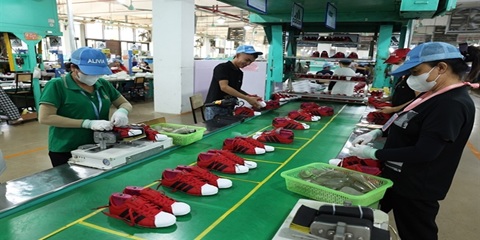
VIỆT NAM'S FOOTWEAR, BAG EXPORTS TO US TOP $8 BILLION IN EIGHT MONTHS
Việt Nam's exports of footwear and handbags to the US exceeded US$8 billion in the first eight months of 2026, as the US and EU remained the country's biggest markets despite sluggish growth in footwear shipments. Exports from Việt Nam's leather and footwear sector reached more than $2.45 billion in August, down 9 per cent from July but up 3 per cent from a year earlier, according to preliminary statistics.

VIETNAM ECONOMY INVESTMENT
LÂM ĐỒNG TARGETS DIGITAL ECONOMY TO ACCOUNT FOR 30 PER CENT OF GRDP BY 2030
Lâm Đồng Province aims to raise the digital economy’s contribution to around 30 per cent of its gross regional domestic product (GRDP) by 2030, as part of a five-year plan to develop digital economy and society issued recently. Under Plan No. 15358/KH-UBND, the province targets more than 60 per cent of small- and medium-sized enterprises (SMEs) to adopt digital technologies by 2030 while increasing the value of cashless payments to 30 times its GRDP.
Events Sponsors






















