Want to be in the loop?
subscribe to
our notification
Business News
GLOBAL INVESTORS WELCOME RESOLUTION 10 FOCUS ON HIGH-QUALITY FDI
International investors welcomed Resolution No.10-NQ/TW on developing the foreign-invested economic sector, highlighting a shift to quality foreign direct investment and the importance of reforms, capital markets, and stronger domestic suppliers.
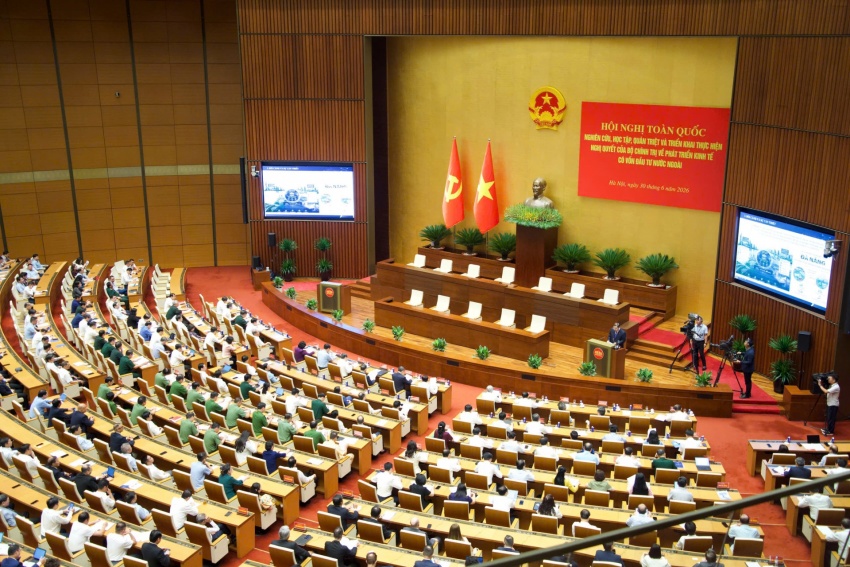
Delegates attend the national conference on studying, disseminating, and implementing Resolution No.10-NQ/TW on developing the foreign-invested economic sector. Photo: VGP
A national conference was held in Hanoi on June 30 to disseminate and implement Resolution 10, which brought together government leaders, local authorities, and representatives of international businesses and investment funds.
Drawing on Japan's experience, Takuya Sahashi, vice chairman of Mitsubishi Corporation Vietnam, said Resolution 10, together with Resolution 68 on private sector development, would serve as the "two wheels" driving Vietnam's next phase of economic growth.
He welcomed the resolution's emphasis on attracting high-quality foreign direct investment (FDI) while strengthening linkages between foreign-invested and domestic enterprises, stressing that Vietnam's long-term development should not rely solely on foreign capital.
"Vietnam's economic development should not depend only on attracting foreign investment, but also on enabling Vietnamese enterprises to participate more deeply in global value chains," Sahashi said. "Through this process, advanced technologies, modern management practices, and international standards will gradually spread to domestic businesses, creating stronger spillover effects and reinforcing the country's industrial base."
To help realise the resolution's objectives, Sahashi called for a national programme to nurture domestic suppliers with strong growth potential, arguing that helping foreign-invested enterprises identify capable local partners is critical to expanding supply chains.
He also proposed improving supplier databases, expanding business-matching platforms and trade exhibitions, simplifying support programmes for SMEs, strengthening upstream industries, and encouraging closer collaboration between educational institutions and businesses to develop a highly skilled workforce. He added that tax incentives for corporate investment in vocational training and education should also be considered.
Citing a recent survey by a Japanese government agency, Sahashi noted that 57 per cent of Japanese companies operating in Vietnam plan to expand their businesses, the highest proportion among ASEAN countries.
"This demonstrates Japanese companies' confidence in Vietnam's long-term investment prospects," he said.
Representatives of international investment funds also welcomed Resolution 10, describing it as a strong signal of Vietnam's commitment to improving FDI quality and developing the capital market as a strategic channel for mobilising international resources.
Dominic Scriven, chairman of Dragon Capital, described Resolution 10 as "a very important resolution for foreign investors" because it clearly recognises the foreign-invested sector as "an inseparable part of Vietnam's economy," reinforcing the principle of equal treatment for all investors.
He also welcomed the resolution's shift from attracting capital by volume to prioritising investment quality, saying, "It is no longer just about capital, but about technology, management expertise, international standards, and sustainable development."
Scriven added that the resolution's commitment not to sacrifice the environment, natural resources, or social welfare for investment would strengthen Vietnam's long-term competitiveness.
Scriven said he was particularly encouraged that the resolution identifies the capital market as an important component of the foreign-invested economy. However, he warned that high financing costs remain a major constraint.
"The gap in the cost of capital between the public and private sectors is still too wide," he said, noting that while the State Treasury can issue long-term bonds at around 4 per cent annually, many businesses still pay 10-12 per cent on three-year corporate bonds.
Dragon Capital therefore proposed incentives for foreign-invested enterprises to retain profits for reinvestment in Vietnam, faster progress towards emerging market status, completion of the central counterparty framework, improvements to foreign exchange mechanisms, a review of foreign ownership limits where appropriate, and more flexible listing requirements for innovative technology and AI companies with accumulated losses.
Meanwhile, Michael Kokalari, chief economist at VinaCapital, said Vietnam was becoming "an increasingly attractive destination for international investors" and argued that the country should maintain momentum in developing large-scale infrastructure projects.
"These projects require substantial long-term capital, and this is an area where VinaCapital and international investors can partner with Vietnam," he said.
Kokalari added that Resolution No10 would further strengthen the economy by encouraging closer linkages between foreign-invested enterprises and domestic suppliers, enhancing Vietnam's competitiveness and attractiveness to global investors.
Source: VIR
Related News

BANKING / FINANCE / INSURANCE / TAX
REMITTANCES TO HCM CITY RISE NEARLY 40% IN Q3
Remittances to HCM City reached more than US$2.83 billion in the third quarter of this year, up 39.5 per cent from the previous quarter and 3.6 per cent year-on-year. This was the first quarter showing positive annual growth this year, helping narrow the decline in remittance inflows over the first nine months. According to the State Bank of Vietnam (SBV)’s Regional Branch 2, remittances transferred to HCM City through credit institutions and economic organisations totalled $2.835 billion in Q3, an increase of more than $802 million from the previous quarter.

TECHNOLOGY
TECH SECTOR GROWTH OPENS UP OPPORTUNITIES FOR VIỆT NAM TO GO GLOBAL
The growth of the electronics, semiconductor and high-tech sectors worldwide is opening up a variety of opportunities for Vietnamese enterprises to integrate more deeply into the global supply chain. However, to become suppliers for these corporations, domestic enterprises must meet rigorous standards regarding quality, technology, productivity and order fulfilment capabilities.

VIETNAM ECONOMY INVESTMENT
FOREIGN INVESTORS SEEKING A SYNCHRONISED MANUFACTURING ECOSYSTEM
Instead of focusing only on land costs and incentives as usual, foreign investors are seeking a synchronised manufacturing ecosystem, from stable power supply and logistics to shared infrastructure and the convenience of completing residence procedures for experts to serve their long-term investment in the country.
MEMBER CORNER / PROMOTIONS
SENTRYSAFE FHW40200 – PROTECT YOUR VALUABLES, ENJOY PEACE OF MIND!
Looking for a reliable solution to protect your important documents, cash, and valuables from fire and water damage? Genuine SENTRYSAFE - Reliable protection for your valuables and peace of mind! Contact Sen Wai Vietnam for more information and personalized product recommendations.

PROPERTY / INDUSTRIAL ZONE
HCM CITY ATTRACTS US$5.7 BILLION INTO EXPORT PROCESSING AND INDUSTRIAL ZONES
HCM City attracted US$5.7 billion in domestic and foreign investment into its export processing and industrial zones during the first nine months of 2026. The figure exceeded the city's full-year target by 31 per cent, highlighting strong momentum in high-quality industrial investment under Resolution No.10-NQ/TW. Total investment reached 131 per cent of the 2026 target of $4.25 billion and represented a 29 per cent increase compared with the same period in 2025, according to the city's Export Processing and Industrial Zones Authority (HEPZA).

INFRASTRUCTURE / CONSTRUCTION / LOGISTIC / PORT
DONG THAP PROVINCE STEPS UP INDUSTRIAL EXPANSION AND INFRASTRUCTURE CONNECTIVITY
Accelerating public investment, strengthening inter-regional connectivity, and expanding industrial land are helping Dong Thap efficiently bolster competitiveness and drive economic growth. Following the 2025 merger of the former Dong Thap and Tien Giang provinces, the expanded Dong Thap province in the Mekong Delta faces mounting pressure to accelerate infrastructure development and strengthen connectivity among local economic zones, urban areas, industrial parks (IPs), and production centres.
Events Sponsors






















