Want to be in the loop?
subscribe to
our notification
Business News
AGRICULTURAL, FORESTRY AND FISHERY EXPORTS ACCELERATED TO REACH $65 BILLION TARGET
This year will continue to be a year of significant fluctuations, with a complex global political and economic context.
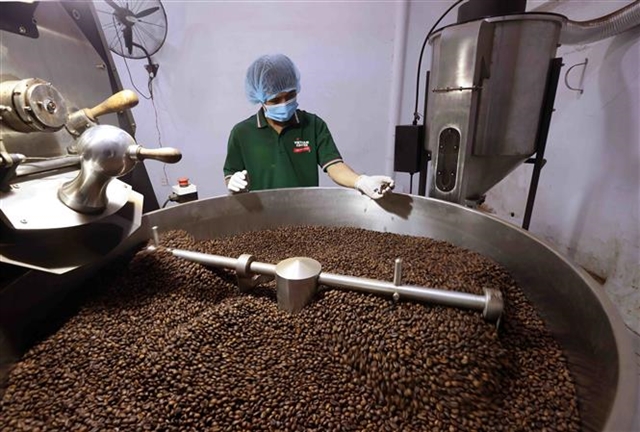
Processing coffee at the Vietnam National Coffee Corporation's factory in Tân Uyên City, Bình Dương Province. — VNA/VNS Photo Vũ Sinh
HÀ NỘI — Việt Nam’s total agro-forestry-fishery trade is estimated at US$57 billion in the first half of this year, with exports reaching $33.5 billion, up 14.3 per cent year-on-year, according to the Ministry of Agriculture and Environment (MAE).
Meanwhile, imports rose 12.8 per cent to $23.5 billion.
This year will continue to be a year of significant fluctuations, with a complex global political and economic context.
Notably, the adjustment of the US tariff policies at the beginning of the year has had a considerable impact on agricultural, forestry and fishery exports.
To achieve this year’s target of $65 billion, the industry will accelerate significantly in the second half of the year.
The ministry has developed scenarios and set specific targets for the remaining quarters of this year.
It targets achieving between $14 billion and $15 billion in Q3, and accelerating exports in Q4 by leveraging the rising demand for agricultural products during the end-of-year holidays, aiming for a strong growth target of $16 billion or more.
Products such as coffee, tea, pepper, cashews, rubber and livestock products are expected to maintain their export momentum and make a significant contribution to the $65 billion target.
The coffee industry recorded a breakthrough performance in the first half of the year, with an estimated export value of $5.5 billion, equivalent to the whole year’s target.
Although Việt Nam's coffee production mainly concentrates on the harvest season from December to April the following year, limiting supply in the second half of the year, the sector is still on track to reach $7.5 billion by year-end, marking a 36.9 per cent increase compared to last year.
To achieve this goal, coffee exporters will continue to explore new trade opportunities, especially with the EU seeking to strengthen co-operation in Asia and the Middle East.
Additionally, efforts are being made to boost exports to major robusta coffee-consuming markets such as China, Japan, South Korea, the Philippines and Thailand.
In the long term, Northeast Asia is considered a key market that could compensate for any decline if market share in the US is affected, according to the MAE's analysis.
The cashew industry has set an export target of $4.5 billion for the year, a slight increase of 2.7 per cent compared to last year.
To achieve this goal, in addition to maintaining major markets such as the US and China, the sector needs to ramp up trade promotion and adjust its export strategy toward markets with high demand but currently low market share, such as the Middle East, particularly the UAE and Saudi Arabia.
The EU market is currently the third-largest export market for Vietnamese cashews and is experiencing strong growth.
However, accessing this market is not straightforward due to strict regulations requiring products to be sustainably produced, free from pesticide residues, and not contributing to deforestation during cultivation. Businesses must focus on improving production processes to ensure compliance with international standards.
According to the MAE, rubber is one of the key sectors with an export target of approximately $3.3 billion, a slight decrease of 4.6 per cent compared to the previous year.
Amid difficulties in traditional markets, the sector needs to intensify efforts to tap into places such as India, Russia, Turkey, Indonesia and South Korea, regions with rapidly increasing demand but still holding a small share in export turnover.
The industry will boost exports to markets with free trade agreements (FTAs) with Việt Nam, such as Brazil, Japan, Germany and Malaysia, countries that have shown strong import trends in recent years.
In particular, improvements in processing and quality are needed to expand exports to mid- and high-end segments, serving industries like fashion and interior design in the EU.
The MAE will assist businesses in building their brands and achieving international certifications such as FSC, which are key factors in increasing export value.
Livestock products are currently seen as a sector with significant room for development, especially as many markets have officially reopened.
Some products have already entered high-demand markets, such as processed chicken meat in Japan and Hong Kong (China), frozen suckling pig meat and whole frozen pigs in Hong Kong and eggs and egg products exported to Singapore, Japan, Hong Kong and Taiwan (China).
To expand market share, the MAE will proactively seek out more accessible markets that can immediately meet the technical regulations and requirements for exports.
Additionally, efforts will continue to negotiate the opening of key markets such as China, Malaysia and Singapore for Việt Nam's strength products, including poultry meat, eggs and pork. — VNS
Source: VNS
Related News

BANKING / FINANCE / INSURANCE / TAX
REMITTANCES TO HCM CITY RISE NEARLY 40% IN Q3
Remittances to HCM City reached more than US$2.83 billion in the third quarter of this year, up 39.5 per cent from the previous quarter and 3.6 per cent year-on-year. This was the first quarter showing positive annual growth this year, helping narrow the decline in remittance inflows over the first nine months. According to the State Bank of Vietnam (SBV)’s Regional Branch 2, remittances transferred to HCM City through credit institutions and economic organisations totalled $2.835 billion in Q3, an increase of more than $802 million from the previous quarter.

TECHNOLOGY
TECH SECTOR GROWTH OPENS UP OPPORTUNITIES FOR VIỆT NAM TO GO GLOBAL
The growth of the electronics, semiconductor and high-tech sectors worldwide is opening up a variety of opportunities for Vietnamese enterprises to integrate more deeply into the global supply chain. However, to become suppliers for these corporations, domestic enterprises must meet rigorous standards regarding quality, technology, productivity and order fulfilment capabilities.

VIETNAM ECONOMY INVESTMENT
FOREIGN INVESTORS SEEKING A SYNCHRONISED MANUFACTURING ECOSYSTEM
Instead of focusing only on land costs and incentives as usual, foreign investors are seeking a synchronised manufacturing ecosystem, from stable power supply and logistics to shared infrastructure and the convenience of completing residence procedures for experts to serve their long-term investment in the country.

MEMBER CORNER / PROMOTIONS
SENTRYSAFE FHW40200 – PROTECT YOUR VALUABLES, ENJOY PEACE OF MIND!
Looking for a reliable solution to protect your important documents, cash, and valuables from fire and water damage? Genuine SENTRYSAFE - Reliable protection for your valuables and peace of mind! Contact Sen Wai Vietnam for more information and personalized product recommendations.

PROPERTY / INDUSTRIAL ZONE
HCM CITY ATTRACTS US$5.7 BILLION INTO EXPORT PROCESSING AND INDUSTRIAL ZONES
HCM City attracted US$5.7 billion in domestic and foreign investment into its export processing and industrial zones during the first nine months of 2026. The figure exceeded the city's full-year target by 31 per cent, highlighting strong momentum in high-quality industrial investment under Resolution No.10-NQ/TW. Total investment reached 131 per cent of the 2026 target of $4.25 billion and represented a 29 per cent increase compared with the same period in 2025, according to the city's Export Processing and Industrial Zones Authority (HEPZA).

INFRASTRUCTURE / CONSTRUCTION / LOGISTIC / PORT
DONG THAP PROVINCE STEPS UP INDUSTRIAL EXPANSION AND INFRASTRUCTURE CONNECTIVITY
Accelerating public investment, strengthening inter-regional connectivity, and expanding industrial land are helping Dong Thap efficiently bolster competitiveness and drive economic growth. Following the 2025 merger of the former Dong Thap and Tien Giang provinces, the expanded Dong Thap province in the Mekong Delta faces mounting pressure to accelerate infrastructure development and strengthen connectivity among local economic zones, urban areas, industrial parks (IPs), and production centres.
Events Sponsors






















