Want to be in the loop?
subscribe to
our notification
Business News
VN STEPS UP BORDER CLEARANCE FOR AGRICULTURAL PRODUCT EXPORTS
With key agricultural products such as lychee, durian, mango, longan and dragon fruit entering the peak harvest season, Vietnamese authorities are stepping up efforts to streamline customs clearance at border gates to prevent congestion and market oversupply.
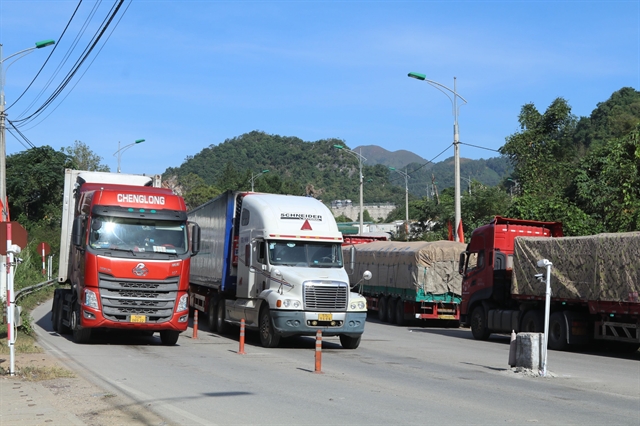
Container tructs at Tân Thanh Border Gate, Lạng Sơn Province. Vietnamese authorities are stepping up efforts to streamline customs clearance at border gates to prevent congestion and market oversupply. — VNA/VNS Photo Quang Duy
HÀ NỘI — With key agricultural products such as lychee, durian, mango, longan and dragon fruit entering the peak harvest season, Vietnamese authorities are stepping up efforts to streamline customs clearance at border gates to prevent congestion and market oversupply.
In a recent directive, Prime Minister Phạm Minh Chính urged the Ministry of Finance to instruct the customs force to prioritise the swift clearance of fresh farm produce for export.
Designating channels for agricultural products
According to Vi Công Tường, deputy head of the Customs Sub-department for Region VI (covering Lạng Sơn and Cao Bằng provinces), import-export activities at Lạng Sơn’s border gates has surged in 2025, with over 214,000 vehicles processed as of June 4, a 23 per cent increase year-on-year. Total trade value through the province has reached nearly US$33.1 billion, with agricultural goods accounting for a significant portion.
Tân Thanh border gate in Lạng Sơn, the province’s largest agricultural trade hub, is currently processing more than 500 tonnes of durian daily, along with other fruits such as jackfruit and mango, all cleared for export on the same day. To cope with rising lychee exports — currently three to five trucks per day and expected to increase — Tân Thanh has designated a dedicated lane and expanded receiving areas to handle up to 200 lychee trucks per day. Customs procedures are completed within just 10 minutes.
At Kim Thành International Border Gate No. II in Lào Cai province, authorities have also implemented special lanes and inspection points to expedite lychee exports to China.
The Ministry of Agriculture and Environment reported that Việt Nam’s 2025 lychee output is expected to reach 303,000 tonnes, up 30 per cent from 2024. While the fruit is exported to over 20 countries, China remains the dominant market, accounting for 90 per cent of total exports. Rapid, efficient customs clearance is essential to preserving product quality.
Deputy Minister of Agriculture and Environment Phùng Đức Tiến recently met with leaders of China’s General Administration of Customs, agreeing to increase inspection capacity and extend working hours at border posts to minimise delays during peak harvest periods.
For lychee exports specifically, the Ministry’s Plant Production and Protection Department has assigned staff to be on standby around the clock at border gates and testing facilities to accelerate phytosanitary procedures.
Lạng Son’s provincial leaders have reiterated their commitment to facilitating smooth customs procedures, especially for fresh fruit exports.
Meeting import market regulations and standards
Deputy Director of the Đồng Đăng – Lạng Sơn Border Gate Economic Zone Management Board Hoàng Khánh Duy noted ongoing coordination with China’s Guangxi authorities to enhance cross-border trade.
However, authorities have also advised businesses to shift towards official export channels, ensure contract-based transactions, and meet strict Chinese requirements on product quality, traceability, planting area codes, and packaging standards.
Mai Xuân Thìn, CEO of Red Dragon Co Ltd, emphasised that meeting China’s increasingly strict food safety and residue standards will boost consumer trust and strengthen Vietnamese products' position in the Chinese market. — VNS
Source: VNS
Related News

BANKING / FINANCE / INSURANCE / TAX
REMITTANCES TO HCM CITY RISE NEARLY 40% IN Q3
Remittances to HCM City reached more than US$2.83 billion in the third quarter of this year, up 39.5 per cent from the previous quarter and 3.6 per cent year-on-year. This was the first quarter showing positive annual growth this year, helping narrow the decline in remittance inflows over the first nine months. According to the State Bank of Vietnam (SBV)’s Regional Branch 2, remittances transferred to HCM City through credit institutions and economic organisations totalled $2.835 billion in Q3, an increase of more than $802 million from the previous quarter.

TECHNOLOGY
TECH SECTOR GROWTH OPENS UP OPPORTUNITIES FOR VIỆT NAM TO GO GLOBAL
The growth of the electronics, semiconductor and high-tech sectors worldwide is opening up a variety of opportunities for Vietnamese enterprises to integrate more deeply into the global supply chain. However, to become suppliers for these corporations, domestic enterprises must meet rigorous standards regarding quality, technology, productivity and order fulfilment capabilities.

VIETNAM ECONOMY INVESTMENT
FOREIGN INVESTORS SEEKING A SYNCHRONISED MANUFACTURING ECOSYSTEM
Instead of focusing only on land costs and incentives as usual, foreign investors are seeking a synchronised manufacturing ecosystem, from stable power supply and logistics to shared infrastructure and the convenience of completing residence procedures for experts to serve their long-term investment in the country.

MEMBER CORNER / PROMOTIONS
SENTRYSAFE FHW40200 – PROTECT YOUR VALUABLES, ENJOY PEACE OF MIND!
Looking for a reliable solution to protect your important documents, cash, and valuables from fire and water damage? Genuine SENTRYSAFE - Reliable protection for your valuables and peace of mind! Contact Sen Wai Vietnam for more information and personalized product recommendations.

PROPERTY / INDUSTRIAL ZONE
HCM CITY ATTRACTS US$5.7 BILLION INTO EXPORT PROCESSING AND INDUSTRIAL ZONES
HCM City attracted US$5.7 billion in domestic and foreign investment into its export processing and industrial zones during the first nine months of 2026. The figure exceeded the city's full-year target by 31 per cent, highlighting strong momentum in high-quality industrial investment under Resolution No.10-NQ/TW. Total investment reached 131 per cent of the 2026 target of $4.25 billion and represented a 29 per cent increase compared with the same period in 2025, according to the city's Export Processing and Industrial Zones Authority (HEPZA).

INFRASTRUCTURE / CONSTRUCTION / LOGISTIC / PORT
DONG THAP PROVINCE STEPS UP INDUSTRIAL EXPANSION AND INFRASTRUCTURE CONNECTIVITY
Accelerating public investment, strengthening inter-regional connectivity, and expanding industrial land are helping Dong Thap efficiently bolster competitiveness and drive economic growth. Following the 2025 merger of the former Dong Thap and Tien Giang provinces, the expanded Dong Thap province in the Mekong Delta faces mounting pressure to accelerate infrastructure development and strengthen connectivity among local economic zones, urban areas, industrial parks (IPs), and production centres.
Events Sponsors






















