Want to be in the loop?
subscribe to
our notification
Business News
VN BANKS STRUGGLE TO KEEP INTEREST RATES STEADY
From mid-March, Sacombank has been offering certificates of deposit (CDs) denominated in dong to individuals and companies. A sum of at least VND10 million (US$441) for five years plus one day carries a coupon of 8.48 per cent per annum while a seven-year CDs get 8.88 per cent for the first year.
CD holders can get a preferred interest rate loan and assign the CDs to the bank at any time.
Earlier, VPBank had issued CDs to individual customers for tenors ranging from 18 to 60 months with an interest rate of up to 9.2 per cent for amounts of VND5 billion and higher.
VietABank has issued long- and medium-term CDs at 8.2 per cent.
Many banks have also launched promotions including lottery draws with bonuses.
Market observers said there is intense competition among banks in terms of deposit interest rates to improve their funding.
The chief of a joint stock commercial bank in HCM City, who declined to be named, said credit growth has been high this year, and so some banks are indeed looking to raise funds.
In HCM City, the credit growth rate has been 6.25 per cent while deposits only grew by 1.77 per cent.
Credit demand is forecast to increase sharply, which has encouraged the lenders to mobilise funds.
Though the market has not yet showed signs of increasing lending interest rates, the sharp increase in the deposit interest rates is making companies fear this possibility in the near future.
At present, the common interest rates are 6-7 per cent for short- and medium-term loans to businesses in priority sectors, while long-term loans are offered at 9-10 per cent.
The rates for short-term loans to non-priority borrowers are between 6.8 and 9 per cent, while they range from 9.3 to 11 per cent for medium- and long-term loans.
The fear of rising interest rates is justified, with a director of a major bank’s branch in HCM City saying some banks have already hiked them by 0.5 per cent and even 1 per cent.
There are many factors that influence interest rates, including inflation, foreign exchange rates, fiscal policies and liquidity.
But according to analysts, the most important factors are the foreign exchange rates and inflation.
They said credit interest rates can decline only when forex rates are stable because when the dollar appreciates people draw their savings from banks to buy the greenback, forcing the banks to hike deposit interest rates and, in turn, lending rates.
The dollar appreciated by only 1 per cent in the first five months of this year.
As for inflation, data from the General Statistics Office shows that the consumer price index (CPI) actually fell in May by 0.53 per cent, the highest decline since 2008.
Liquidity in the banking sector is steady.
In the event, analysts are sanguine that there will be no pressure on interest rates and the central bank is in a good terms of regulating the rates.
They even believe that the rates can be cut at the end of this year if the Government’s Resolution on bad debt settlement is approved.
The managers of many banks have said they have to keep their interest rates at a reasonable level to ensure liquidity.
Nguyen Van Thang, chairman of Vietinbank, said only when the bad debts are settled would lenders have more resources to do business and lower lending interest rates.
Dr Nguyen Duc Kien, chairman of the National Assembly’s Economics Commission, agreed with Thang, saying if the resolution is approved interest rates can be cut by 0.75 percentage points.
Vietnamese products
A study by VIBIZ in March of 75
shops and agents trading rice and 121 rice users in Ha Noi and HCM City, 64 per cent of Vietnamese rice varieties sold in the market had foreign names.
The survey also found that 53 per cent of consumers preferred foreign rice coming from Thailand, Cambodia and Japan.
Not only food products but also many others have been given foreign names.
Many fashion products sold at big shopping malls are Vietnamese but have foreign brand names.
Viet Tien Garment Corporation, for instance, has given its products names such as Sam Sciaro, Manhattan, TT-up. Nha Be Garment Corporation sells Mattana and Novelty, and Phu Nhuan Jewelry Company has Jemma, targeting high-end customers.
Even high-rise buildings in the central areas of major cities have foreign names.
The tendency of giving foreign names to Vietnamese products can also be seen at property projects. The words “Plaza”,”Tower” and “Centre” were used to indicate the main use of the buildings.
“Times”, “Garden”, “City”, “Square”, “Riverside”, “Park”, “Orchards” have also been used for residential buildings.
Garment and footwear manufacturers and traders all believe that to popularise their brands it is necessary to choose foreign names which are easy to remember. They add that Italian-sounding names are seemingly the most popular because in people’s minds Italian products always lead the world in fashion and jewellery.
A real estate developer explained that foreign names not only help show the functions of the buildings but also the products’ “class”. Foreign names always indicate high-end products which have high prices.
Analysts said Vietnamese companies are encouraged to use foreign brand names because most Vietnamese consumers still prefer foreign products.
For instance, though instant noodles sold at Metro, Aeon and Lotte supermarkets cost as much as VND16,000 (US$0.8), triple that of a Vietnamese product, many people still buy them.
Buying foreign products gives them a sense of pride since it is a status symbol underlining their social acceptability and class.
Manufacturers are only too happy to play along.
The underlying reason is clear: consumers do not have trust in locally made products.
Many even prefer ‘xuat du’ products of famous brands to domestic ones.
Xuat du is a term used to describe products made in the same factory as legitimate luxury products without permission. They are made illegally from scraps and leftover materials and sold on the black market.
A survey by VIBIZ found that 57.3 per cent of consumers polled prefer these foreign fakes to legitimate Vietnamese goods.
Analysts said Vietnamese also prefer products sold through professional distribution systems.
On the other hand, many Vietnamese companies believe it is enough to focus investment into production and give foreign names to their products, and do not pay attention to building professional retail systems.
Because of this, foreign goods are able to push Vietnamese them off store shelves.
Vo Van Quyen, director of the Ministry of Industry and Trade’s Domestic Market Department, told Thoi Bao Kinh Doanh that most Vietnamese consumer companies are still small- or medium-sized and have limited resources, and so lack the capability to create professional distribution networks.
Analysts said to overcome this problem, the Government should provide credit and taxation support to Vietnamese producers to enable them to establish modern distribution systems and promote their brands.
Source: VIR
Related News

MEMBER CORNER / PROMOTIONS
AN ELECTRIFYING NIGHT WITH THE "QUEEN OF DANCE" THU MINH AT THE GRAND HO TRAM!
The stage at The Grand Ballroom is set to catch fire as Vietnam’s undisputed "Queen of Dance," Thu Minh, takes the spotlight. Renowned for her powerhouse vocals, magnetic stage presence, and sultry, high-energy performances, Thu Minh promises an evening of pure musical euphoria. The energy escalates with an exclusive appearance by special guest and The Voice champion, Vu Thao My.

HR / LABOUR/ EMPLOYMENT
HIGH-QUALITY HUMAN RESOURCES NEEDED TO ATTRACT NEW TECH INVESTMENT CAPITAL
Besides infrastructure, Việt Nam must also rapidly develop a highly skilled workforce to attract investment in AI, semiconductors and advanced manufacturing, experts have said. Don Lam, CEO and co-founder of investment management company VinaCapital, said that global technology investors were increasingly looking at the readiness of the entire ecosystem, with high-quality human resources a decisive factor.

HR / LABOUR/ EMPLOYMENT
HIRING OUTLOOK STRENGTHENS IN Q4 AS SKILLS SHORTAGES PERSIST
Hiring intentions among employers in Việt Nam strengthened in the fourth quarter, with 52 per cent of surveyed companies planning to increase headcount between October and December, according to a ManpowerGroup survey released this week. Việt Nam's hiring outlook was stronger than the Asia Pacific and Middle East (APME) regional average of 33 per cent and the global average of 29 per cent, ranking third in the region and 11th globally among 42 markets surveyed.

BANKING / FINANCE / INSURANCE / TAX
LARGE BANKS FORECAST TO GAIN HIGHER PROFITABILITY IN H2 2026
The return on average assets (ROAA) of the banking sector will likely remain stable at around 1.5 per cent in the second half of 2026, but profitability divergence among banks will increase, with large banks outperforming peers on stronger margins and diversified earnings, analysts forecast. In a recent report on the banking sector, analysts from the Vietnam Investors Service Rating said the sector’s ROAA rose by 10 basis points quarter-on-quarter to 1.51 per cent in the first half of this year, driven by net interest margin (NIM) improvements at some State-owned banks and large private banks.
GARMENT / TEXTILE
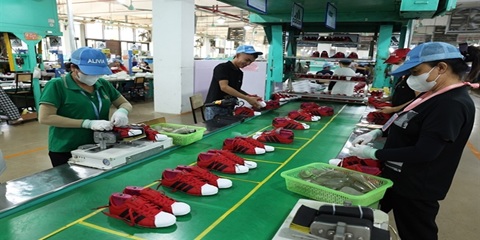
VIỆT NAM'S FOOTWEAR, BAG EXPORTS TO US TOP $8 BILLION IN EIGHT MONTHS
Việt Nam's exports of footwear and handbags to the US exceeded US$8 billion in the first eight months of 2026, as the US and EU remained the country's biggest markets despite sluggish growth in footwear shipments. Exports from Việt Nam's leather and footwear sector reached more than $2.45 billion in August, down 9 per cent from July but up 3 per cent from a year earlier, according to preliminary statistics.

VIETNAM ECONOMY INVESTMENT
LÂM ĐỒNG TARGETS DIGITAL ECONOMY TO ACCOUNT FOR 30 PER CENT OF GRDP BY 2030
Lâm Đồng Province aims to raise the digital economy’s contribution to around 30 per cent of its gross regional domestic product (GRDP) by 2030, as part of a five-year plan to develop digital economy and society issued recently. Under Plan No. 15358/KH-UBND, the province targets more than 60 per cent of small- and medium-sized enterprises (SMEs) to adopt digital technologies by 2030 while increasing the value of cashless payments to 30 times its GRDP.
Events Sponsors






















