Want to be in the loop?
subscribe to
our notification
Business News
VIETNAM SEMICONDUCTOR INDUSTRY ADVANCES IN VALUE CHAIN
Vietnam's semiconductor industry is gradually getting more involved in high value-added stages of the global supply chain. This is marked by the impending inauguration of Viettel's first chip manufacturing plant and the clearer presence of major global tech corporations in the country.
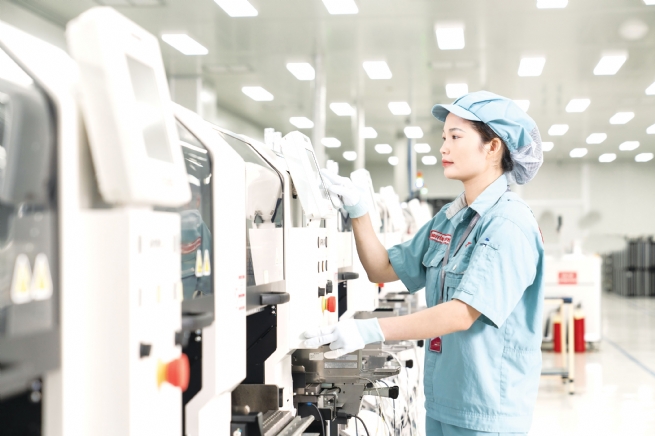
High-quality human resources are crucial to the development of Vietnam’s semiconductor industry
According to a report from the U.S. Semiconductor Industry Association (SIA), semiconductor revenue expanded about 20% year on year in 2024 and projected to grow by 12% to nearly US$700 billion in 2025. The growth is primarily driven by the explosive demand from artificial intelligence, data centers, electric vehicles, and 5G devices.
In recent years, the Vietnamese government has issued numerous strategic policies and guidelines and has created favorable conditions for investment in semiconductor development.
Notable examples include Resolutions 57 and 68 of the Politburo, Resolutions 193 and 198 of the National Assembly, the Law on Digital Technology Industry, the Law on Science, Technology and Innovation, the announcement of a list of 11 strategic technology sectors, including semiconductors, and Program 1017 on semiconductor human resource development.
At the second meeting of the National Steering Committee for Semiconductor Industry Development, Deputy Minister of Finance Nguyen Duc Tam reported that Vietnam is starting to participate in higher value-added stages such as the manufacturing of semiconductor equipment, materials, and components, as well as chip packaging and testing.
Notably, Vietnam is preparing for the inauguration of Viettel’s first chip manufacturing plant. The country is gradually gaining global recognition as a promising destination for the semiconductor industry and has been selected to host exhibitions in the world’s largest semiconductor exhibition series organized by the Global Semiconductor Alliance.
The strategic decisions by two tech giants, Nvidia and Qualcomm, to choose Vietnam as a hub for AI and semiconductor research, development and manufacturing are regarded as major milestones in Vietnam’s deeper integration into the global semiconductor value chain.
This has led to a major relocation of high-value supply chains to Vietnam and represented a leap forward in the country's position on the global semiconductor and technology map.
Reporting on the implementation of the Program on semiconductor human resource development to 2030, with a vision to 2050 (Program 1017), Deputy Minister Tam stated that nine of the 34 tasks have been completed, and 25 are progressing on schedule.
In terms of the current workforce, there are about 7,000 engineers working at chip design companies and around 6,000 engineers and 10,000 technicians working at chip packaging, testing, and semiconductor material and equipment manufacturing companies.
The semiconductor innovation network has brought together more than 100 Vietnamese experts from around the world.
In human resource training and development, 320 lecturers have participated in in-depth training courses, and approximately 6,300 undergraduate students are studying semiconductors. More than 12,000 students are enrolled in related fields that can be converted into semiconductor competencies after supplemental training.
Roughly 600 master's students and nearly 120 PhD candidates are currently undergoing semiconductor training while over 1,600 learners have completed short-term training courses.
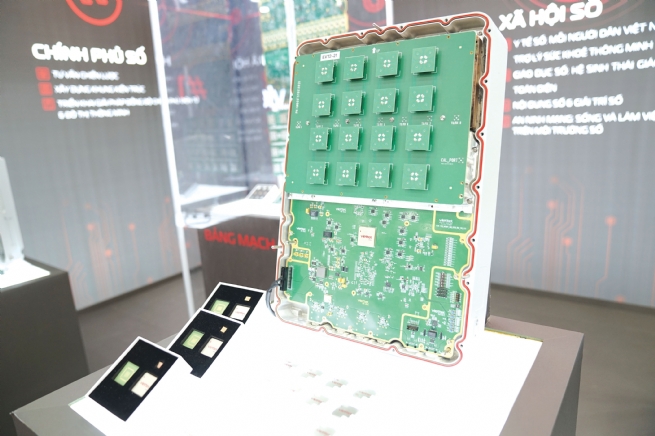
Viettel is possessing many advantages in participating in the semiconductor industry
In terms of training system, 166 universities offer semiconductor-related programs, and about 10 small-scale semiconductor labs have been built for training purposes. The ‘Triple Helix’ model in semiconductor training is being vigorously implemented. The Ministry of Finance also brought Vietnam's first Semiconductor Incubation and Development Center into operation.
To diversify resources for semiconductor workforce development, the Ministry of Finance has secured 1,000 chip design and semiconductor technology licenses, worth tens of millions of USD, from global corporations such as Cadence, Siemens, ARM, and Lam Research to support training in over 30 universities. Japan, Taiwan (China), and European countries have also agreed to provide around 1,000 scholarships annually.
International cooperation has been prioritized and actively promoted. Government leaders consistently provide close direction, spend much time on meeting and working with many leaders and experts in the semiconductor field, integrate semiconductor cooperation into international agendas and foreign affairs.
Vietnamese universities and businesses have also taken strong action. Several major firms like Coherent, Marvell, Viettel, FPT, and Phenikaa have actively participated in semiconductor training at universities.
To further develop the semiconductor industry in the coming time, the Ministry of Finance proposed selectively attracting FDI fund, establishing 100 chip design firms, a small-scale chip fabrication plant, and 10 packaging, testing, and semiconductor facilities. It also plans to provide in-depth semiconductor training for 1,300 lecturers and build four national shared semiconductor laboratories, along with other labs at the institutional level to support implementation.
Source: VCCI
Related News

BANKING / FINANCE / INSURANCE / TAX
REMITTANCES TO HCM CITY RISE NEARLY 40% IN Q3
Remittances to HCM City reached more than US$2.83 billion in the third quarter of this year, up 39.5 per cent from the previous quarter and 3.6 per cent year-on-year. This was the first quarter showing positive annual growth this year, helping narrow the decline in remittance inflows over the first nine months. According to the State Bank of Vietnam (SBV)’s Regional Branch 2, remittances transferred to HCM City through credit institutions and economic organisations totalled $2.835 billion in Q3, an increase of more than $802 million from the previous quarter.

TECHNOLOGY
TECH SECTOR GROWTH OPENS UP OPPORTUNITIES FOR VIỆT NAM TO GO GLOBAL
The growth of the electronics, semiconductor and high-tech sectors worldwide is opening up a variety of opportunities for Vietnamese enterprises to integrate more deeply into the global supply chain. However, to become suppliers for these corporations, domestic enterprises must meet rigorous standards regarding quality, technology, productivity and order fulfilment capabilities.

VIETNAM ECONOMY INVESTMENT
FOREIGN INVESTORS SEEKING A SYNCHRONISED MANUFACTURING ECOSYSTEM
Instead of focusing only on land costs and incentives as usual, foreign investors are seeking a synchronised manufacturing ecosystem, from stable power supply and logistics to shared infrastructure and the convenience of completing residence procedures for experts to serve their long-term investment in the country.

MEMBER CORNER / PROMOTIONS
SENTRYSAFE FHW40200 – PROTECT YOUR VALUABLES, ENJOY PEACE OF MIND!
Looking for a reliable solution to protect your important documents, cash, and valuables from fire and water damage? Genuine SENTRYSAFE - Reliable protection for your valuables and peace of mind! Contact Sen Wai Vietnam for more information and personalized product recommendations.

PROPERTY / INDUSTRIAL ZONE
HCM CITY ATTRACTS US$5.7 BILLION INTO EXPORT PROCESSING AND INDUSTRIAL ZONES
HCM City attracted US$5.7 billion in domestic and foreign investment into its export processing and industrial zones during the first nine months of 2026. The figure exceeded the city's full-year target by 31 per cent, highlighting strong momentum in high-quality industrial investment under Resolution No.10-NQ/TW. Total investment reached 131 per cent of the 2026 target of $4.25 billion and represented a 29 per cent increase compared with the same period in 2025, according to the city's Export Processing and Industrial Zones Authority (HEPZA).

INFRASTRUCTURE / CONSTRUCTION / LOGISTIC / PORT
DONG THAP PROVINCE STEPS UP INDUSTRIAL EXPANSION AND INFRASTRUCTURE CONNECTIVITY
Accelerating public investment, strengthening inter-regional connectivity, and expanding industrial land are helping Dong Thap efficiently bolster competitiveness and drive economic growth. Following the 2025 merger of the former Dong Thap and Tien Giang provinces, the expanded Dong Thap province in the Mekong Delta faces mounting pressure to accelerate infrastructure development and strengthen connectivity among local economic zones, urban areas, industrial parks (IPs), and production centres.
Events Sponsors






















