Want to be in the loop?
subscribe to
our notification
Business News
VIETNAM POWERS UP AS PRIME DATA CENTRE INVESTMENT DESTINATION
Vietnam is fast becoming a prime hotspot for data centre investment in Asia-Pacific, offering the region’s second-highest yield-on-cost after Singapore, according to a new report from Cushman & Wakefield.
The Asia-Pacific Data Centre Investment Landscape report from July 10 found Yield on Cost (YoC) on data centre investments in Vietnam to be in the range of 17.5 to 18.8 per cent, behind Singapore’s 21 to 23 per cent.
This positions Vietnam as one of the most attractive emerging markets, driven by surging demand, competitive development costs, and proactive government support.
Report author and head of Insights and Analysis for Cushman & Wakefield’s Asia-Pacific Data Centre Group, Pritesh Swamy, said that Vietnam’s recently introduced policy change allowing foreign investors to acquire land, and to own and operate data centres without a local partner, has demonstrated the government’s commitment to boosting digital infrastructure across the country.
"Data centres have been classified as 'high-priority technology' for development and investment, and we expect to see further interest from international investors in the months to come," said Swamy.
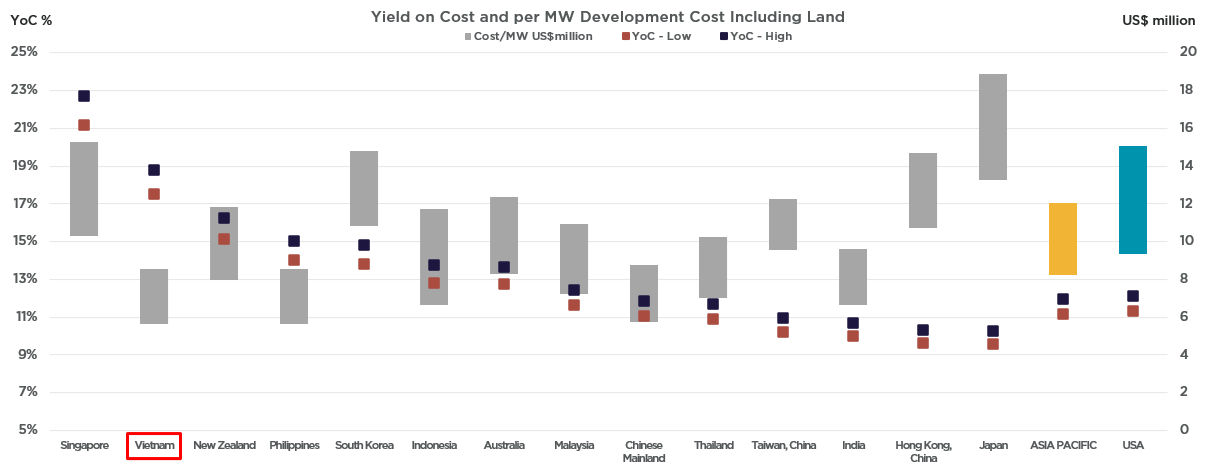
Yield on cost and per MW development cost including land, 2025. Source: Cushman & Wakefield
The average development cost, including construction and land costs, per MW of data centre capacity in Vietnam is approximately $7.1 million. This is significantly below the regional average of $10.1 million/MW and nearly half the cost of development in Japan, which is the region’s the most expensive market at $16.1 million/MW.
By 2030, the total capital expenditure (CapEx) requirement for planned data centre projects in Vietnam is estimated at $755 million.
While this figure is modest compared to major markets such as Japan ($47 billion), Australia ($21 billion), or Malaysia and India ($20 billion each), it underscores the market’s early-stage growth and high return potential.
Vietnam’s current capitalisation rate ranges from 7 to 8 per cent, well above the regional average of 5.8 per cent, offering an attractive risk premium for forward-looking investors.
Vietnam’s infrastructure shortfall is part of a broader regional trend, highlighting robust demand amid constrained supply.
The Asia-Pacific region averages over 350,000 people per MW of colocation capacity, several times higher than the US.
In Vietnam, this figure exceeds 1.77 million people per MW, among the highest in the region. Even if all under-construction and planned projects are completed by 2030, the country would still face a significant shortfall, with a projected density of more than 690,000 people per MW.
Vietnam’s macroeconomic fundamentals further support the sector’s growth. Although the country has yet to reach a $1 trillion GDP like some regional peers, it is among the fastest-growing economies with strong breakout potential.
Cushman & Wakefield’s analysis shows that markets with GDPs under $1 trillion, including Vietnam, the Philippines, Thailand, Taiwan, and New Zealand, account for 7 per cent of regional GDP but only 5 per cent of total data centre capacity, indicating substantial headroom for expansion.
Source: VIR
Related News

BANKING / FINANCE / INSURANCE / TAX
REMITTANCES TO HCM CITY RISE NEARLY 40% IN Q3
Remittances to HCM City reached more than US$2.83 billion in the third quarter of this year, up 39.5 per cent from the previous quarter and 3.6 per cent year-on-year. This was the first quarter showing positive annual growth this year, helping narrow the decline in remittance inflows over the first nine months. According to the State Bank of Vietnam (SBV)’s Regional Branch 2, remittances transferred to HCM City through credit institutions and economic organisations totalled $2.835 billion in Q3, an increase of more than $802 million from the previous quarter.

TECHNOLOGY
TECH SECTOR GROWTH OPENS UP OPPORTUNITIES FOR VIỆT NAM TO GO GLOBAL
The growth of the electronics, semiconductor and high-tech sectors worldwide is opening up a variety of opportunities for Vietnamese enterprises to integrate more deeply into the global supply chain. However, to become suppliers for these corporations, domestic enterprises must meet rigorous standards regarding quality, technology, productivity and order fulfilment capabilities.

VIETNAM ECONOMY INVESTMENT
FOREIGN INVESTORS SEEKING A SYNCHRONISED MANUFACTURING ECOSYSTEM
Instead of focusing only on land costs and incentives as usual, foreign investors are seeking a synchronised manufacturing ecosystem, from stable power supply and logistics to shared infrastructure and the convenience of completing residence procedures for experts to serve their long-term investment in the country.

MEMBER CORNER / PROMOTIONS
SENTRYSAFE FHW40200 – PROTECT YOUR VALUABLES, ENJOY PEACE OF MIND!
Looking for a reliable solution to protect your important documents, cash, and valuables from fire and water damage? Genuine SENTRYSAFE - Reliable protection for your valuables and peace of mind! Contact Sen Wai Vietnam for more information and personalized product recommendations.

PROPERTY / INDUSTRIAL ZONE
HCM CITY ATTRACTS US$5.7 BILLION INTO EXPORT PROCESSING AND INDUSTRIAL ZONES
HCM City attracted US$5.7 billion in domestic and foreign investment into its export processing and industrial zones during the first nine months of 2026. The figure exceeded the city's full-year target by 31 per cent, highlighting strong momentum in high-quality industrial investment under Resolution No.10-NQ/TW. Total investment reached 131 per cent of the 2026 target of $4.25 billion and represented a 29 per cent increase compared with the same period in 2025, according to the city's Export Processing and Industrial Zones Authority (HEPZA).

INFRASTRUCTURE / CONSTRUCTION / LOGISTIC / PORT
DONG THAP PROVINCE STEPS UP INDUSTRIAL EXPANSION AND INFRASTRUCTURE CONNECTIVITY
Accelerating public investment, strengthening inter-regional connectivity, and expanding industrial land are helping Dong Thap efficiently bolster competitiveness and drive economic growth. Following the 2025 merger of the former Dong Thap and Tien Giang provinces, the expanded Dong Thap province in the Mekong Delta faces mounting pressure to accelerate infrastructure development and strengthen connectivity among local economic zones, urban areas, industrial parks (IPs), and production centres.
Events Sponsors






















