Want to be in the loop?
subscribe to
our notification
Business News
VIETNAM CHARTS NEW COURSE FOR MARITIME INDUSTRIAL ECOSYSTEM
Vietnam is moving to develop a fully integrated maritime industrial ecosystem under a new strategic direction that elevates shipbuilding beyond manufacturing into a broader driver of economic and national development.
The conclusion of Party General Secretary and State President To Lam, set out in Notice No.125-TB/VPTW dated July 18, marks a new approach to the development of Vietnam’s maritime industry, with the aim of building a comprehensive maritime industrial ecosystem, strengthening national self-reliance, and supporting the country’s ambition to become a strong maritime nation.
“We have just received instructions from the Ministry of Construction (MoC) to study the implementation of Party General Secretary and State President To Lam’s conclusion on the development of the national maritime industry. This can be regarded as a turning point, opening a new phase of development for Vietnam’s maritime industry,” said Le Do Muoi, director general of the Vietnam Maritime and Waterway Administration.
In addition to overseeing the maritime sector, Muoi has spent many years researching transport development strategies, having previously served as director of the Institute of Transport Strategy and Development.
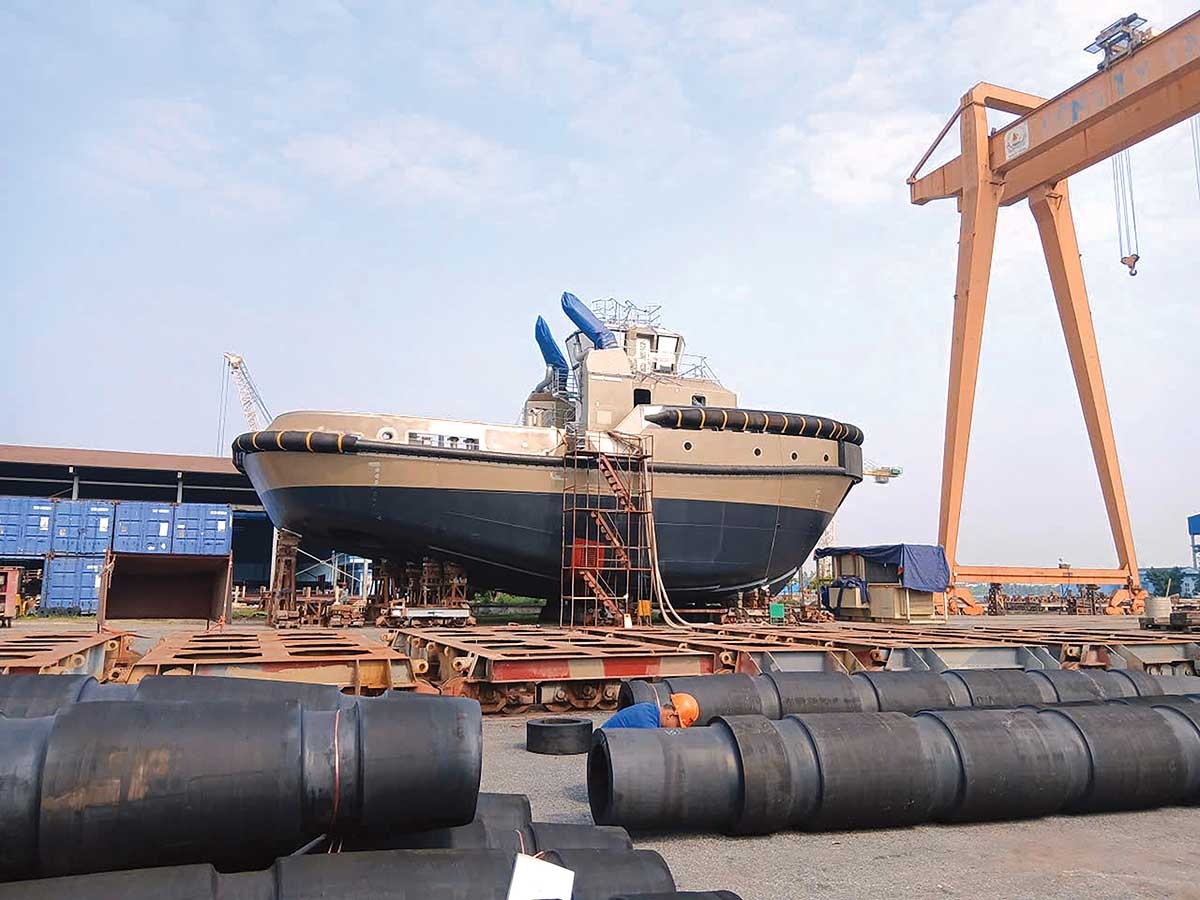
Final assembly of an export tugboat at Song Cam Shipyard
The Vietnam Maritime and Waterway Administration has also been assigned by the MoC to lead the preparation of a scheme to strengthen the capacity of domestic shipbuilding enterprises through 2030, with a vision to 2050.
The implementation of Notice 125 is expected to provide the basis to review and update the scheme in line with the new direction for developing the national maritime industry.
Under Official Letter No.11299/BXD-QLDN, issued on July 21, the MoC assigned the Vietnam Maritime and Waterway Administration to coordinate with relevant agencies in conducting a comprehensive review of Notice 125, developing an implementation plan, and advising the MoC on directives to put the conclusion into practice.
According to Muoi, the most significant aspect of Notice 125 is that, for the first time, the maritime industry has been elevated to the level of a national strategic mission.
Accordingly, the development of the maritime industry, with shipbuilding as one of its core pillars, is intended to support economic growth while strengthening national defence, security, logistics, and supply chain resilience.
Another fundamental shift is the requirement to develop the shipbuilding industry as part of an integrated maritime ecosystem, linking oceangoing vessels, inland waterway craft, seaports, logistics, supporting industries, technical services, training, research, ship registration, finance, and insurance.
“The conclusion emphasises that development should not focus on individual shipyards, localities or products in isolation. Instead, it calls for an integrated value chain that creates a stable market and enhances the overall efficiency of the entire industry. Based on this direction, we will review and update the scheme on strengthening the capacity of domestic shipbuilding enterprises through 2030, with a vision to 2050, to ensure it fully reflects the new policy orientation,” Muoi said.
In the draft scheme submitted to the MoC in mid-July, the drafting agency identified the development of the shipbuilding industry as an essential requirement for implementing Vietnam’s Strategy for the Sustainable Development of the Marine Economy, safeguarding national defense and security, and enhancing the competitiveness of the country’s marine economy.
Under the draft, Vietnam aims to account for 0.8–0.9 per cent of global shipbuilding output by 2030, meeting domestic demand for the construction and replacement of merchant vessels with a total capacity of around 4–5 million tonnes, while gradually enhancing the industry's production capacity.
Looking ahead to 2050, the scheme targets raising Vietnam’s share of global shipbuilding output to around 2 per cent, while increasing the localisation rate to more than 50 per cent.
However, the current draft remains largely focused on enhancing the capacity of the shipbuilding sector, whereas Notice No.125 envisions the creation of a comprehensive national maritime industrial ecosystem, in which shipbuilding forms one component of a broader value chain linked with seaports, shipping fleets, logistics, supporting industries, and emerging marine economic sectors.
This requires the scheme to be reviewed and updated to support the development of a complete maritime industrial ecosystem, aligning demand for oceangoing vessels, inland waterway craft, public service vessels, offshore technical services, and defence and security with domestic industrial capabilities based on the principles of competitiveness, quality and efficiency.
“This is no longer solely a matter for the shipbuilding industry. It is a national maritime industry development agenda that requires the participation of ministries, sectors, local authorities and the business community,” Muoi stressed.
Another key feature of Notice No.125 is its requirement for a comprehensive review of the shipbuilding industry's capabilities.
Party General Secretary and State President To Lam called for a full assessment and classification of the industry's capabilities based on a unified data system, clearly identifying capacities that should be preserved, upgraded, integrated, transformed, or restructured.
The review should also identify strategically valuable enterprises, assets, technologies, data, and skilled technical workforces to ensure they are utilised and developed effectively.
The findings of the review shall provide an important basis for policymaking, resource allocation, and evaluating implementation outcomes.
Source: VIR
Related News

BANKING / FINANCE / INSURANCE / TAX
REMITTANCES TO HCM CITY RISE NEARLY 40% IN Q3
Remittances to HCM City reached more than US$2.83 billion in the third quarter of this year, up 39.5 per cent from the previous quarter and 3.6 per cent year-on-year. This was the first quarter showing positive annual growth this year, helping narrow the decline in remittance inflows over the first nine months. According to the State Bank of Vietnam (SBV)’s Regional Branch 2, remittances transferred to HCM City through credit institutions and economic organisations totalled $2.835 billion in Q3, an increase of more than $802 million from the previous quarter.

TECHNOLOGY
TECH SECTOR GROWTH OPENS UP OPPORTUNITIES FOR VIỆT NAM TO GO GLOBAL
The growth of the electronics, semiconductor and high-tech sectors worldwide is opening up a variety of opportunities for Vietnamese enterprises to integrate more deeply into the global supply chain. However, to become suppliers for these corporations, domestic enterprises must meet rigorous standards regarding quality, technology, productivity and order fulfilment capabilities.
VIETNAM ECONOMY INVESTMENT
FOREIGN INVESTORS SEEKING A SYNCHRONISED MANUFACTURING ECOSYSTEM
Instead of focusing only on land costs and incentives as usual, foreign investors are seeking a synchronised manufacturing ecosystem, from stable power supply and logistics to shared infrastructure and the convenience of completing residence procedures for experts to serve their long-term investment in the country.
MEMBER CORNER / PROMOTIONS
SENTRYSAFE FHW40200 – PROTECT YOUR VALUABLES, ENJOY PEACE OF MIND!
Looking for a reliable solution to protect your important documents, cash, and valuables from fire and water damage? Genuine SENTRYSAFE - Reliable protection for your valuables and peace of mind! Contact Sen Wai Vietnam for more information and personalized product recommendations.
PROPERTY / INDUSTRIAL ZONE
HCM CITY ATTRACTS US$5.7 BILLION INTO EXPORT PROCESSING AND INDUSTRIAL ZONES
HCM City attracted US$5.7 billion in domestic and foreign investment into its export processing and industrial zones during the first nine months of 2026. The figure exceeded the city's full-year target by 31 per cent, highlighting strong momentum in high-quality industrial investment under Resolution No.10-NQ/TW. Total investment reached 131 per cent of the 2026 target of $4.25 billion and represented a 29 per cent increase compared with the same period in 2025, according to the city's Export Processing and Industrial Zones Authority (HEPZA).
INFRASTRUCTURE / CONSTRUCTION / LOGISTIC / PORT
DONG THAP PROVINCE STEPS UP INDUSTRIAL EXPANSION AND INFRASTRUCTURE CONNECTIVITY
Accelerating public investment, strengthening inter-regional connectivity, and expanding industrial land are helping Dong Thap efficiently bolster competitiveness and drive economic growth. Following the 2025 merger of the former Dong Thap and Tien Giang provinces, the expanded Dong Thap province in the Mekong Delta faces mounting pressure to accelerate infrastructure development and strengthen connectivity among local economic zones, urban areas, industrial parks (IPs), and production centres.
Events Sponsors






















