Want to be in the loop?
subscribe to
our notification
Business News
VIETNAM APPROVES ROADMAP FOR INT’L FINANCIAL CENTERS THROUGH 2035
Vietnam has approved a development plan through 2035 for its international financial centers, with the one in Ho Chi Minh City positioned as a comprehensive global financial hub.
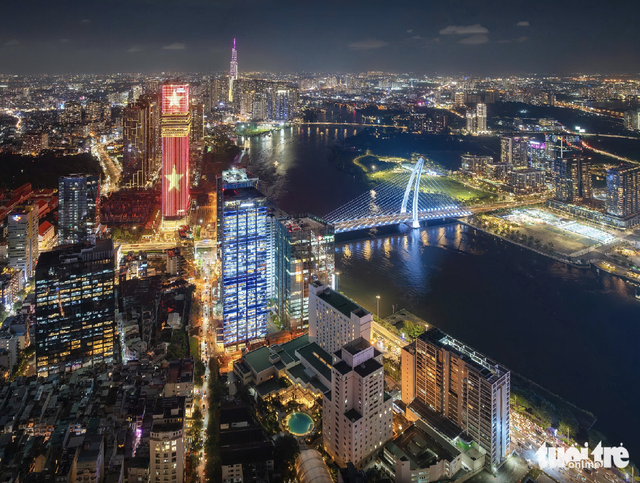
Ho Chi Minh City has reserved land for the Vietnam International Financial Center. Photo: Van Trung
Deputy Prime Minister Nguyen Van Thang, chairman of the governing board of the Vietnam International Financial Center, has signed the decision approving the development plan.
As per the plan, the Vietnam International Financial Center in Ho Chi Minh City will focus on three strategic pillars, including capital market development, asset management, and commodity markets.
The Vietnam International Financial Center in Ho Chi Minh City will provide traditional and advanced financial services, while leveraging synergies among capital raising, investment, payments, and the issuance and trading of financial products.
It will focus on asset management, fund management, green finance, and digital finance.
Besides, it will develop commodity trading and derivatives linked to international trade and logistics.
Meanwhile, the Vietnam International Financial Center in the central city of Da Nang will focus on innovation and financial technology.
The governing board will establish a competitive legal framework recognized internationally, including mechanisms for dispute resolution and enforcement of rulings.
The plan prioritizes attracting leading financial institutions, intermediaries, and major investment funds from the region and the world.
Infrastructure development will cover finance, digital systems, data, transportation, and urban facilities to ensure seamless domestic and international connectivity.
For the 2026-30 period, the government aims to complete a comprehensive legal framework, governance model and supervisory mechanism aligned with international standards, while launching pilot operations for priority financial products and services.
Core financial, digital, legal and social infrastructure supporting the international financial centers will also be completed during this phase.
Vietnam plans to attract major international financial institutions, investment funds, global banks, professional market participants, and highly skilled financial professionals to pave the way for sustainable growth and deeper global integration.
During the 2031-35 period, the government intends to expand and complete a modern financial ecosystem covering capital markets, green finance, digital finance and fintech, while improving market depth, diversity, and connectivity.
By 2035, Vietnam aims for its international financial centers to become key gateways for capital flows with a prominent position in the Asia-Pacific and global financial networks.
The plan targets ranking among the world's top 75 financial hubs, the top 25 in the Asia-Pacific region and the top three within ASEAN under the Global Financial Centres Index or equivalent benchmarks.
Source: Tuổi Trẻ News
Related News

VIETNAM ECONOMY INVESTMENT
FOREIGN INVESTORS SEEKING A SYNCHRONISED MANUFACTURING ECOSYSTEM
Instead of focusing only on land costs and incentives as usual, foreign investors are seeking a synchronised manufacturing ecosystem, from stable power supply and logistics to shared infrastructure and the convenience of completing residence procedures for experts to serve their long-term investment in the country.

INFRASTRUCTURE / CONSTRUCTION / LOGISTIC / PORT
DONG THAP PROVINCE STEPS UP INDUSTRIAL EXPANSION AND INFRASTRUCTURE CONNECTIVITY
Accelerating public investment, strengthening inter-regional connectivity, and expanding industrial land are helping Dong Thap efficiently bolster competitiveness and drive economic growth. Following the 2025 merger of the former Dong Thap and Tien Giang provinces, the expanded Dong Thap province in the Mekong Delta faces mounting pressure to accelerate infrastructure development and strengthen connectivity among local economic zones, urban areas, industrial parks (IPs), and production centres.

PROPERTY / INDUSTRIAL ZONE
HCM CITY ATTRACTS US$5.7 BILLION INTO EXPORT PROCESSING AND INDUSTRIAL ZONES
HCM City attracted US$5.7 billion in domestic and foreign investment into its export processing and industrial zones during the first nine months of 2026. The figure exceeded the city's full-year target by 31 per cent, highlighting strong momentum in high-quality industrial investment under Resolution No.10-NQ/TW. Total investment reached 131 per cent of the 2026 target of $4.25 billion and represented a 29 per cent increase compared with the same period in 2025, according to the city's Export Processing and Industrial Zones Authority (HEPZA).

BANKING / FINANCE / INSURANCE / TAX
REMITTANCES TO HCM CITY RISE NEARLY 40% IN Q3
Remittances to HCM City reached more than US$2.83 billion in the third quarter of this year, up 39.5 per cent from the previous quarter and 3.6 per cent year-on-year. This was the first quarter showing positive annual growth this year, helping narrow the decline in remittance inflows over the first nine months. According to the State Bank of Vietnam (SBV)’s Regional Branch 2, remittances transferred to HCM City through credit institutions and economic organisations totalled $2.835 billion in Q3, an increase of more than $802 million from the previous quarter.
VIETNAM ECONOMY INVESTMENT
LOCALITIES REPORT BREAKTHROUGH RESULTS IN FDI IN FIRST NINE MONTHS
In Ho Chi Minh City, total registered capital reached $17.2 billion in the first nine months, up 4.2 times from the same period last year. The figure included more than $9.35 billion in newly registered capital and over $4.9 billion in additional capital for existing projects. Foreign investors also registered more than $2.9 billion through capital contributions and share purchases.

TECHNOLOGY
TECH SECTOR GROWTH OPENS UP OPPORTUNITIES FOR VIỆT NAM TO GO GLOBAL
The growth of the electronics, semiconductor and high-tech sectors worldwide is opening up a variety of opportunities for Vietnamese enterprises to integrate more deeply into the global supply chain. However, to become suppliers for these corporations, domestic enterprises must meet rigorous standards regarding quality, technology, productivity and order fulfilment capabilities.
Events Sponsors






















