Want to be in the loop?
subscribe to
our notification
Business News
VIỆT NAM’S TEXTILE AND GARMENT INDUSTRY ACCELERATES EXPORTS
Việt Nam’s textile and garment industry is pressing forward with steady growth and enhanced positioning in the global supply chain.
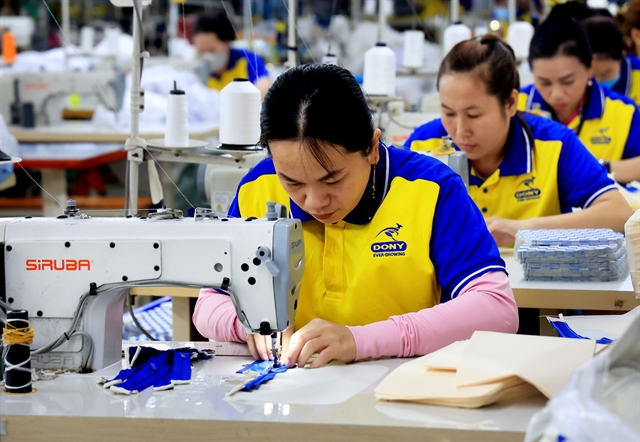
As of April 15, Việt Nam’s total textile and garment export turnover reached US$1.8 billion. — VNA/VNS Photo
HÀ NỘI — Việt Nam’s textile and garment industry is pressing forward with steady growth and enhanced positioning in the global supply chain, thanks to timely strategies in response to ongoing international challenges.
As of April 15, Việt Nam’s total textile and garment export turnover reached US$1.8 billion, representing an 8.7 per cent increase compared to the same period in 2024.
Recent statistics from the General Department of Customs show encouraging growth across key export markets. The US remains Việt Nam’s largest customer, with market share climbing from 36.3 per cent to 38 per cent, followed by gains in the EU (from 9.1 per cent to 9.4 per cent) and Japan (from 10.8 per cent to 11 per cent).
This growth is viewed as a positive signal, especially amid unpredictable market conditions and declining global consumer demand as impacts from the US's reciprocal tax policy.
However, challenges surfaced in early April when the US announced a temporary 10 per cent tariff on Vietnamese textile and garment imports, causing disruption in orders and uncertainty across the sector.
Fortunately, the 90-day delay before officially imposing tariffs on import goods is being viewed as a 'golden time' for enterprises to accelerate production and exports.
Industry experts anticipate the latter half of 2025 to be particularly difficult, marked by unpredictable demand and ongoing trade tensions.
In response, many businesses have begun formulating contingency plans while closely monitoring negotiations between Việt Nam and the US over tax rates.
In the short term, Việt Nam’s garment companies are pursuing diversification strategies - expanding into new markets, strengthening domestic sales, and improving raw material management.
They are also investing in services, workforce training and retail operations to enhance overall resilience.
Garment 10 Corporation, reported VNĐ1.25 trillion ($48 million) in revenue during the first quarter - a 12 per cent increase year-over-year.
Hưng Yên Garment Corporation (Hugaco) also recorded a 10 per cent revenue increase and confirmed sufficient orders through the end of July, with negotiations ongoing for the remaining months of the year.
Yet, Hugaco chairman Nguyễn Xuân Dương warned that unequal tax policies among competing textile-exporting nations could erode Việt Nam's competitiveness, shifting orders to countries with lower costs.
According to Việt Nam National Textile and Garment Group (Vinatex), the 90-day period for US tariffs presents a crucial opportunity for Việt Nam’s manufacturers to ramp up production and exports.
Although garment orders remain relatively stable, upstream segments such as the yarn industry have started to experience strain, with some companies halting operations due to supply chain bottlenecks. This underscores the need for a more integrated and self-reliant industry framework.
The chairman of the Việt Nam Textile and Apparel Association (Vitas), Vũ Đức Giang, emphasised the importance of market agility. With 22 new-generation free trade agreements either active or pending, Vietnamese companies are well-positioned to diversify both clientele and product lines, a critical factor in reaching the sector’s $48 billion export target for the year.
Vinatex chairman, Lê Tiến Trường, urged companies to maximise productivity in the second quarter of this year by extending regulated overtime, reorganising production lines and securing reserves to weather the uncertainties of the latter half of 2025.
He highlighted the necessity of meeting current orders efficiently to demonstrate reliability and build credibility with international clients.
Trường also emphasised transparency in sourcing and compliance with anti-fraud regulations. Vinatex is actively encouraging internal material sourcing, market-by-market risk assessments and broader efforts to diversify products and partners to mitigate market dependencies. — VNS
Source: VNS
Related News

VIETNAM ECONOMY INVESTMENT
FOREIGN INVESTORS SEEKING A SYNCHRONISED MANUFACTURING ECOSYSTEM
Instead of focusing only on land costs and incentives as usual, foreign investors are seeking a synchronised manufacturing ecosystem, from stable power supply and logistics to shared infrastructure and the convenience of completing residence procedures for experts to serve their long-term investment in the country.

INFRASTRUCTURE / CONSTRUCTION / LOGISTIC / PORT
DONG THAP PROVINCE STEPS UP INDUSTRIAL EXPANSION AND INFRASTRUCTURE CONNECTIVITY
Accelerating public investment, strengthening inter-regional connectivity, and expanding industrial land are helping Dong Thap efficiently bolster competitiveness and drive economic growth. Following the 2025 merger of the former Dong Thap and Tien Giang provinces, the expanded Dong Thap province in the Mekong Delta faces mounting pressure to accelerate infrastructure development and strengthen connectivity among local economic zones, urban areas, industrial parks (IPs), and production centres.

PROPERTY / INDUSTRIAL ZONE
HCM CITY ATTRACTS US$5.7 BILLION INTO EXPORT PROCESSING AND INDUSTRIAL ZONES
HCM City attracted US$5.7 billion in domestic and foreign investment into its export processing and industrial zones during the first nine months of 2026. The figure exceeded the city's full-year target by 31 per cent, highlighting strong momentum in high-quality industrial investment under Resolution No.10-NQ/TW. Total investment reached 131 per cent of the 2026 target of $4.25 billion and represented a 29 per cent increase compared with the same period in 2025, according to the city's Export Processing and Industrial Zones Authority (HEPZA).

BANKING / FINANCE / INSURANCE / TAX
REMITTANCES TO HCM CITY RISE NEARLY 40% IN Q3
Remittances to HCM City reached more than US$2.83 billion in the third quarter of this year, up 39.5 per cent from the previous quarter and 3.6 per cent year-on-year. This was the first quarter showing positive annual growth this year, helping narrow the decline in remittance inflows over the first nine months. According to the State Bank of Vietnam (SBV)’s Regional Branch 2, remittances transferred to HCM City through credit institutions and economic organisations totalled $2.835 billion in Q3, an increase of more than $802 million from the previous quarter.
VIETNAM ECONOMY INVESTMENT
LOCALITIES REPORT BREAKTHROUGH RESULTS IN FDI IN FIRST NINE MONTHS
In Ho Chi Minh City, total registered capital reached $17.2 billion in the first nine months, up 4.2 times from the same period last year. The figure included more than $9.35 billion in newly registered capital and over $4.9 billion in additional capital for existing projects. Foreign investors also registered more than $2.9 billion through capital contributions and share purchases.

TECHNOLOGY
TECH SECTOR GROWTH OPENS UP OPPORTUNITIES FOR VIỆT NAM TO GO GLOBAL
The growth of the electronics, semiconductor and high-tech sectors worldwide is opening up a variety of opportunities for Vietnamese enterprises to integrate more deeply into the global supply chain. However, to become suppliers for these corporations, domestic enterprises must meet rigorous standards regarding quality, technology, productivity and order fulfilment capabilities.
Events Sponsors






















