Want to be in the loop?
subscribe to
our notification
Business News
VIỆT NAM’S STOCK MARKET LOOKS TO STRONG 2025, LED BY BANKS
Recent financial disclosures from over 900 listed enterprises reveal a 20.9 per cent year-on-year growth in profits after tax for the fourth quarter (Q4) of 2024.
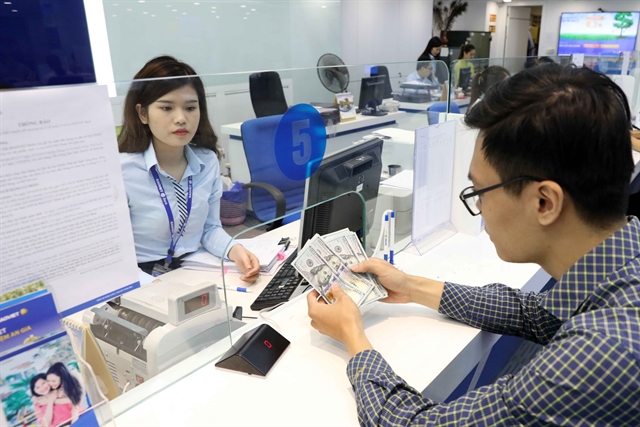
A customer conducts a transaction at an office of a bank in Hà Nội. — VNA/VNS Photo
HÀ NỘI — As Việt Nam’s economy strides confidently into 2025, the outlook for listed companies appears increasingly robust, with the banking sector positioned as a key driver of stock market growth.
Recent financial disclosures from over 900 listed enterprises reveal a 20.9 per cent year-over-year growth in profits after tax for the fourth quarter (Q4) of 2024. This marks the fourth consecutive quarter of stable gain, reinforcing optimism for 2025.
Several industries have played a pivotal role in this upward trajectory, particularly real estate, retail, aviation, consumer goods, telecommunications and information technology.
The non-financial sector continues to be a primary growth engine, boasting a 25.7 per cent profit expansion in Q4 2024, but slightly below the 29 per cent recorded in the previous quarter.
Meanwhile, the financial sector has also seen improved momentum, registering a 16.7 per cent profit increase year-on-year, up from 14.9 per cent in Q3 2024.
Notably, the real estate sector saw a significant surge in profit after tax (101.3 per cent), primarily driven by Vinhomes’s exceptional growth (1,482.3 per cent).
This remarkable increase was fuelled by the company’s accelerated handover of homes at the Royal Island mega-project in Hải Phòng City, along with contributions from other key players such as Khang Điền House, Phát Điều Real Estate, Đất Xanh Group, NLG Corp and Văn PHú - Invest.
These figures indicate a broad-based recovery across multiple sectors, creating a favourable environment for sustained market expansion.
In 2024, the total profit after tax of the market grew by 22.3 per cent year-on-year, primarily driven by the non-financial sector, which saw a strong increase of 28.7 per cent.
While the financial sector posted more modest growth at 17.5 per cent, several industries experienced exceptional surges, including retail (479.3 per cent), tourism and entertainment (319.6 per cent) and telecommunications (144.1 per cent).
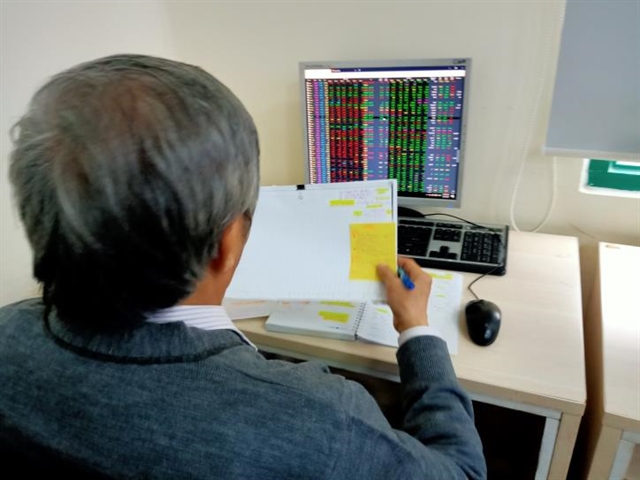
An investor tracks the market's movements. — VNA/VNS Photo
Market’s driving force
Among the key contributors to the market’s rallies, the banking industry stands out as the front runner.
By the end of 2024, the total market capitalisation of banks stood at over VNĐ578.1 trillion (US$22.6 million), accounting for 8.1 per cent of the combined capitalisation across Việt Nam’s three stock exchanges.
Preliminary financial reports indicate that banks achieved a profit after tax of VNĐ67.1 trillion in Q4 2024, reflecting a significant 27.3 per cent rise over the previous year.
This growth rate substantially surpasses the average profit increase of 9.1 per cent among 33 major stocks in other sectors.
The banking sector’s impressive performance can be attributed to several key factors.
First, credit expansion has been a crucial driver, with lending activities picking up as the economy regains momentum.
Meanwhile, digital transformation efforts by banks have yielded positive results, improving operational efficiency and boosting revenue streams.
Additionally, favourable interest rate policies and proactive monetary measures by the State Bank of Việt (SBV) have provided an enabling environment for banks to thrive.
Market analysts are increasingly optimistic about the role of banking stocks in shaping Vietnam’s stock market performance in 2025.
Đào Hồng Dương from VPBank Securities said that the VN-Index would likely be propelled by sectors demonstrating high-profit growth and attractive valuations, with banks leading the charge.
Looking ahead, projections suggest a 17.7 per cent profit growth for banks this year.
Given expectations of double-digit GDP growth, credit expansion in the banking sector could reach 16-18 per cent in 2025.
This optimistic outlook is further bolstered by proactive public investment and infrastructure development initiatives, which will drive demand for banking services.
Given that the banking sector comprises about 25-30 per cent of the total capitalisation on the Hồ Chi Minh Stock Exchange (HoSE), its performance will have a ripple effect on the broader market.
Bank stocks, characterised by their liquidity, market capitalisation and favourable valuations, are attracting significant attention from both domestic and foreign investors.
In particular, the prospect of increased foreign ownership levels in the country’s banking sector could further enhance investor sentiment and capital inflows.
Despite the positive outlook, certain risks could impact the market’s performance.
Global economic uncertainties, geopolitical tensions and potential fluctuations in interest rates could pose challenges for Việt Nam’s financial markets. Additionally, the real estate sector, while showing signs of recovery, remains an area of concern due to lingering structural issues. — VNS
Source: VNS
Related News

VIETNAM ECONOMY INVESTMENT
FOREIGN INVESTORS SEEKING A SYNCHRONISED MANUFACTURING ECOSYSTEM
Instead of focusing only on land costs and incentives as usual, foreign investors are seeking a synchronised manufacturing ecosystem, from stable power supply and logistics to shared infrastructure and the convenience of completing residence procedures for experts to serve their long-term investment in the country.

INFRASTRUCTURE / CONSTRUCTION / LOGISTIC / PORT
DONG THAP PROVINCE STEPS UP INDUSTRIAL EXPANSION AND INFRASTRUCTURE CONNECTIVITY
Accelerating public investment, strengthening inter-regional connectivity, and expanding industrial land are helping Dong Thap efficiently bolster competitiveness and drive economic growth. Following the 2025 merger of the former Dong Thap and Tien Giang provinces, the expanded Dong Thap province in the Mekong Delta faces mounting pressure to accelerate infrastructure development and strengthen connectivity among local economic zones, urban areas, industrial parks (IPs), and production centres.

PROPERTY / INDUSTRIAL ZONE
HCM CITY ATTRACTS US$5.7 BILLION INTO EXPORT PROCESSING AND INDUSTRIAL ZONES
HCM City attracted US$5.7 billion in domestic and foreign investment into its export processing and industrial zones during the first nine months of 2026. The figure exceeded the city's full-year target by 31 per cent, highlighting strong momentum in high-quality industrial investment under Resolution No.10-NQ/TW. Total investment reached 131 per cent of the 2026 target of $4.25 billion and represented a 29 per cent increase compared with the same period in 2025, according to the city's Export Processing and Industrial Zones Authority (HEPZA).

BANKING / FINANCE / INSURANCE / TAX
REMITTANCES TO HCM CITY RISE NEARLY 40% IN Q3
Remittances to HCM City reached more than US$2.83 billion in the third quarter of this year, up 39.5 per cent from the previous quarter and 3.6 per cent year-on-year. This was the first quarter showing positive annual growth this year, helping narrow the decline in remittance inflows over the first nine months. According to the State Bank of Vietnam (SBV)’s Regional Branch 2, remittances transferred to HCM City through credit institutions and economic organisations totalled $2.835 billion in Q3, an increase of more than $802 million from the previous quarter.

VIETNAM ECONOMY INVESTMENT
LOCALITIES REPORT BREAKTHROUGH RESULTS IN FDI IN FIRST NINE MONTHS
In Ho Chi Minh City, total registered capital reached $17.2 billion in the first nine months, up 4.2 times from the same period last year. The figure included more than $9.35 billion in newly registered capital and over $4.9 billion in additional capital for existing projects. Foreign investors also registered more than $2.9 billion through capital contributions and share purchases.

TECHNOLOGY
TECH SECTOR GROWTH OPENS UP OPPORTUNITIES FOR VIỆT NAM TO GO GLOBAL
The growth of the electronics, semiconductor and high-tech sectors worldwide is opening up a variety of opportunities for Vietnamese enterprises to integrate more deeply into the global supply chain. However, to become suppliers for these corporations, domestic enterprises must meet rigorous standards regarding quality, technology, productivity and order fulfilment capabilities.
Events Sponsors






















