Want to be in the loop?
subscribe to
our notification
Business News
VIỆT NAM’S SHRIMP EXPORTS MAINTAIN STEADY GROWTH
Việt Nam's shrimp exports have demonstrated impressive resilience in the first two months of 2025, solidifying their status as the leading export product of the seafood industry. The shrimp export value in the two months reached US$542 million out of a total seafood export value at $1.4 billion, according to the Việt Nam Association of Seafood Exporters and Producers (VASEP).
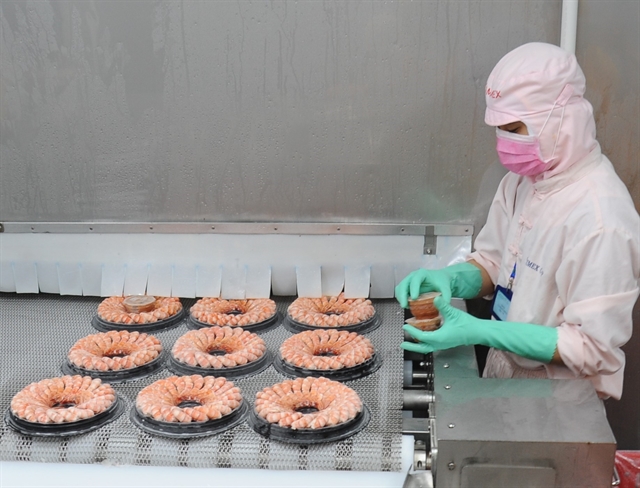
Processed shrimp for export. The shrimp export value in the first two months of 2025 reached US$542 million. VNA/VNS Photo
HÀ NỘI — Việt Nam's shrimp exports have demonstrated impressive resilience in the first two months of 2025, solidifying their status as the leading export product of the seafood industry.
The shrimp export value in the first two months of 2025 reached US$542 million out of a total seafood export value of $1.4 billion, according to the Việt Nam Association of Seafood Exporters and Producers (VASEP).
This continued strong growth is attributed to Việt Nam’s effective utilisation of free trade agreements (FTAs), strategic market expansions and the increasing emphasis on adding value through deep processing.
Việt Nam’s network of FTAs with over 60 countries and economies, has been instrumental in creating a solid foundation for seafood businesses to expand into international markets.
VASEP Secretary General Nguyễn Hoài Nam highlights that Việt Nam seafood is now reaching over 160 markets globally. They include the markets importing Vietnamese shrimp worth billions of US dollars that have established bilateral or multilateral FTAs with Việt Nam.
Among the most significant agreements is the Việt Nam-European Union Free Trade Agreement (EVFTA), which experts believe holds substantial potential for expanding shrimp exports to the EU.
Despite the EU being the world's largest seafood consumer, Việt Nam’s share in this market remains relatively small, presenting significant growth opportunities for the future.
Việt Nam has also entered into two high-profile FTAs with the United Kingdom (UK), the Comprehensive and Progressive Agreement for Trans-Pacific Partnership (CPTPP) and the Việt Nam-UK Free Trade Agreement (UKVFTA).
The UK is the sixth-largest market for Việt Nam shrimp, accounting for 5.5 per cent of the total turnover, with shrimp exports to the UK seeing an 8 per cent growth in January 2025 compared to the previous year.
Additionally, the Comprehensive Economic Partnership Agreement (CEPA) signed with the United Arab Emirates (UAE) in late 2024 is expected to open up new opportunities for Việt Nam’s seafood exports in the Middle East, a region increasingly important to Việt Nam's trading portfolio.
Hồ Quốc Lực, chairman of Sao Ta Food Joint Stock Company, emphasises that through the efforts of businesses and with the support of FTAs, Vietnamese shrimp has established a strong presence in key markets in the world such as Japan, South Korea and the EU.
However, VASEP points out that expanding into new markets also comes with challenges. The seafood industry faces stiff competition from leading shrimp-producing countries such as Ecuador, India, and Thailand.
In addition, stricter regulations related to traceability, quality control, and standards in major markets like the US and EU require continuous adaptation from local firms.
To maintain competitiveness, Vietnamese shrimp exporters must focus on improving product quality, enhancing value-added processing, and ensuring compliance with stringent market requirements.
The Ministry of Industry and Trade also works to remove technical barriers, reduce tariffs, and open up new export avenues for Việt Nam seafood.
Deep processing
According to VASEP, Vietnamese shrimp products, including items like steamed shrimp, breaded shrimp, fried breaded shrimp and shrimp dumplings, become more popular with consumers worldwide.
General director of Minh Phú Seafood Corporation, Lê Văn Quang, points out that Vietnamese enterprises have successfully developed value-added shrimp products that set them apart from competitors including Ecuador and India.
In 2024, deep-processed shrimp accounted for over 40 per cent of Việt Nam's total shrimp export turnover at $4 billion.
Việt Nam is now positioning itself as the second-largest supplier of processed shrimp in the US market, specifically for value-added items like steamed, seasoned and breaded shrimp.
Despite increasing competition from Ecuador and India, Vietnamese shrimp continues to dominate high-end markets, particularly in Japan, South Korea, the EU, the US and Australia, thanks to its processed products.
To sustain growth and expand the shrimp market share in regions like Europe, businesses must focus on strict adherence to quality, environmental standards, and product design.
Việt Nam’s shrimp exporters must also explore new technologies in farming shrimp and enhancing seed quality.
Maintaining these advantages will be critical for ensuring that the shrimp industry continues to thrive in the face of growing global competition. — VNS
Source: VNS
Related News

BANKING / FINANCE / INSURANCE / TAX
REMITTANCES TO HCM CITY RISE NEARLY 40% IN Q3
Remittances to HCM City reached more than US$2.83 billion in the third quarter of this year, up 39.5 per cent from the previous quarter and 3.6 per cent year-on-year. This was the first quarter showing positive annual growth this year, helping narrow the decline in remittance inflows over the first nine months. According to the State Bank of Vietnam (SBV)’s Regional Branch 2, remittances transferred to HCM City through credit institutions and economic organisations totalled $2.835 billion in Q3, an increase of more than $802 million from the previous quarter.

TECHNOLOGY
TECH SECTOR GROWTH OPENS UP OPPORTUNITIES FOR VIỆT NAM TO GO GLOBAL
The growth of the electronics, semiconductor and high-tech sectors worldwide is opening up a variety of opportunities for Vietnamese enterprises to integrate more deeply into the global supply chain. However, to become suppliers for these corporations, domestic enterprises must meet rigorous standards regarding quality, technology, productivity and order fulfilment capabilities.

VIETNAM ECONOMY INVESTMENT
FOREIGN INVESTORS SEEKING A SYNCHRONISED MANUFACTURING ECOSYSTEM
Instead of focusing only on land costs and incentives as usual, foreign investors are seeking a synchronised manufacturing ecosystem, from stable power supply and logistics to shared infrastructure and the convenience of completing residence procedures for experts to serve their long-term investment in the country.
MEMBER CORNER / PROMOTIONS
SENTRYSAFE FHW40200 – PROTECT YOUR VALUABLES, ENJOY PEACE OF MIND!
Looking for a reliable solution to protect your important documents, cash, and valuables from fire and water damage? Genuine SENTRYSAFE - Reliable protection for your valuables and peace of mind! Contact Sen Wai Vietnam for more information and personalized product recommendations.

PROPERTY / INDUSTRIAL ZONE
HCM CITY ATTRACTS US$5.7 BILLION INTO EXPORT PROCESSING AND INDUSTRIAL ZONES
HCM City attracted US$5.7 billion in domestic and foreign investment into its export processing and industrial zones during the first nine months of 2026. The figure exceeded the city's full-year target by 31 per cent, highlighting strong momentum in high-quality industrial investment under Resolution No.10-NQ/TW. Total investment reached 131 per cent of the 2026 target of $4.25 billion and represented a 29 per cent increase compared with the same period in 2025, according to the city's Export Processing and Industrial Zones Authority (HEPZA).

INFRASTRUCTURE / CONSTRUCTION / LOGISTIC / PORT
DONG THAP PROVINCE STEPS UP INDUSTRIAL EXPANSION AND INFRASTRUCTURE CONNECTIVITY
Accelerating public investment, strengthening inter-regional connectivity, and expanding industrial land are helping Dong Thap efficiently bolster competitiveness and drive economic growth. Following the 2025 merger of the former Dong Thap and Tien Giang provinces, the expanded Dong Thap province in the Mekong Delta faces mounting pressure to accelerate infrastructure development and strengthen connectivity among local economic zones, urban areas, industrial parks (IPs), and production centres.
Events Sponsors






















