Want to be in the loop?
subscribe to
our notification
Business News
VIỆT NAM’S COFFEE INDUSTRY SPOTS OPPORTUNITY AMID RISING GLOBAL PRICES
The country's coffee export turnover reached more than US$560 million last month.
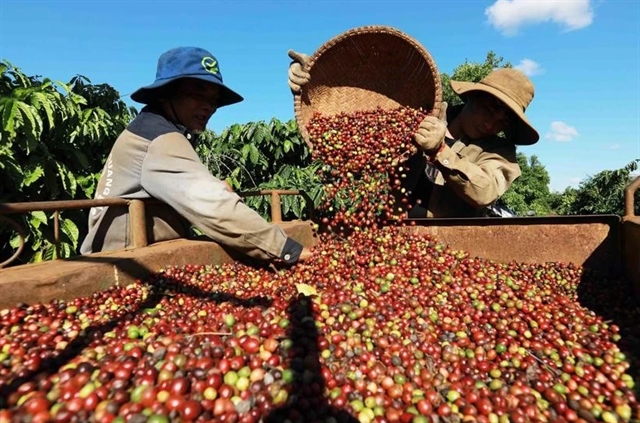
Farmers harvesting coffee. — VNA/VNS Photo
HÀ NỘI — As global coffee prices surge, Việt Nam's coffee industry is presented with a significant opportunity to expand its export market share, industry insiders say.
A recent study by the Food and Agriculture Organization noted that coffee prices rose globally by around 40 per cent in 2024, largely due to unfavourable weather conditions caused by climate change.
This has reduced production in Brazil, Colombia and Indonesia, while demand in Europe, the US and Asia has soared.
Last month, Việt Nam's coffee export turnover reached more than US$560 million, bringing the total export value for the first seven months of the year to $3.6 billion and marking an impressive year-on-year growth of 20 per cent, according to data from the Ministry of Agriculture and Environment.
The industry's growth is mostly attributed to the jump in global coffee prices.
Việt Nam is the largest exporter of Robusta coffee in the world, accounting for about 40 per cent of global market share. The country is now looking to seize the opportunity to expand its market share.
Nguyễn Nam Hải, president of the Vietnam Coffee Cocoa Association (Vicofa), said that the international coffee market has never been as favourable as it is now.
With high prices and growing demand, coupled with Việt Nam’s stable supply, the country is in an advantageous position, he said.
However, to fully capitalise on this opportunity, Việt Nam needs to delve deeper into processing, rather than relying on raw bean exports, he added.
Although exports have increased in value, the product structure of Việt Nam’s coffee exports still reveals significant limitations.
The share of deep-processed coffee, including roasted, instant and specialty coffee, currently accounts for only 12-15 per cent of total exports, according to Vicofa.
This figure is modest compared to the products' potential. In Brazil and Colombia, the ratio ranges from 30-40 per cent.
Thời báo Ngân hàng (The Banking Times) quoted founder and CEO of TNI King Coffee Lê Hoàng Diệp Thảo as saying that investing in deep processing helps companies multiply the value of their products significantly.
But initial investments can be substantial, especially for instant coffee technology, which she said requires hundreds of billions of Vietnamese đồng in capital. Not all businesses are financially capable of such investments.
Other reasons Việt Nam’s coffee sector has been slow to transition to deep processing are technological challenges and branding issues, she added.
Technology and branding challenges
The technology for processing instant coffee and specialty coffee in Việt Nam is still not uniformly developed.
Large enterprises like Vinacafé, Trung Nguyên and Nestlé have made significant investments, but the number of small and medium-sized enterprises with sufficient capabilities is limited.
Vietnamese coffee brands have not yet been firmly established on the international market. While Việt Nam is well known for its production volume, when it comes to global brands, consumers often think of Starbucks (USA), Lavazza (Italy) or Nestlé (Switzerland). This makes it difficult for processed coffee products from Việt Nam to compete in the premium segment.
Đinh Văn Thành, an agricultural economics expert, said that if Việt Nam continued to depend on raw coffee exports, it would remain only an "ingredient factory" for large corporations.
A long-term strategy for investment in deep processing is needed, along with efforts to elevate the national coffee brand on the global stage, he added.
Despite these challenges, positive signals are emerging from businesses. Trung Nguyên Legend, for example, is expanding its instant coffee exports to the Middle East and Eastern Europe.
Vinacafé is focusing on developing the ASEAN market, while several start-ups in Lâm Đồng and Gia Lai are boldly building specialty coffee brands for markets like Japan and South Korea.
Instead of selling raw beans, they are partnering with companies to process roasted coffee and sell it directly to the South Korean market, said Thảo. The selling price is double that of raw beans, while farmers also earn better profits.
To capitalise on high coffee prices and expand export potential, experts recommended three key strategies for Việt Nam’s coffee industry.
Việt Nam should first invest in deep processing technology. The Government should offer preferential credit policies to businesses that invest in production lines for instant and specialty coffee, rather than leaving them to manage on their own.
Experts also suggest that the country focus on building a national coffee brand, similar to Thailand's Jasmine rice or Colombia’s Arabica coffee. A strong, internationally recognised coffee brand is essential for Việt Nam.
Finally, Việt Nam should prioritise emerging markets like the Middle East, South Asia and Eastern Europe, where coffee demand is growing rapidly. This presents an opportunity for processed Vietnamese coffee to expand its distribution channels. — VNS
Source: VNS
Related News

BANKING / FINANCE / INSURANCE / TAX
REMITTANCES TO HCM CITY RISE NEARLY 40% IN Q3
Remittances to HCM City reached more than US$2.83 billion in the third quarter of this year, up 39.5 per cent from the previous quarter and 3.6 per cent year-on-year. This was the first quarter showing positive annual growth this year, helping narrow the decline in remittance inflows over the first nine months. According to the State Bank of Vietnam (SBV)’s Regional Branch 2, remittances transferred to HCM City through credit institutions and economic organisations totalled $2.835 billion in Q3, an increase of more than $802 million from the previous quarter.

TECHNOLOGY
TECH SECTOR GROWTH OPENS UP OPPORTUNITIES FOR VIỆT NAM TO GO GLOBAL
The growth of the electronics, semiconductor and high-tech sectors worldwide is opening up a variety of opportunities for Vietnamese enterprises to integrate more deeply into the global supply chain. However, to become suppliers for these corporations, domestic enterprises must meet rigorous standards regarding quality, technology, productivity and order fulfilment capabilities.

VIETNAM ECONOMY INVESTMENT
FOREIGN INVESTORS SEEKING A SYNCHRONISED MANUFACTURING ECOSYSTEM
Instead of focusing only on land costs and incentives as usual, foreign investors are seeking a synchronised manufacturing ecosystem, from stable power supply and logistics to shared infrastructure and the convenience of completing residence procedures for experts to serve their long-term investment in the country.
MEMBER CORNER / PROMOTIONS
SENTRYSAFE FHW40200 – PROTECT YOUR VALUABLES, ENJOY PEACE OF MIND!
Looking for a reliable solution to protect your important documents, cash, and valuables from fire and water damage? Genuine SENTRYSAFE - Reliable protection for your valuables and peace of mind! Contact Sen Wai Vietnam for more information and personalized product recommendations.

PROPERTY / INDUSTRIAL ZONE
HCM CITY ATTRACTS US$5.7 BILLION INTO EXPORT PROCESSING AND INDUSTRIAL ZONES
HCM City attracted US$5.7 billion in domestic and foreign investment into its export processing and industrial zones during the first nine months of 2026. The figure exceeded the city's full-year target by 31 per cent, highlighting strong momentum in high-quality industrial investment under Resolution No.10-NQ/TW. Total investment reached 131 per cent of the 2026 target of $4.25 billion and represented a 29 per cent increase compared with the same period in 2025, according to the city's Export Processing and Industrial Zones Authority (HEPZA).

INFRASTRUCTURE / CONSTRUCTION / LOGISTIC / PORT
DONG THAP PROVINCE STEPS UP INDUSTRIAL EXPANSION AND INFRASTRUCTURE CONNECTIVITY
Accelerating public investment, strengthening inter-regional connectivity, and expanding industrial land are helping Dong Thap efficiently bolster competitiveness and drive economic growth. Following the 2025 merger of the former Dong Thap and Tien Giang provinces, the expanded Dong Thap province in the Mekong Delta faces mounting pressure to accelerate infrastructure development and strengthen connectivity among local economic zones, urban areas, industrial parks (IPs), and production centres.
Events Sponsors






















