Want to be in the loop?
subscribe to
our notification
Business News
VIỆT NAM RANKS AMONG MOST COST-COMPETITIVE LOCATIONS ON GLOBAL INDUSTRIAL MAP
Việt Nam has again been recognised as a highly cost-competitive location for industrial and logistics investment, ranking in the most affordable tier globally for rent, labour and energy.
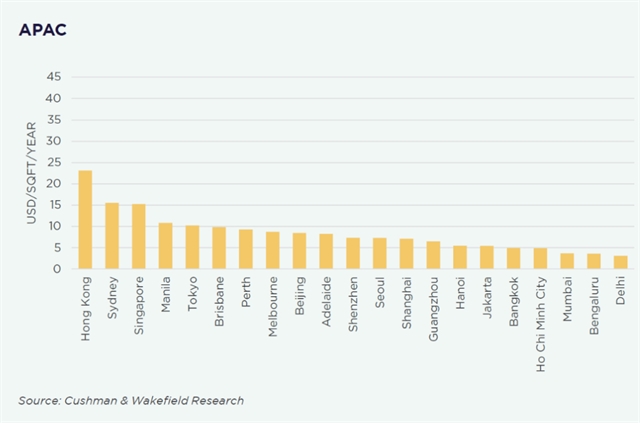
Logistic rent levels in the last quarter of 2024. Việt Nam is a highly cost-competitive location for industrial and logistics investment. – Photo Courtesy of Cushman & Wakefield
HCM CITY – Việt Nam has again been recognised as a highly cost-competitive location for industrial and logistics investment, ranking in the most affordable tier globally for rent, labour and energy.
Highlighted in the recently published 2025 Waypoint: Global Industrial Dynamics Report by real estate services firm Cushman & Wakefield—evaluating more than 120 markets worldwide—Việt Nam emerges as one of the select countries recognised for its highly affordable environment for these critical site selection elements.
Despite an increase of 70 percent in industrial rental rates between 2019 and 2025, overall costs remain remarkably attractive in comparison to regional counterparts. The average logistics real estate rental prices are around US$5.3 per square metre per month in Hà Nội and $4.9 per square metre per month in HCM City.
Logistics and manufacturing operations remain heavily reliant on human capital. A large, cost-effective labour force is a critical factor influencing site selection and operational strategy, from determining which processes to localise to the level of automation investment.
In Việt Nam, labour costs are currently less than 25 per cent of the global median wage, placing the country among the most affordable labour markets in the Asia-Pacific region.
Meanwhile, electricity demand in modern logistics facilities is rising, driven by automation systems, smart management platforms, advanced material handling equipment, and the growing adoption of electric vehicles. As a result, operating costs are becoming an increasingly important consideration in investment decisions.
In addition, Việt Nam maintains its competitive edge, with industrial electricity prices among the lowest globally, only higher than Indonesia and Nigeria.
The combination of these three core cost factors - labour, energy, and real estate - has positioned Việt Nam as a highly attractive destination on the global industrial map, particularly for manufacturing and logistics. To optimise production, secure supply, and efficiently distribute goods to consumers, businesses must develop a real estate strategy aligned with long-term operational goals, said Cushman & Wakefield.
Global Industrial Dynamics Coordinates 2025 is a research report based on survey results from Cushman & Wakefield’s logistics and industrial market experts across 127 markets worldwide. The survey was conducted from April 7 to April 18, 2025, shortly after the Trump administration announced a 90-day suspension of most elevated tariffs, while maintaining a 10 percent tariff on nearly all global imports. – VNS
Source: VNS
Related News

BANKING / FINANCE / INSURANCE / TAX
REMITTANCES TO HCM CITY RISE NEARLY 40% IN Q3
Remittances to HCM City reached more than US$2.83 billion in the third quarter of this year, up 39.5 per cent from the previous quarter and 3.6 per cent year-on-year. This was the first quarter showing positive annual growth this year, helping narrow the decline in remittance inflows over the first nine months. According to the State Bank of Vietnam (SBV)’s Regional Branch 2, remittances transferred to HCM City through credit institutions and economic organisations totalled $2.835 billion in Q3, an increase of more than $802 million from the previous quarter.

TECHNOLOGY
TECH SECTOR GROWTH OPENS UP OPPORTUNITIES FOR VIỆT NAM TO GO GLOBAL
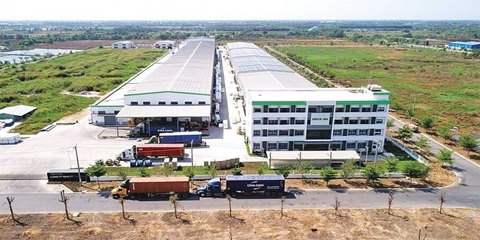
The growth of the electronics, semiconductor and high-tech sectors worldwide is opening up a variety of opportunities for Vietnamese enterprises to integrate more deeply into the global supply chain. However, to become suppliers for these corporations, domestic enterprises must meet rigorous standards regarding quality, technology, productivity and order fulfilment capabilities.
VIETNAM ECONOMY INVESTMENT
FOREIGN INVESTORS SEEKING A SYNCHRONISED MANUFACTURING ECOSYSTEM
Instead of focusing only on land costs and incentives as usual, foreign investors are seeking a synchronised manufacturing ecosystem, from stable power supply and logistics to shared infrastructure and the convenience of completing residence procedures for experts to serve their long-term investment in the country.

MEMBER CORNER / PROMOTIONS
SENTRYSAFE FHW40200 – PROTECT YOUR VALUABLES, ENJOY PEACE OF MIND!
Looking for a reliable solution to protect your important documents, cash, and valuables from fire and water damage? Genuine SENTRYSAFE - Reliable protection for your valuables and peace of mind! Contact Sen Wai Vietnam for more information and personalized product recommendations.
PROPERTY / INDUSTRIAL ZONE
HCM CITY ATTRACTS US$5.7 BILLION INTO EXPORT PROCESSING AND INDUSTRIAL ZONES
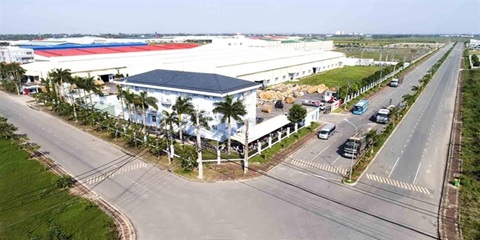
HCM City attracted US$5.7 billion in domestic and foreign investment into its export processing and industrial zones during the first nine months of 2026. The figure exceeded the city's full-year target by 31 per cent, highlighting strong momentum in high-quality industrial investment under Resolution No.10-NQ/TW. Total investment reached 131 per cent of the 2026 target of $4.25 billion and represented a 29 per cent increase compared with the same period in 2025, according to the city's Export Processing and Industrial Zones Authority (HEPZA).
INFRASTRUCTURE / CONSTRUCTION / LOGISTIC / PORT
DONG THAP PROVINCE STEPS UP INDUSTRIAL EXPANSION AND INFRASTRUCTURE CONNECTIVITY
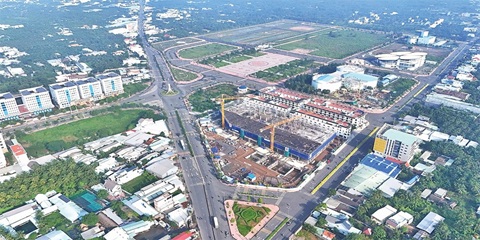
Accelerating public investment, strengthening inter-regional connectivity, and expanding industrial land are helping Dong Thap efficiently bolster competitiveness and drive economic growth. Following the 2025 merger of the former Dong Thap and Tien Giang provinces, the expanded Dong Thap province in the Mekong Delta faces mounting pressure to accelerate infrastructure development and strengthen connectivity among local economic zones, urban areas, industrial parks (IPs), and production centres.
Events Sponsors






















