Want to be in the loop?
subscribe to
our notification
Business News
VIỆT NAM ENJOYS POSITIVE EXPORT GROWTH IN NEW MARKETS
By the end of April, Việt Nam’s total export turnover reached US$140.34 billion, an increase of 13 per cent compared to the same period in 2024
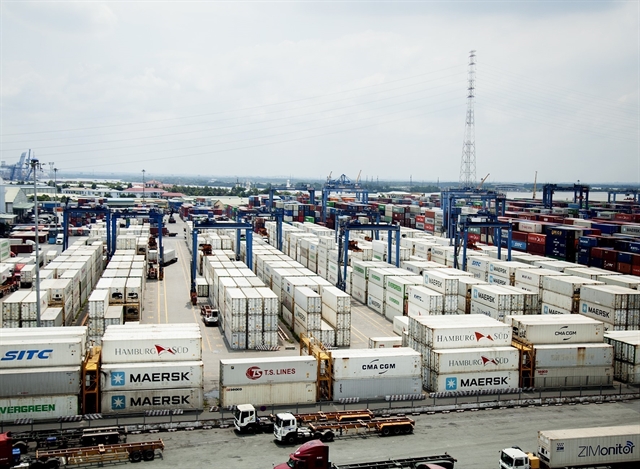
Good containers seen at Tân Cảng Cát Lái Port in HCM City. — VNA/VNS Photo
HÀ NỘI — The export situation in the early months of 2025 has continued to show promising signs, as Vietnamese enterprises have not only maintained their market share with traditional partners but have also actively expanded into new markets.
Positive indicators
According to the Ministry of Industry and Trade, by the end of April, Việt Nam’s total export turnover reached US$140.34 billion, an increase of 13 per cent compared to the same period in 2024. Although exports to the US showed signs of slowing down, overall export turnover still recorded growth thanks to compensation from other markets. Specifically, exports to China reached $18.1 billion, up 2.1 per cent; to the EU, $18.5 billion, up 12.8 per cent; to Japan, $8.5 billion, up 12 per cent; and to the Republic of Korea, $8.9 billion, up 9.1 per cent year-on-year.
Exports to China increased mainly due to a strong recovery in demand for food and aquatic products in this billion-population market starting from the second quarter of 2024. Products such as shrimp, tra fish, and tropical fruits continued to hold a large share, as the advantages of free trade agreements (FTAs) such as the ASEAN-China FTA and the Regional Comprehensive Economic Partnership (RCEP) have been exploited effectively, according to Nông Đức Lai, Việt Nam's Trade Counsellor in China.
In the British market, thanks to the UK-Việt Nam FTA, export turnover continued to surge, particularly in machinery, equipment, textiles, and footwear. In the Canadian market, the Comprehensive and Progressive Agreement for Trans-Pacific Partnership (CPTPP) helped drive export growth of over 13.5 per cent in 2024, with this momentum continuing into 2025.
Additionally, ASEAN countries, India, as well as regions such as the Middle East and Africa, are emerging as promising markets for Vietnamese businesses.
In recent times, many businesses in sectors such as aquatic products, garment and textiles, wood, and food have actively explored markets like Latin America and the Middle East.
Trương Văn Cẩm, vice chairman of the Vietnam Textile and Apparel Association, said that Việt Nam's textile and garment exports still largely focus on major markets. However, effectively expanding into new markets such as the EU, Canada, Mexico, and the Middle East is essential to enhance the industry’s resilience. At present, many enterprises have actively participated in international trade fairs, engaged in online business matchmaking, and tapped into the potential of non-traditional markets beyond the US and the EU. As a result, export turnover has maintained a notable growth rate.
Strengthening internal capabilities
In reality, the key driving force behind Việt Nam’s recent success in tapping into new markets lies in its market diversification strategy and the flexibility of the business community.
The signing and implementation of next-generation FTAs such as the EU-Việt Nam Free Trade Agreement (EVFTA), CPTPP, UKVFTA, and RCEP have significantly expanded market access for Vietnamese goods. At the same time, domestic capabilities have been continuously reinforced, with many sectors investing heavily in deep processing, increasing value-added content, ensuring traceability, and complying with international environmental standards.
However, to sustain long-term growth momentum, experts suggested Vietnamese enterprises accelerate the professionalisation of international trade promotion, make stronger use of cross-border e-commerce, and actively integrate into global value chains at a higher level.
The State should continue to improve mechanisms that support small- and medium-sized enterprises, facilitating their access to preferential capital sources; shorten procedures for tax refunds and international certification to reduce costs and risks as businesses enter new markets. Additionally, strongly developing the domestic market through demand-stimulating policies and improving logistics infrastructure will be key factors in building a safe ‘buffer zone’ for Việt Nam, proposed Professor Trần Ngọc Anh from US-based Indiana University.
Regarding support directions for the business community, Nguyễn Ngọc Hòa, chairman of the HCM City Business Association (HUBA), emphasised the need to closely monitor FDI flows, ensure transparency in product origin, and strongly encourage domestic businesses to invest in technology, branding, and value-added service sectors.
Challenges, he noted, also present opportunities for Việt Nam to restructure its growth model.
Enterprises should accelerate transformation, increase the localisation rate of their products, invest in design and brand building, and develop professional after-sales services, Hòa stated, adding that this is not only a pressing requirement to enhance added value but also a key factor for Việt Nam to assert its position in the global supply chain. — VNS
Source: VNS
Related News

BANKING / FINANCE / INSURANCE / TAX
REMITTANCES TO HCM CITY RISE NEARLY 40% IN Q3
Remittances to HCM City reached more than US$2.83 billion in the third quarter of this year, up 39.5 per cent from the previous quarter and 3.6 per cent year-on-year. This was the first quarter showing positive annual growth this year, helping narrow the decline in remittance inflows over the first nine months. According to the State Bank of Vietnam (SBV)’s Regional Branch 2, remittances transferred to HCM City through credit institutions and economic organisations totalled $2.835 billion in Q3, an increase of more than $802 million from the previous quarter.

TECHNOLOGY
TECH SECTOR GROWTH OPENS UP OPPORTUNITIES FOR VIỆT NAM TO GO GLOBAL
The growth of the electronics, semiconductor and high-tech sectors worldwide is opening up a variety of opportunities for Vietnamese enterprises to integrate more deeply into the global supply chain. However, to become suppliers for these corporations, domestic enterprises must meet rigorous standards regarding quality, technology, productivity and order fulfilment capabilities.

VIETNAM ECONOMY INVESTMENT
FOREIGN INVESTORS SEEKING A SYNCHRONISED MANUFACTURING ECOSYSTEM
Instead of focusing only on land costs and incentives as usual, foreign investors are seeking a synchronised manufacturing ecosystem, from stable power supply and logistics to shared infrastructure and the convenience of completing residence procedures for experts to serve their long-term investment in the country.
MEMBER CORNER / PROMOTIONS
SENTRYSAFE FHW40200 – PROTECT YOUR VALUABLES, ENJOY PEACE OF MIND!
Looking for a reliable solution to protect your important documents, cash, and valuables from fire and water damage? Genuine SENTRYSAFE - Reliable protection for your valuables and peace of mind! Contact Sen Wai Vietnam for more information and personalized product recommendations.

PROPERTY / INDUSTRIAL ZONE
HCM CITY ATTRACTS US$5.7 BILLION INTO EXPORT PROCESSING AND INDUSTRIAL ZONES
HCM City attracted US$5.7 billion in domestic and foreign investment into its export processing and industrial zones during the first nine months of 2026. The figure exceeded the city's full-year target by 31 per cent, highlighting strong momentum in high-quality industrial investment under Resolution No.10-NQ/TW. Total investment reached 131 per cent of the 2026 target of $4.25 billion and represented a 29 per cent increase compared with the same period in 2025, according to the city's Export Processing and Industrial Zones Authority (HEPZA).

INFRASTRUCTURE / CONSTRUCTION / LOGISTIC / PORT
DONG THAP PROVINCE STEPS UP INDUSTRIAL EXPANSION AND INFRASTRUCTURE CONNECTIVITY
Accelerating public investment, strengthening inter-regional connectivity, and expanding industrial land are helping Dong Thap efficiently bolster competitiveness and drive economic growth. Following the 2025 merger of the former Dong Thap and Tien Giang provinces, the expanded Dong Thap province in the Mekong Delta faces mounting pressure to accelerate infrastructure development and strengthen connectivity among local economic zones, urban areas, industrial parks (IPs), and production centres.
Events Sponsors






















