Want to be in the loop?
subscribe to
our notification
Business News
TRANSPORT SECTOR SHOWS STRONG DIVERGENCE IN H1 PERFORMANCE
While leading companies are reporting robust growth, others, particularly those with ageing fleets, are facing declining profits.
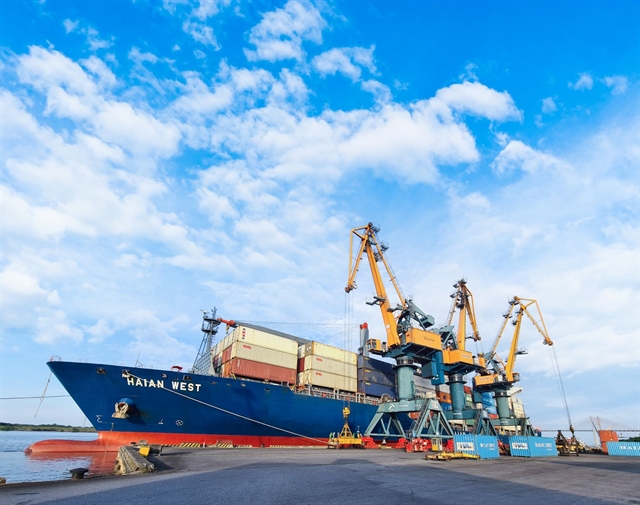
A container ship managed and operated by Hai An Transport & Stevedoring. — Photo haiants.vn
HÀ NỘI — The Vietnamese transport sector has witnessed significant divergence in performance during the first half of 2025, with leading companies reporting robust growth while others, particularly those with ageing fleets, facing declining profits.
This trend reflects the broader dynamics of Việt Nam's trade landscape, which has seen a substantial increase in export and import activity.
According to the General Statistics Office, Việt Nam’s total export-import turnover reached US$432 billion in the first half of 2025, marking a 16.1 per cent increase from the same period last year. Key export commodities, including textiles, footwear, computers and electronic components, maintained double-digit growth, driven by rising demand and a strategy of front-loading to mitigate the impacts of changing tariffs.
In the medium to long term, companies are diversifying their export markets and increasing local content to leverage signed trade agreements, thereby expanding their consumer base and reducing the impact of US tariffs.
As a direct consequence of the shifts in trade flows, the transport sector has experienced a notable difference in performance.
For instance, Hai An Transport & Stevedoring JSC reported a remarkable revenue increase of 47.9 per cent to VNĐ2.44 trillion ($93 million) in the first half of 2025, with profit after tax soaring by 291.3 per cent to VNĐ688 billion. This result meant the company achieved 79.5 per cent of its annual profit target in just six months.
In February, Hai An successfully acquired another container ship, Haian Zeta, with a capacity of 1,702 TEU, increasing its fleet to 17 vessels primarily focused on intra-Asian routes.
However, Haian Zeta has been chartered to partner Sealead Shipping for operations on the route from the Mediterranean and North Africa to the east coast of the US. This marks Hai An's first foray into the US market, paving the way for future investments in long-haul routes to destinations like the US and Europe.
Previously, Hai An has also been proactive in modernising its fleet, adding vessels including Haian Link and Haian Bell (2018), Haian Mind (2019), Haian East and Haian West (2021), as well as Anbien Bay, Haian City and A Roku (2022).
In 2024, the company expanded its operations further by taking delivery of four new container ships.
In contrast, the PetroVietnam Transportation Corporation (PVTrans) saw its revenue rise by 29.3 per cent to VNĐ7.14 trillion, but its profit after tax fell by 6.1 per cent to VNĐ638 billion, completing only 66.4 per cent of its annual profit target.
Meanwhile, Vietnam Ocean Shipping JSC (Vosco) and Vinaship reported significant downturns.
Vosco’s profit before tax plummeted to a loss of VNĐ43.7 billion, while Vinaship's profit dropped dramatically by 98.7 per cent to just VNĐ440 million.
Until recently, neither company had made new investments for over a decade.
Vinaship invested in the Vinaship Unity vessel at the end of 2024, while Vosco announced plans to invest in 10 new vessels, with a total potential value of $414 million. However, their ageing fleets may hinder their operational efficiency compared to newer ships.
Given their performance, stock prices for Vosco and Vinaship have remained stagnant over the past seven months.
Hai An’s stock experienced a surge in May following tariff delays, but has since levelled off, showing only a slight decline of 1.2 per cent from late May to mid-August.
Looking ahead, Shinhan Securities Vietnam predicts that new tariffs imposed by the US are unlikely to trigger a surge in shipping volumes in the latter half of the year.
With average spot freight rates on major routes from the Far East to the US dropping significantly, the industry may face overcapacity challenges.
The long-term application of high tariffs on imported goods, particularly from China, could lead to shifts in maritime trade flows.
Analysts expect increased activity on intra-Asian and Asia-Europe routes as domestic companies adapt to mitigate the impacts of the US market. — BIZHUB/VNS
Source: VNS
Related News

BANKING / FINANCE / INSURANCE / TAX
REMITTANCES TO HCM CITY RISE NEARLY 40% IN Q3
Remittances to HCM City reached more than US$2.83 billion in the third quarter of this year, up 39.5 per cent from the previous quarter and 3.6 per cent year-on-year. This was the first quarter showing positive annual growth this year, helping narrow the decline in remittance inflows over the first nine months. According to the State Bank of Vietnam (SBV)’s Regional Branch 2, remittances transferred to HCM City through credit institutions and economic organisations totalled $2.835 billion in Q3, an increase of more than $802 million from the previous quarter.

TECHNOLOGY
TECH SECTOR GROWTH OPENS UP OPPORTUNITIES FOR VIỆT NAM TO GO GLOBAL
The growth of the electronics, semiconductor and high-tech sectors worldwide is opening up a variety of opportunities for Vietnamese enterprises to integrate more deeply into the global supply chain. However, to become suppliers for these corporations, domestic enterprises must meet rigorous standards regarding quality, technology, productivity and order fulfilment capabilities.

VIETNAM ECONOMY INVESTMENT
FOREIGN INVESTORS SEEKING A SYNCHRONISED MANUFACTURING ECOSYSTEM
Instead of focusing only on land costs and incentives as usual, foreign investors are seeking a synchronised manufacturing ecosystem, from stable power supply and logistics to shared infrastructure and the convenience of completing residence procedures for experts to serve their long-term investment in the country.

MEMBER CORNER / PROMOTIONS
SENTRYSAFE FHW40200 – PROTECT YOUR VALUABLES, ENJOY PEACE OF MIND!
Looking for a reliable solution to protect your important documents, cash, and valuables from fire and water damage? Genuine SENTRYSAFE - Reliable protection for your valuables and peace of mind! Contact Sen Wai Vietnam for more information and personalized product recommendations.

PROPERTY / INDUSTRIAL ZONE
HCM CITY ATTRACTS US$5.7 BILLION INTO EXPORT PROCESSING AND INDUSTRIAL ZONES
HCM City attracted US$5.7 billion in domestic and foreign investment into its export processing and industrial zones during the first nine months of 2026. The figure exceeded the city's full-year target by 31 per cent, highlighting strong momentum in high-quality industrial investment under Resolution No.10-NQ/TW. Total investment reached 131 per cent of the 2026 target of $4.25 billion and represented a 29 per cent increase compared with the same period in 2025, according to the city's Export Processing and Industrial Zones Authority (HEPZA).

INFRASTRUCTURE / CONSTRUCTION / LOGISTIC / PORT
DONG THAP PROVINCE STEPS UP INDUSTRIAL EXPANSION AND INFRASTRUCTURE CONNECTIVITY
Accelerating public investment, strengthening inter-regional connectivity, and expanding industrial land are helping Dong Thap efficiently bolster competitiveness and drive economic growth. Following the 2025 merger of the former Dong Thap and Tien Giang provinces, the expanded Dong Thap province in the Mekong Delta faces mounting pressure to accelerate infrastructure development and strengthen connectivity among local economic zones, urban areas, industrial parks (IPs), and production centres.
Events Sponsors






















