Want to be in the loop?
subscribe to
our notification
Business News
TEXTILE STOCKS LOOK POSITIVE AMID GLOBAL SUPPLY CHAIN SHIFTS
The US may further outsource textile production, benefiting countries like Việt Nam.
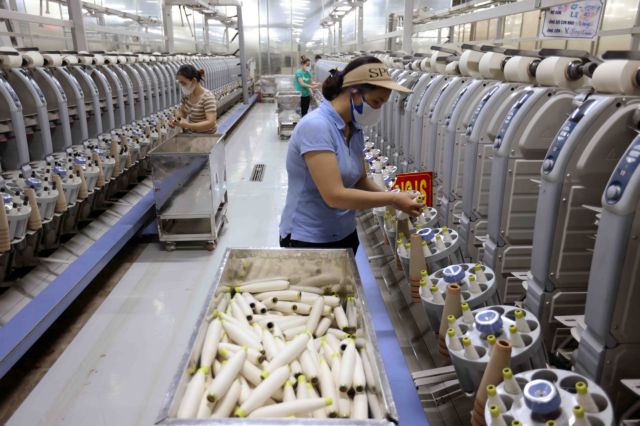
Workers at a yarn production line. — VNA/VNS Photo
HÀ NỘI — Việt Nam’s textile and garment sector is experiencing a significant upswing, driven by favourable global dynamics and robust export performance.
Recent statements from the US President Donald Trump, suggesting a shift in American industrial focus away from traditional manufacturing, have been interpreted by investors as an opportunity for Việt Nam to expand its role in global apparel supply chains.
Speaking in New Jersey, Trump emphasised that the US should concentrate on advanced industries such as artificial intelligence and military equipment, rather than traditional manufacturing like apparel.
This perspective has been perceived as an indication that the US may further outsource textile production, benefiting countries like Việt Nam.
The Vietnamese stock market responded positively to these developments.
On May 26, shares of several textile companies, including Vinatex (VGT), TNG Investment and Trading JSC (TNG), Hòa Thọ Textile & Garment JSC (HTG), Thành Công Textile Garment Investment Trading JSC (TCM), Sông Hồng Garment (MSH) and GIlimex (GIL), hit their daily biggest gains.
The momentum continued into the following day, with HTG maintaining its upper limit and other stocks like TNG, VGT and TCM posting gains exceeding 6 per cent. This surge reflects renewed investor confidence in the sector's growth prospects
Việt Nam’s position as the world's second-largest textile exporter, trailing only China, underscores its significance in the global market.
According to the General Department of Việt Nam Customs, the country's textile and garment exports reached US$8.69 billion in the first quarter of 2025, with the US accounting for 43.6 per cent of this figure.
April saw a 15 per cent year-over-year increase, totalling $3.64 billion.
Several factors contribute to this positive outlook.
Major US retailers are reportedly facing low inventory levels, particularly for fall and winter apparel, with stock sufficient for only six to eight weeks.
The decline in Chinese market share in Japan and South Korea may be attributed to increased scrutiny of tax evasion practices by Chinese companies amid ongoing trade negotiations between the US and its trading partners.
Simultaneously, competitors like Bangladesh and Pakistan are grappling with energy shortages and political instability, hindering their production capabilities.
This scenario positions Việt Nam as a reliable alternative for international buyers seeking stable supply chains.
Domestic garment production also remains robust, as evidenced by the Industrial Production Index (IIP) and labour indices consistently showing upward trends without any months of contraction since the beginning of this year.
Typically, textile production experiences one or two months of contraction in the first quarter due to seasonal low demand and holidays.
Previously, during the May seminar organised by Vinatex, Dr Lê Tiến Trường, chairman of Vinatex's Board of Directors, highlighted the significant opportunities for orders in the textile industry during the first six months of the year, suggesting that this positive trend could extend through the end of the third quarter of 2025.
Trường also said that between now and July 10, the US may introduce temporary countervailing tax policies for Việt Nam, pending the outcomes of negotiations between the Ministry of Industry and Trade and the government.
Even though orders in Q3 could remain strong due to low US inventories, Q4 may experience a decline of around 10 per cent due to reduced consumer demand in the US, he added.
Industry experts suggest that the current market conditions could herald a new growth phase for Vietnamese textile stocks.
Technical analyses indicate that these stocks have surpassed medium-term resistance levels, and any supportive international policies or increased order volumes could further propel their ascent.
However, challenges persist. A recent increase in domestic electricity prices, effective from May 10, has raised production costs, particularly affecting yarn manufacturers with narrow profit margins.
Companies must navigate these cost pressures while capitalising on emerging global opportunities. — BIZHUB/VNS
Source: VNS
Related News
VIETNAM ECONOMY INVESTMENT
FOREIGN INVESTORS SEEKING A SYNCHRONISED MANUFACTURING ECOSYSTEM
Instead of focusing only on land costs and incentives as usual, foreign investors are seeking a synchronised manufacturing ecosystem, from stable power supply and logistics to shared infrastructure and the convenience of completing residence procedures for experts to serve their long-term investment in the country.
INFRASTRUCTURE / CONSTRUCTION / LOGISTIC / PORT
DONG THAP PROVINCE STEPS UP INDUSTRIAL EXPANSION AND INFRASTRUCTURE CONNECTIVITY
Accelerating public investment, strengthening inter-regional connectivity, and expanding industrial land are helping Dong Thap efficiently bolster competitiveness and drive economic growth. Following the 2025 merger of the former Dong Thap and Tien Giang provinces, the expanded Dong Thap province in the Mekong Delta faces mounting pressure to accelerate infrastructure development and strengthen connectivity among local economic zones, urban areas, industrial parks (IPs), and production centres.
PROPERTY / INDUSTRIAL ZONE
HCM CITY ATTRACTS US$5.7 BILLION INTO EXPORT PROCESSING AND INDUSTRIAL ZONES
HCM City attracted US$5.7 billion in domestic and foreign investment into its export processing and industrial zones during the first nine months of 2026. The figure exceeded the city's full-year target by 31 per cent, highlighting strong momentum in high-quality industrial investment under Resolution No.10-NQ/TW. Total investment reached 131 per cent of the 2026 target of $4.25 billion and represented a 29 per cent increase compared with the same period in 2025, according to the city's Export Processing and Industrial Zones Authority (HEPZA).

BANKING / FINANCE / INSURANCE / TAX
REMITTANCES TO HCM CITY RISE NEARLY 40% IN Q3
Remittances to HCM City reached more than US$2.83 billion in the third quarter of this year, up 39.5 per cent from the previous quarter and 3.6 per cent year-on-year. This was the first quarter showing positive annual growth this year, helping narrow the decline in remittance inflows over the first nine months. According to the State Bank of Vietnam (SBV)’s Regional Branch 2, remittances transferred to HCM City through credit institutions and economic organisations totalled $2.835 billion in Q3, an increase of more than $802 million from the previous quarter.
VIETNAM ECONOMY INVESTMENT
LOCALITIES REPORT BREAKTHROUGH RESULTS IN FDI IN FIRST NINE MONTHS
In Ho Chi Minh City, total registered capital reached $17.2 billion in the first nine months, up 4.2 times from the same period last year. The figure included more than $9.35 billion in newly registered capital and over $4.9 billion in additional capital for existing projects. Foreign investors also registered more than $2.9 billion through capital contributions and share purchases.

TECHNOLOGY
TECH SECTOR GROWTH OPENS UP OPPORTUNITIES FOR VIỆT NAM TO GO GLOBAL
The growth of the electronics, semiconductor and high-tech sectors worldwide is opening up a variety of opportunities for Vietnamese enterprises to integrate more deeply into the global supply chain. However, to become suppliers for these corporations, domestic enterprises must meet rigorous standards regarding quality, technology, productivity and order fulfilment capabilities.
Events Sponsors






















