Want to be in the loop?
subscribe to
our notification
Business News
TEXTILE AND GARMENT SECTOR SEES EXPORT GROWTH
The domestic textiles and garment industry is witnessing a surge in export orders in 2025, driven by a positive economic outlook and competitive advantages, positioning the country as a key player in the global market.
Accordingly, Vietnam posted $3.19 billion in textiles and garments industry exports in January – a 1.8 per cent increase from the same period last year – driven by robust demand from major markets such as the United States, EU, and Japan.
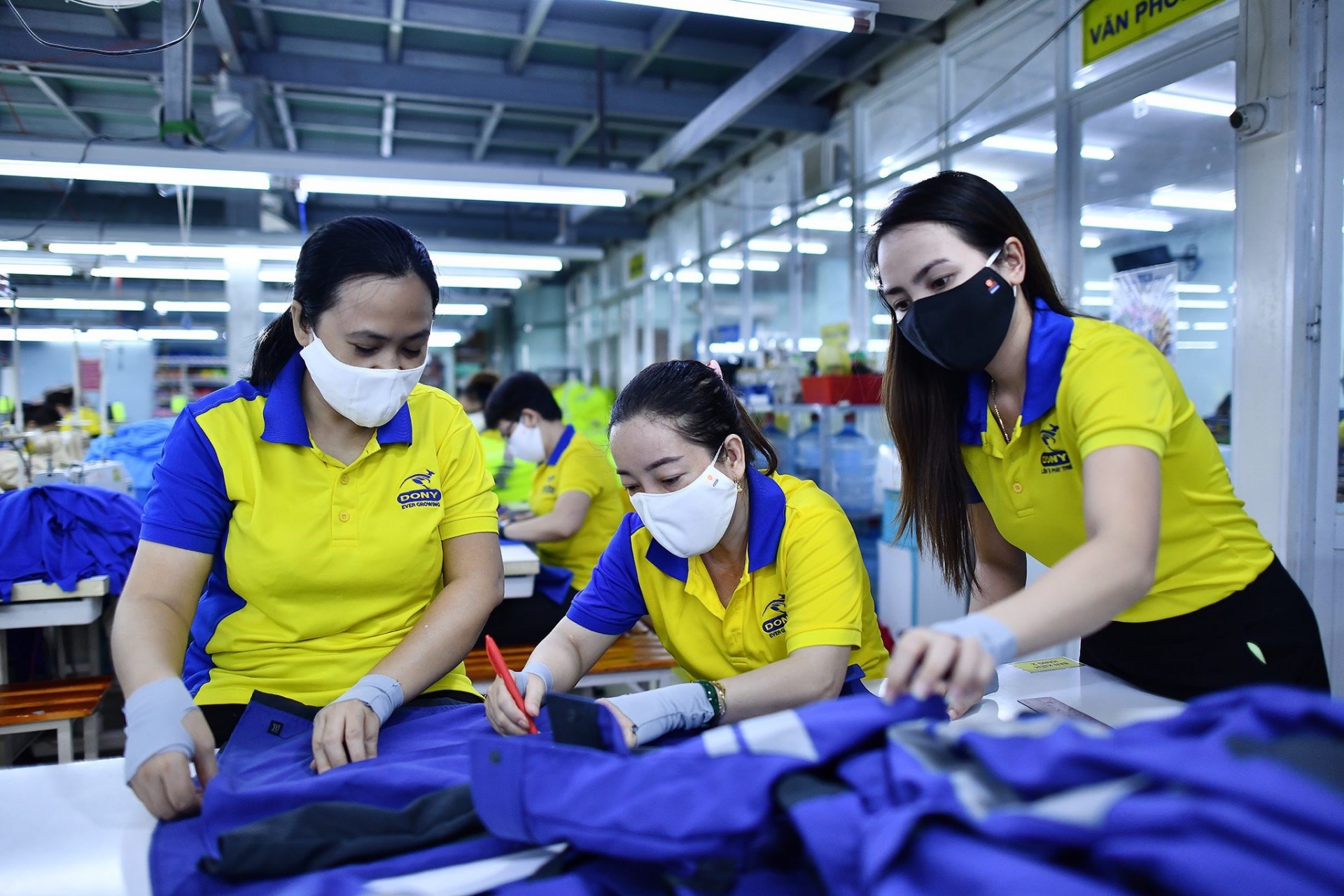
Photo: baodautu.vn
Orders have already been booked through Q2, with some extending into Q3.
“Our company has secured significant orders for Q2 of 2025, setting a strong pace for the year,” said Than Duc Viet, general director of Garment 10 Corporation.
Garment 10 is actively expanding its reach in both domestic and export markets, targeting traditional markets in the US, EU, and Japan while exploring opportunities in South Korea, China, and other Asian nations. The company underscored the sector’s potential in 2024 by posting $187.9 million in total revenue and $5.26 million in pre-tax profit, up 10 per cent and 7 per cent on-year, respectively.
TNG Investment and Trading JSC revealed that many of its factories have locked in orders through Q2, with 46 per cent of exports headed to the US and 13 per cent to the EU. Song Hong Garment JSC directs over 70 per cent of its exports to the US and plans to expand production capacity by 25 per cent in 2025.
Meanwhile, Thanh Cong Textile Investment Trading JSC has successfully filled its Q1 orders and is actively fulfilling contracts for Q2. The company plans to develop a strategic business plan aimed at enhancing value for shareholders and investors, with primary export markets in Asia accounting for 68 per cent of its exports, followed by the Americas at 27.4 per cent and Europe at 4.2 per cent in 2025.
State conglomerate Vietnam National Textile and Garment Group reported that several subsidiaries have already received orders through Q3 of this year, with additional negotiations underway. To meet rising Spring-Summer demand, many companies have ramped up production schedules to ensure timely order fulfilment, sustaining the recovery momentum that began in late 2024.
However, challenges remain. According to SSI Research, the industry is expected to return to a compound annual growth rate of 13–15 per cent in 2025 – similar to 2015–2019. Rising shipping costs are also a concern, with freight rates increasing by 3 per cent for Asia-to-US West Coast routes and 1 per cent for Asia-to-US East Coast routes, according to Eimskip, Iceland’s leading shipping and logistics company. Transportation expenses are projected to rise by 10–15 per cent on-year, which may pressure profit margins despite a forecast 15 per cent revenue growth.
In 2024, Vietnam surpassed Bangladesh to become the world’s second-largest textiles and apparel exporter, trailing only China, with total export revenues reaching $44 billion.
SSI Research notes that Vietnam’s textile and apparel industry maintains a competitive edge thanks to tariffs 10–20 per cent lower than China’s and significantly cheaper labour costs—less than half of China’s, which rose 40 per cent from 2019 to 2023.
Vietnam’s textile and apparel industry is poised for continued expansion in 2025, leveraging cost advantages, rapid production turnaround, and strong global demand while proactively managing rising logistics costs and adapting to shifting trade dynamics to solidify its position in the competitive international market.
Source: VIR
Related News
VIETNAM ECONOMY INVESTMENT
FOREIGN INVESTORS SEEKING A SYNCHRONISED MANUFACTURING ECOSYSTEM
Instead of focusing only on land costs and incentives as usual, foreign investors are seeking a synchronised manufacturing ecosystem, from stable power supply and logistics to shared infrastructure and the convenience of completing residence procedures for experts to serve their long-term investment in the country.
INFRASTRUCTURE / CONSTRUCTION / LOGISTIC / PORT
DONG THAP PROVINCE STEPS UP INDUSTRIAL EXPANSION AND INFRASTRUCTURE CONNECTIVITY
Accelerating public investment, strengthening inter-regional connectivity, and expanding industrial land are helping Dong Thap efficiently bolster competitiveness and drive economic growth. Following the 2025 merger of the former Dong Thap and Tien Giang provinces, the expanded Dong Thap province in the Mekong Delta faces mounting pressure to accelerate infrastructure development and strengthen connectivity among local economic zones, urban areas, industrial parks (IPs), and production centres.
PROPERTY / INDUSTRIAL ZONE
HCM CITY ATTRACTS US$5.7 BILLION INTO EXPORT PROCESSING AND INDUSTRIAL ZONES
HCM City attracted US$5.7 billion in domestic and foreign investment into its export processing and industrial zones during the first nine months of 2026. The figure exceeded the city's full-year target by 31 per cent, highlighting strong momentum in high-quality industrial investment under Resolution No.10-NQ/TW. Total investment reached 131 per cent of the 2026 target of $4.25 billion and represented a 29 per cent increase compared with the same period in 2025, according to the city's Export Processing and Industrial Zones Authority (HEPZA).

BANKING / FINANCE / INSURANCE / TAX
REMITTANCES TO HCM CITY RISE NEARLY 40% IN Q3
Remittances to HCM City reached more than US$2.83 billion in the third quarter of this year, up 39.5 per cent from the previous quarter and 3.6 per cent year-on-year. This was the first quarter showing positive annual growth this year, helping narrow the decline in remittance inflows over the first nine months. According to the State Bank of Vietnam (SBV)’s Regional Branch 2, remittances transferred to HCM City through credit institutions and economic organisations totalled $2.835 billion in Q3, an increase of more than $802 million from the previous quarter.
VIETNAM ECONOMY INVESTMENT
LOCALITIES REPORT BREAKTHROUGH RESULTS IN FDI IN FIRST NINE MONTHS
In Ho Chi Minh City, total registered capital reached $17.2 billion in the first nine months, up 4.2 times from the same period last year. The figure included more than $9.35 billion in newly registered capital and over $4.9 billion in additional capital for existing projects. Foreign investors also registered more than $2.9 billion through capital contributions and share purchases.

TECHNOLOGY
TECH SECTOR GROWTH OPENS UP OPPORTUNITIES FOR VIỆT NAM TO GO GLOBAL
The growth of the electronics, semiconductor and high-tech sectors worldwide is opening up a variety of opportunities for Vietnamese enterprises to integrate more deeply into the global supply chain. However, to become suppliers for these corporations, domestic enterprises must meet rigorous standards regarding quality, technology, productivity and order fulfilment capabilities.
Events Sponsors






















