Want to be in the loop?
subscribe to
our notification
Business News
SUPPORTING INDUSTRIES KEY TO SUSTAINABLE TEXTILE-GARMENT DEVELOPMENT
In 2025, Vietnam's textile and garment industry targets US$47-48 billion in export revenue, a US$3-4 billion increase from last year. To achieve this, businesses must expand markets and secure a proactive raw material supply while meeting strict standards on transparency, sustainability and labor compliance from key importers like the U.S. and the EU.
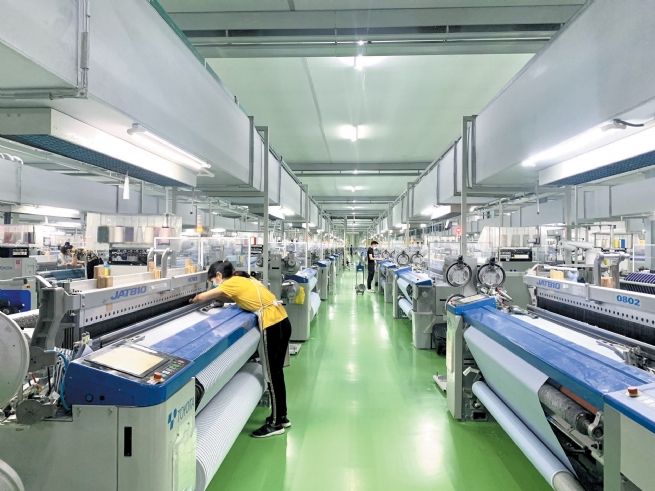
Developing supporting industries is key for Vietnam’s textile and garment industry to enhance cost control, competitiveness, and supply chain autonomy, strengthening its global position and sustainable growth
Vietnam’s textile and garment industry faces a major challenge: reliance on imports. About 70% of raw materials come from China due to an underdeveloped domestic textile and dyeing sector. This dependence hinders cost control and weakens global competitiveness.
The ongoing "export yarn, import fabric" issue creates obstacles. Companies face rising input costs amid global inflation, squeezing profit margins. Even basic accessories like buttons and zippers depend on imports, raising costs and reducing flexibility.
The lack of domestic supply makes businesses vulnerable to global supply chain disruptions. As importers tighten regulations on origin and sustainability, Vietnam’s textile industry must transform to sustain and grow exports.
According to the Department of Industry, Ministry of Industry and Trade, the lack of a robust domestic supply chain has left textile and garment businesses susceptible to global supply chain fluctuations. As importers impose stricter requirements on origin and sustainability, the industry must adapt swiftly to sustain and grow its market presence. To facilitate this transition, the government has been implementing policies to promote the development of supporting industries, creating favorable conditions for domestic manufacturers to produce raw materials, reduce import dependence and enhance competitiveness on the international stage.
As part of these efforts, the government has introduced various support measures for domestic raw material manufacturers. The issuance of Decree 115/2024/ND-CP provides a clear legal framework for investment in supporting industries, particularly within the textile and garment sector.
The government is also reviewing amendments to Decree 111/2015/ND-CP to further support domestic enterprises. Policies like tax incentives, fee reductions and preferential loan rates for raw material manufacturers are key to strengthening the industry's global competitiveness.
The Vietnam Textile and Apparel Association (VITAS) is working closely with enterprises to foster a domestic supply chain. Truong Van Cam, Vice Chairman of VITAS, emphasized that the establishment of a fashion materials center would enable local businesses to access high-quality supplies, reduce reliance on imports, and better leverage the benefits of free trade agreements (FTAs). This move not only enhances production autonomy but also mitigates risks associated with global supply chain disruptions.
Attracting investment from multinational corporations and supporting local enterprises in developing supporting industries remains a top priority. Some foreign direct investment (FDI) enterprises have been investing in fabric production in Vietnam since 2018. Over 15 years, only 10% of FDI textile and garment products have been used domestically, helping meet origin requirements in many FTAs and providing local firms with tax benefits and lower material costs.
A noteworthy recent project is the high-tech fabric manufacturing complex by Syre Group in Nhon Hoi A Industrial Park, Binh Dinh, with an investment of US$700 million to US$1 billion. Tim King, Senior Operations Director at Syre said that the complex will employ advanced technology to meet international environmental protection and green production standards. Notably, the project will incorporate recycled materials from clothing and textile waste, marking a significant step toward a circular economy and reducing Vietnam’s reliance on imported materials.
Moreover, enterprises must focus on technological innovation. The adoption of automation, artificial intelligence (AI) and robotics in production processes not only enhances efficiency but also lowers costs, improves stability and ensures compliance with increasingly stringent export standards under FTAs. For instance, Garment 10 Corporation has integrated automated machinery and AI to optimize productivity and labor costs, laying a strong foundation for sustainable development.
For long-term growth, the textile industry must move beyond contract manufacturing to a full-scale industrial upgrade. Developing supporting industries is key to cost control, competitiveness, and supply chain autonomy. Securing domestic raw materials will help Vietnam strengthen its global position and achieve sustainable growth.
Source: VCCI
Related News

VIETNAM ECONOMY INVESTMENT
FOREIGN INVESTORS SEEKING A SYNCHRONISED MANUFACTURING ECOSYSTEM
Instead of focusing only on land costs and incentives as usual, foreign investors are seeking a synchronised manufacturing ecosystem, from stable power supply and logistics to shared infrastructure and the convenience of completing residence procedures for experts to serve their long-term investment in the country.

INFRASTRUCTURE / CONSTRUCTION / LOGISTIC / PORT
DONG THAP PROVINCE STEPS UP INDUSTRIAL EXPANSION AND INFRASTRUCTURE CONNECTIVITY
Accelerating public investment, strengthening inter-regional connectivity, and expanding industrial land are helping Dong Thap efficiently bolster competitiveness and drive economic growth. Following the 2025 merger of the former Dong Thap and Tien Giang provinces, the expanded Dong Thap province in the Mekong Delta faces mounting pressure to accelerate infrastructure development and strengthen connectivity among local economic zones, urban areas, industrial parks (IPs), and production centres.

PROPERTY / INDUSTRIAL ZONE
HCM CITY ATTRACTS US$5.7 BILLION INTO EXPORT PROCESSING AND INDUSTRIAL ZONES
HCM City attracted US$5.7 billion in domestic and foreign investment into its export processing and industrial zones during the first nine months of 2026. The figure exceeded the city's full-year target by 31 per cent, highlighting strong momentum in high-quality industrial investment under Resolution No.10-NQ/TW. Total investment reached 131 per cent of the 2026 target of $4.25 billion and represented a 29 per cent increase compared with the same period in 2025, according to the city's Export Processing and Industrial Zones Authority (HEPZA).

BANKING / FINANCE / INSURANCE / TAX
REMITTANCES TO HCM CITY RISE NEARLY 40% IN Q3
Remittances to HCM City reached more than US$2.83 billion in the third quarter of this year, up 39.5 per cent from the previous quarter and 3.6 per cent year-on-year. This was the first quarter showing positive annual growth this year, helping narrow the decline in remittance inflows over the first nine months. According to the State Bank of Vietnam (SBV)’s Regional Branch 2, remittances transferred to HCM City through credit institutions and economic organisations totalled $2.835 billion in Q3, an increase of more than $802 million from the previous quarter.
VIETNAM ECONOMY INVESTMENT
LOCALITIES REPORT BREAKTHROUGH RESULTS IN FDI IN FIRST NINE MONTHS
In Ho Chi Minh City, total registered capital reached $17.2 billion in the first nine months, up 4.2 times from the same period last year. The figure included more than $9.35 billion in newly registered capital and over $4.9 billion in additional capital for existing projects. Foreign investors also registered more than $2.9 billion through capital contributions and share purchases.

TECHNOLOGY
TECH SECTOR GROWTH OPENS UP OPPORTUNITIES FOR VIỆT NAM TO GO GLOBAL
The growth of the electronics, semiconductor and high-tech sectors worldwide is opening up a variety of opportunities for Vietnamese enterprises to integrate more deeply into the global supply chain. However, to become suppliers for these corporations, domestic enterprises must meet rigorous standards regarding quality, technology, productivity and order fulfilment capabilities.
Events Sponsors






















