Want to be in the loop?
subscribe to
our notification
Business News
STATE-OWNED ENTERPRISES SET TO BECOME A STRONGER DRIVER OF ECONOMIC GROWTH
As Việt Nam strives to achieve double-digit economic growth, enhancing the operational efficiency of SOEs while reinforcing their pioneering and leading role has become an urgent priority.
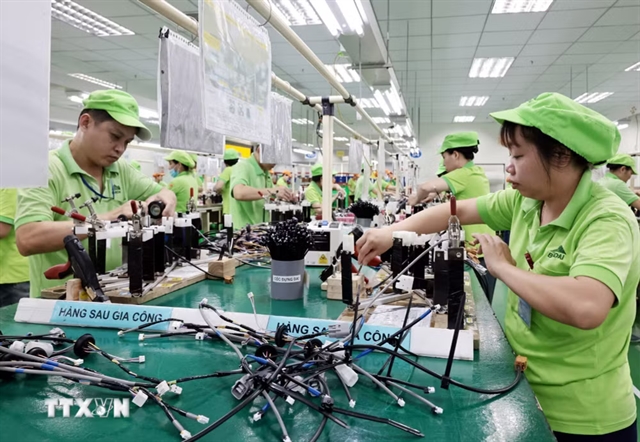
Electrical wiring harness production line at an enterprise in Phú Thọ. — VNA/VNS Photo
HÀ NỘI — Although state-owned enterprises (SOEs) account for only a small proportion of the total number of businesses, they continue to control substantial resources across many strategic sectors and make significant contributions to the national economy.
As Việt Nam strives to achieve double-digit economic growth, enhancing the operational efficiency of SOEs while reinforcing their pioneering and leading role has become an urgent priority.
According to the Ministry of Finance, the number of SOEs had declined dramatically from more than 12,000 in the 1990s to just 695 by the end of last year.
Despite this sharp reduction, these enterprises still held total assets worth VNĐ4.5 quadrillion (approximately US$172.5 billion) and contributed VNĐ390 trillion to the state budget.
SOEs’ new role in economic development
Resolution No. 79-NQ/TW, issued by the Politburo on January 6 this year on the development of the state sector, affirms that the state economy, with state-owned enterprises (SOEs) at its core, is an especially important component of Việt Nam's socialist-oriented market economy.
However, the resolution also acknowledges that SOEs have yet to operate efficiently enough to match their position and the resources they control. Their international competitiveness remains limited, and their pioneering role in innovation and leadership in key and essential industries has not been sufficiently demonstrated.
Against the backdrop of Việt Nam's ambition to achieve double-digit economic growth, Resolution 79 dentifies the state economy as the pioneer in creating development, leading the way, promoting industrialisation and modernisation, restructuring the economy, and establishing a new growth model driven primarily by science and technology, innovation, and digital transformation.
Accordingly, restructuring SOEs must be accelerated to improve operational efficiency through the adoption of advanced technologies and modern corporate governance practices that meet international standards. At the same time, Việt Nam aims to build large state-owned economic groups, corporations, and enterprises capable of leading strategic and essential sectors of the economy.
Hoàng Văn Cường, former vice rector of the National Economics University, believes that the restructuring of SOEs has entered a new phase requiring changes not only in organisational models but also in governance mindset. In line with Resolution 79, the objective is no longer merely to reorganise, downsize or address historical shortcomings, but focus on developing a more efficient SOE sector with stronger international competitiveness and sufficient capacity to drive the national economy.
The new direction calls for the establishment of diversified ownership economic groups capable of mastering advanced technologies and integrating deeply into global value chains, rather than concentrating solely on equitisation or state capital divestment, said Cường.
To achieve this objective, Việt Nam must first reform its management model by clearly separating the state's regulatory function from its role as the owner of state capital.
Agribank supports businesses in accelerating growth in 2026. — Photo Vietnam+
Restructuring priorities for greater efficiency
Phan Đức Hiếu, a member of the 16th National Assembly and the National Assembly's Committee for Economic and Financial Affairs, emphasised that the most important task in the coming period is to establish a common understanding of SOE restructuring. Restructuring should not simply mean reducing the number of enterprises through mergers, dissolution, or capital divestment.
Its fundamental objective should be to enhance the efficiency and competitiveness of SOEs and the state sector as a whole, in line with Resolution 79's vision of SOEs serving as leaders, pathfinders, and drivers of innovation.
To achieve this objective, Hiếu proposed three key groups of solutions. First, long-standing financial, legal, and land-related issues must be comprehensively resolved, as these have become persistent bottlenecks hindering equitisation, ownership transfer, and enterprise restructuring.
Many SOEs still face situations where their charter capital exists only on paper but has not been fully contributed in practice. Land-use plans remain unclear, while numerous assets and projects cannot yet be accurately valued during ownership transfer.
The Ministry of Finance should conduct a comprehensive review of these obstacles, classify them according to the relevant authorities, and submit appropriate solutions to the National Assembly, the Government, or relevant ministries for final resolution, said Hiếu. If necessary, a special resolution could be introduced to address outstanding issues arising during the equitisation and restructuring of SOEs.
The second group of solutions focuses on improving corporate governance in accordance with international best practices. Việt Nam should not simply adopt the OECD Corporate Governance Principles wholesale. Instead, it should selectively apply provisions that are appropriate for different categories of enterprises and sectors.
These principles should then be institutionalised through the legal system, particularly regulations governing modern corporate governance, professional executive recruitment and the appointment of independent board members.
The third solution is to shift decisively from an administrative approach to restructuring and state capital divestment toward a market-oriented mechanism. The sale of state capital should not follow rigid plans but should instead be guided by market demand, as investors are more interested in a company's business prospects than in the value of its assets alone.
In practice, many state-owned economic groups have already begun implementing modern governance models.
Speaking at a recent online seminar on SOE governance, Nguyễn Thị Sơn Bình, deputy director of the SME Service Center under Viettel Telecom Corporation, stated that Viettel's mission extends beyond business development. The company aims to become a core force in building open economic ecosystems that connect state-owned enterprises, private businesses and household enterprises to generate synergies across the economy.
Viettel has adopted a lean management model, using digital transformation and innovation as key drivers of growth. The company has significantly reduced unnecessary management layers to shorten information flows and accelerate decision-making, viewing speed as a fundamental competitive advantage in today's rapidly evolving technological environment.
Sharing the view that institutional bottlenecks must be removed to accelerate restructuring, Doãn Thanh Tuấn, deputy director general of the Department of State-Owned Enterprise Development under the Ministry of Finance, observed that several factors have slowed SOE restructuring, with implementation capacity being among the most critical.
Besides objective constraints, there remains a widespread reluctance among officials to make decisions due to concerns about violating regulations or making mistakes, he said.
SOE restructuring has been slowed by a multi-layered management system, incomplete decentralisation, and lengthy approval procedures, said Tuấn.
He said key priorities ahead include protecting officials who act properly and transparently, streamlining the legal framework, and strengthening decentralisation with stronger post-implementation oversight.
He added that these directions have been reflected in recent policies and regulations. The Ministry of Public Security is drafting a resolution on special mechanisms to address legal issues related to economic development, while the Ministry of Finance is developing criteria for SOE classification and further guidance to support the restructuring process. — VNS
Source: VNS
Related News

BANKING / FINANCE / INSURANCE / TAX
REMITTANCES TO HCM CITY RISE NEARLY 40% IN Q3
Remittances to HCM City reached more than US$2.83 billion in the third quarter of this year, up 39.5 per cent from the previous quarter and 3.6 per cent year-on-year. This was the first quarter showing positive annual growth this year, helping narrow the decline in remittance inflows over the first nine months. According to the State Bank of Vietnam (SBV)’s Regional Branch 2, remittances transferred to HCM City through credit institutions and economic organisations totalled $2.835 billion in Q3, an increase of more than $802 million from the previous quarter.

TECHNOLOGY
TECH SECTOR GROWTH OPENS UP OPPORTUNITIES FOR VIỆT NAM TO GO GLOBAL
The growth of the electronics, semiconductor and high-tech sectors worldwide is opening up a variety of opportunities for Vietnamese enterprises to integrate more deeply into the global supply chain. However, to become suppliers for these corporations, domestic enterprises must meet rigorous standards regarding quality, technology, productivity and order fulfilment capabilities.
VIETNAM ECONOMY INVESTMENT
FOREIGN INVESTORS SEEKING A SYNCHRONISED MANUFACTURING ECOSYSTEM
Instead of focusing only on land costs and incentives as usual, foreign investors are seeking a synchronised manufacturing ecosystem, from stable power supply and logistics to shared infrastructure and the convenience of completing residence procedures for experts to serve their long-term investment in the country.
MEMBER CORNER / PROMOTIONS
SENTRYSAFE FHW40200 – PROTECT YOUR VALUABLES, ENJOY PEACE OF MIND!
Looking for a reliable solution to protect your important documents, cash, and valuables from fire and water damage? Genuine SENTRYSAFE - Reliable protection for your valuables and peace of mind! Contact Sen Wai Vietnam for more information and personalized product recommendations.
PROPERTY / INDUSTRIAL ZONE
HCM CITY ATTRACTS US$5.7 BILLION INTO EXPORT PROCESSING AND INDUSTRIAL ZONES
HCM City attracted US$5.7 billion in domestic and foreign investment into its export processing and industrial zones during the first nine months of 2026. The figure exceeded the city's full-year target by 31 per cent, highlighting strong momentum in high-quality industrial investment under Resolution No.10-NQ/TW. Total investment reached 131 per cent of the 2026 target of $4.25 billion and represented a 29 per cent increase compared with the same period in 2025, according to the city's Export Processing and Industrial Zones Authority (HEPZA).
INFRASTRUCTURE / CONSTRUCTION / LOGISTIC / PORT
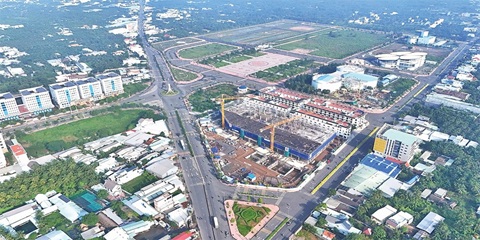
DONG THAP PROVINCE STEPS UP INDUSTRIAL EXPANSION AND INFRASTRUCTURE CONNECTIVITY
Accelerating public investment, strengthening inter-regional connectivity, and expanding industrial land are helping Dong Thap efficiently bolster competitiveness and drive economic growth. Following the 2025 merger of the former Dong Thap and Tien Giang provinces, the expanded Dong Thap province in the Mekong Delta faces mounting pressure to accelerate infrastructure development and strengthen connectivity among local economic zones, urban areas, industrial parks (IPs), and production centres.
Events Sponsors






















