Want to be in the loop?
subscribe to
our notification
Business News
SOUTHEAST MEKONG DELTA PROVINCES SHOW POSITIVE SIGNS IN ATTRACTING FDI IN 2025
Provinces in the Southeast Mekong Delta are demonstrating strong potential in attracting foreign investment and are forecast to remain key FDI destinations in Việt Nam.
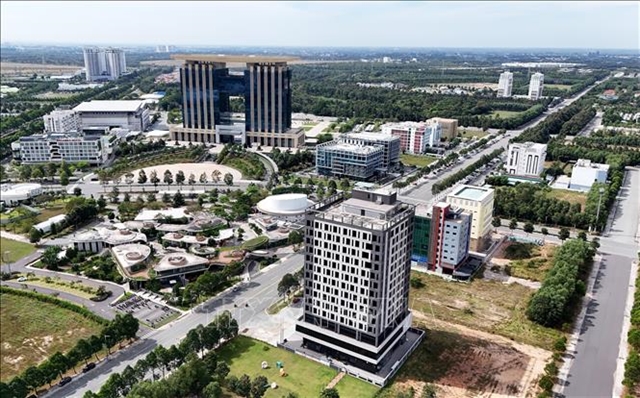
Southeastern Mekong Delta provinces are showing strong signs of attracting foreign investment, and are forecast to continue as prime FDI destinations. – VNA/VNS Photo
HCM CITY – Provinces in the Southeast Mekong Delta are demonstrating strong potential in attracting foreign investment and are forecast to remain key FDI destinations in Việt Nam.
According to Bình Dương Province’s Department of Planning and Investment, despite global economic challenges, the province continues to attract FDI, surpassing last year’s target and ranking second nationwide in FDI attraction.
Since the beginning of the year the province has issued investment registration certificates for seven FDI projects amounting to nearly US$1 billion and primarily in high-tech industries, electronics component manufacturing and logistics.
This reflects a positive outlook for the province's socio-economic development and enhances its competitiveness in attracting international investment.
Wong Man Li, chairman of Man Wah Holding from China, expressed admiration for Bình Dương's economic growth, acknowledging its favourable investment environment. The company plans to expand its local operations by building a new factory and increasing production capacity.
Additionally, the province is collaborating with the World Bank to develop industrial parks based on the eco-industrial park model, utilising green energy and operating under a “smart” operations centre.
According to the province’s plans for 2021-30 period, the development of new-generation industrial parks is a crucial foundation for attracting investment in high-tech industries.
Meanwhile, Đồng Nai Province recently granted investment certificates for seven FDI projects worth US$243 million.
It aims to attract US$1.1 billion in FDI this year, but has already secured US$690 million.
Mostly located in industrial zones, they prioritise environmentally friendly, high-tech and less labour-intensive operations. Investors plan to accelerate factory construction, with some facilities expected to be completed within 6 to 18 months.
Advantages in FDI attraction
Experts attribute Bình Dương Province's success in attracting FDI to its robust infrastructure, attractive investment policies and favourable business environment.
Its focus on high-tech industries makes it an appealing destination for foreign investors, particularly in smart manufacturing, green technology and digital transformation.
Additionally, Bình Dương is implementing administrative reforms to streamline investment licensing, assist businesses in overcoming challenges, and foster a more investor-friendly environment.
Mai Hùng Dũng, deputy chairman of the Bình Dương People's Committee, said the province was steadily implementing measures to attract FDI inflows, prioritising the development of industrial parks, with nearly 20,000 hectares planned along key transport routes to create a new industrial belt that would drive economic growth and further investment.
Similarly, Đồng Nai Province is developing four new industrial zones, adding over 2,500 hectares of industrial land to attract investors, namely Bàu Cạn - Tân Hiệp, Phước Bình 2, Long Đức 3, and Xuân Quế - Sông Nhạn.
Võ Tấn Đức, chairman of the Đồng Nai People's Committee, said the province was enhancing its investment environment to attract FDI projects in various sectors including tourism, agriculture, infrastructure, and property.
It was also committed to supporting businesses by promptly addressing challenges and ensuring smooth operations, and would engage with domestic and foreign companies for feedback, and provide necessary support for them to attend domestic and international investment promotion events, he added. – VNS
Source: VNS
Related News

BANKING / FINANCE / INSURANCE / TAX
REMITTANCES TO HCM CITY RISE NEARLY 40% IN Q3
Remittances to HCM City reached more than US$2.83 billion in the third quarter of this year, up 39.5 per cent from the previous quarter and 3.6 per cent year-on-year. This was the first quarter showing positive annual growth this year, helping narrow the decline in remittance inflows over the first nine months. According to the State Bank of Vietnam (SBV)’s Regional Branch 2, remittances transferred to HCM City through credit institutions and economic organisations totalled $2.835 billion in Q3, an increase of more than $802 million from the previous quarter.

TECHNOLOGY
TECH SECTOR GROWTH OPENS UP OPPORTUNITIES FOR VIỆT NAM TO GO GLOBAL
The growth of the electronics, semiconductor and high-tech sectors worldwide is opening up a variety of opportunities for Vietnamese enterprises to integrate more deeply into the global supply chain. However, to become suppliers for these corporations, domestic enterprises must meet rigorous standards regarding quality, technology, productivity and order fulfilment capabilities.

VIETNAM ECONOMY INVESTMENT
FOREIGN INVESTORS SEEKING A SYNCHRONISED MANUFACTURING ECOSYSTEM
Instead of focusing only on land costs and incentives as usual, foreign investors are seeking a synchronised manufacturing ecosystem, from stable power supply and logistics to shared infrastructure and the convenience of completing residence procedures for experts to serve their long-term investment in the country.

MEMBER CORNER / PROMOTIONS
SENTRYSAFE FHW40200 – PROTECT YOUR VALUABLES, ENJOY PEACE OF MIND!
Looking for a reliable solution to protect your important documents, cash, and valuables from fire and water damage? Genuine SENTRYSAFE - Reliable protection for your valuables and peace of mind! Contact Sen Wai Vietnam for more information and personalized product recommendations.

PROPERTY / INDUSTRIAL ZONE
HCM CITY ATTRACTS US$5.7 BILLION INTO EXPORT PROCESSING AND INDUSTRIAL ZONES
HCM City attracted US$5.7 billion in domestic and foreign investment into its export processing and industrial zones during the first nine months of 2026. The figure exceeded the city's full-year target by 31 per cent, highlighting strong momentum in high-quality industrial investment under Resolution No.10-NQ/TW. Total investment reached 131 per cent of the 2026 target of $4.25 billion and represented a 29 per cent increase compared with the same period in 2025, according to the city's Export Processing and Industrial Zones Authority (HEPZA).

INFRASTRUCTURE / CONSTRUCTION / LOGISTIC / PORT
DONG THAP PROVINCE STEPS UP INDUSTRIAL EXPANSION AND INFRASTRUCTURE CONNECTIVITY
Accelerating public investment, strengthening inter-regional connectivity, and expanding industrial land are helping Dong Thap efficiently bolster competitiveness and drive economic growth. Following the 2025 merger of the former Dong Thap and Tien Giang provinces, the expanded Dong Thap province in the Mekong Delta faces mounting pressure to accelerate infrastructure development and strengthen connectivity among local economic zones, urban areas, industrial parks (IPs), and production centres.
Events Sponsors






















