Want to be in the loop?
subscribe to
our notification
Business News
RESOLUTION 79-NQ/TW: DRIVING BREAKTHROUGH IN STATE ECONOMY
Resolution No. 79-NQ/TW on the development of the state economic sector, issued by the Politburo in early 2026, aims not only to address long-standing bottlenecks in Vietnam’s state-owned enterprise (SOE) sector but also to redefine the sector’s role and leadership approach within a new growth model.
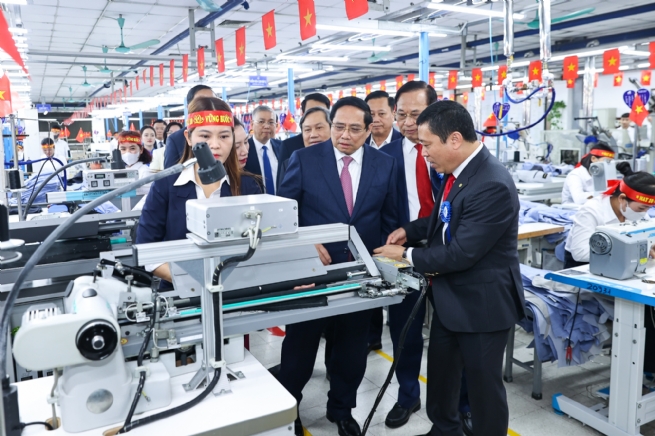
Prime Minister Pham Minh Chinh pays a working visit to Garment 10 Corporation, January 8, 2026
Party General Secretary To Lam recently signed Resolution No. 79-NQ/TW, dated January 6, 2026, which was issued by the Politburo on the development of the state economic sector.
The Resolution affirms that the state economic sector is a particularly important component of the socialist-oriented market economy. Over 80 years of development, and especially during nearly 40 years of the national renewal process, the state economic sector has maintained a leading role by orienting, guiding, and regulating economic activities, contributing to economic growth, macroeconomic stability, the maintenance of major economic balances, and the assurance of national defense and security…
However, despite these results, the state economic sector continues to face shortcomings and inefficiencies. To achieve the goal of becoming a developing country with modern industry by 2030 and a developed, high-income country by 2045, the Politburo calls for focused, decisive, coordinated, and effective implementation of key orientations and policies for the development of the state economic sector.
Advancing SOEs into the World’s Top 500
Regarding specific targets, the Resolution sets out a roadmap to 2030 that aims to place 50 SOEs among the 500 largest enterprises in Southeast Asia and 1 to 3 SOEs among the 500 largest enterprises worldwide.
The plan calls for the development of several strong state economic groups and SOEs with large scale, modern technology, and regional and international competitiveness. These entities are expected to play a pioneering role and guide domestic enterprises to participate more deeply in selected global production and supply chains, particularly in key and strategic sectors of the economy. Under the Resolution, 100% of SOEs are to implement modern corporate governance on digital platforms, and 100% of state economic groups and state-owned corporations are to fully apply the corporate governance principles of the Organization for Economic Co-operation and Development (OECD).
For state-owned credit institutions, the goal is to have at least three state-owned commercial banks ranked among the 100 largest banks in Asia by total assets.
For public service units, the policy continues to expand socialization in the provision of public services, further streamline organizational structures, and aim to retain only public service units that serve political missions, state management, and the provision of basic and essential public services.
With a vision to 2045, the state economic sector is to become a solid foundation for ensuring strategic autonomy, self-reliance, and comprehensive economic competitiveness. About 60 SOEs are to rank among the 500 largest enterprises in Southeast Asia; five SOEs are to be among the 500 largest enterprises globally; and at least 50% of public service units are to fully cover both recurrent and investment expenditures, or fully cover recurrent expenditures while operating effectively under market mechanisms.
Changing mindset and governance
In terms of general solutions, the Resolution calls for a transition from administrative control to development facilitation and modern governance. It requires a clear separation among ownership functions, economic management functions, and the execution of political missions. Mechanisms are to be established to protect officials who take initiative for the common interest, with clear distinctions between objective errors and legal violations to ensure appropriate handling. At the same time, databases on state economic entities and resources are to be standardized and interconnected to support policy formulation.
For specific solutions, the objective is to complete nationwide measurement, statistical work, digitization, and cleansing of the land data system by the end of 2026, and to connect and share it with other national data systems.
Enterprises, particularly SOEs, are encouraged to invest overseas in the exploration, extraction, and processing of mineral resources that are unavailable domestically or have limited reserves.
Basic surveys are to be strengthened, and data systems on marine and island resources are to be developed, together with plans for effective exploitation and use to support economic development in combination with national defense, security, and sovereignty protection. Priority is given to developing other key marine and island infrastructure works to meet economic development objectives and strengthen defense and security, with the aim of making the marine economy an important component of the state economic sector.
Appropriate mechanisms are to be issued to create a synchronized legal framework and implement controlled experimental frameworks (sandboxes) to promote the development of the space economy, low-altitude economy, and the aviation and aerospace industries.
Forms of mobilizing social resources and public-private partnerships are encouraged in the investment in and operation of underground works. Public-private partnership is promoted in the development and application of artificial intelligence and advanced digital technologies.
In addition, the expansion of investment models under public-private approaches such as “public investment - private management,” “private investment - public use,” and other public-private partnership arrangements is encouraged to build, manage, and operate infrastructure facilities in the most effective manner.
Allowing full use of proceeds from equitization and state capital divestment
For SOEs, policies are introduced to encourage the development of large-scale entities through increases in charter capital, including allowing the use of all proceeds from equitization and state capital divestment at enterprises, increasing the proportion of after-tax profits retained by enterprises, and reviewing and reassessing assets that have been fully depreciated but remain usable. Consolidation, mergers, and enterprise transfers are encouraged to leverage overall sector advantages.
SOEs are permitted to decide on the use of science and technology development funds to proactively carry out or commission external research and development under product-based contracting mechanisms. Mechanisms also allow SOEs to independently establish, or cooperate with the State and other enterprises to establish, venture capital funds.
The State Capital Investment Corporation (SCIC) is to undergo comprehensive restructuring toward professional capital investment operations, moving toward the establishment of a national investment fund. Resources are to be concentrated from enterprise capital restructuring and other assigned state resources to: (i) invest in the development of large-scale enterprises and enterprises with strong performance; (ii) invest in projects in technology, innovation, and digital transformation that are significant to the economy; and (iii) carry out direct investment and provide support resources for SOEs to invest overseas and undertake mergers and acquisitions to access new, core, and strategic technologies and industries, or to pursue high-return objectives.
The capacity and operational effectiveness of the Vietnam Asset Management Company (VAMC) and the Vietnam Debt and Asset Trading Corporation (DATC) are to be strengthened to support restructuring processes, particularly financial restructuring and the resolution of bad debts in the SOE sector and commercial banks under market mechanisms.
Source: VCCI
Related News

CHARITY / EXHIBITION / OTHER EVENTS
INVESTMENT OPPORTUNITIES IN CA MAU PROVINCE: 96 PROJECTS AND 20 STRATEGIC PROJECTS
We are pleased to share with you information on investment projects currently seeking investors in Ca Mau Province. Should your esteemed company or association be interested, we kindly invite you to review the project information and complete the registration form via the links provided. The Ho Chi Minh City Investment and Trade Promotion Centre (ITPC) will consolidate the expressions of interest and facilitate connections with the leadership of Ca Mau Province at a meeting tentatively scheduled for 13 November 2026 in Ho Chi Minh City.
MEMBER CORNER / PROMOTIONS
BẰNG KIỀU LIVESHOW - A SYMPHONY OF LOVE UNDER THE GOLDEN GLOW
A masterclass in live music that takes the audience on a soulful journey through immortal love songs, guided by the peerless artistry and emotive storytelling of renowned singer Bằng Kiều. The highlight of the night is his seamless musical chemistry with special guest Triệu Hồng Ngọc, promising passionate and deeply resonant duets inside the magnificent Grand Ballroom.
INFRASTRUCTURE / CONSTRUCTION / LOGISTIC / PORT
ĐÀ NẴNG GREEN-LIGHTS US$105 MILLION THAI DEVELOPMENT DEAL
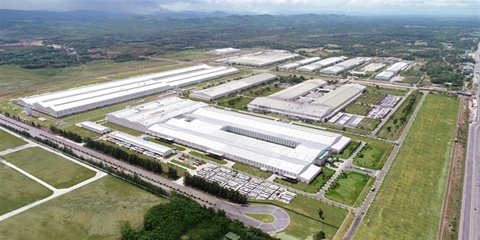
The central city has approved an investment proposal by Thailand’s WHA Group to develop infrastructure for the 400ha WHA Đà Nẵng Industrial Park project on two communes of Thăng Bình and Đồng Dương, with an investment of more than VNĐ2.7 trillion (US$105 million). The city said it approved WHA Industrial Development International's status as an investor in the project, which is expected to take place between 2027 and 2034.
VIETNAM ECONOMY INVESTMENT
MOBILE PHONE EXPORTS RISE 20% TO $51.8 BILLION IN FIRST NINE MONTHS
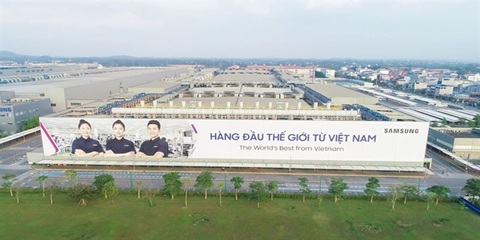
Exports of mobile phones and components rose 20 per cent year-on-year to nearly US$51.8 billion in the first nine months of 2026, with China, the US and Republic of Korea accounting for more than half of the total. Shipments to the three markets reached a combined $26.18 billion, or 50.6 per cent of total exports of the product group during the period, according to data from the Vietnam Department of Customs under the Ministry of Finance.

INFRASTRUCTURE / CONSTRUCTION / LOGISTIC / PORT
VIỆT NAM-CAMBODIA TRADE GATHERS PACE TOWARDS $20 BILLION TARGET
Trade between Việt Nam and Cambodia continues to grow, remaining a bright spot and a key pillar of bilateral cooperation as the two countries aim to raise two-way trade to US$20 billion in the coming years. After setting a record of more than $11.3 billion last year, bilateral trade reached about $8.7 billion in the first eight months of this year, up 8.3 per cent year on year.
VIETNAM ECONOMY INVESTMENT
FRUIT AND VEGETABLE EXPORTS POISED TO HIT $10 BILLION IN 2026
Fruit and vegetable exports are on track to reach nearly US$10 billion in 2026, after rising 19.9 per cent year on year to nearly US$7.4 billion in the first nine months, driven by strong seasonal demand and abundant tropical fruit supplies. The Ministry of Agriculture and Environment said the growth reflected stronger international demand for fresh produce and processed agricultural products.
Events Sponsors






















