Want to be in the loop?
subscribe to
our notification
Business News
QUANG NINH STARTS WORK ON SMART BORDER GATE IN MONG CAI
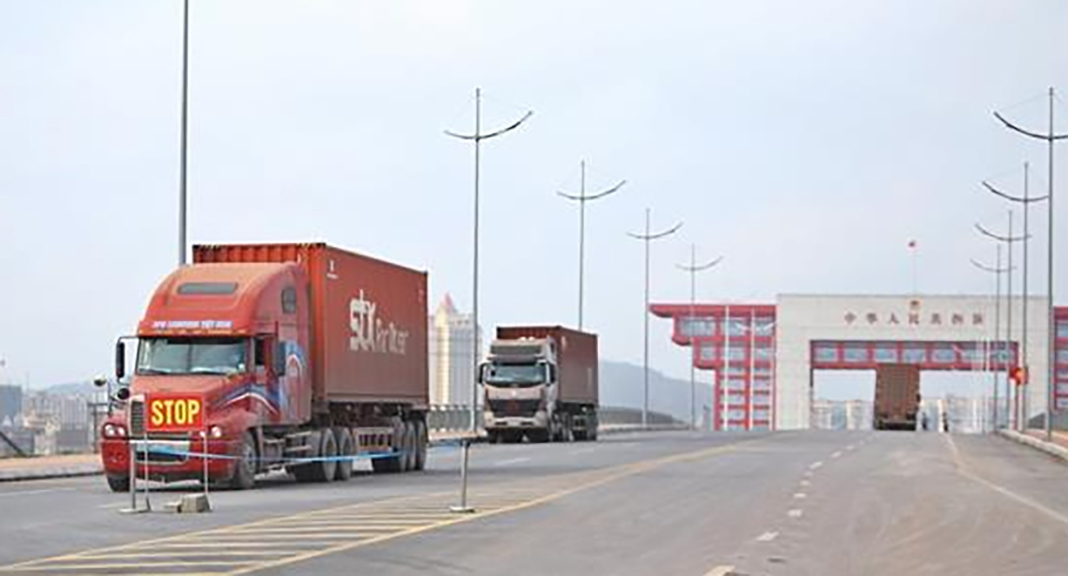
Container trucks pass through Mong Cai border gate – PHOTO: VNA
HCMC – The northern province of Quang Ninh on February 11 launched construction of a pilot smart border gate at the Mong Cai–Dongxing international crossing, with first-phase funding totaling nearly VND947 billion.
The pilot will be implemented at Bac Luan I Bridge for passenger traffic and Bac Luan II Bridge for cargo, under a proposal approved by the prime minister.
According to the provincial authorities, the model will apply artificial intelligence, big data, unmanned intelligent guided vehicles (IGVs) and cloud computing. It aims to introduce a “single declaration” mechanism and inter-agency data sharing to enable 24/7 customs clearance.
Vice Chairman of the Quang Ninh People’s Committee Vu Van Dien described the pilot as a step toward modernizing border management and strengthening cross-border economic cooperation between Vietnam and China.
The project also targets green growth. IGVs and electric vehicles will be used to transport goods, with authorities expecting lower labor demand, fewer operational errors and reduced CO2 and fine dust emissions in the border area.
For import-export businesses, the model is expected to form dedicated and closed cargo flows using automation systems. Customs procedures could operate around the clock, shortening clearance times and cutting logistics costs, particularly for agricultural products, seafood and other perishable goods.
For residents and tourists, automated control lanes combined with biometric identification technology will gradually replace manual procedures to speed up entry and exit processes.
An integrated operations center will connect and share data among relevant agencies on both sides, aiming to improve coordination, reduce overlap and enhance transparency in border management.
The pilot will be carried out in two phases through 2030.
Phase 1, scheduled for 2026, will focus on upgrading infrastructure and installing equipment at Bac Luan I and II bridges. The provincial budget will prioritize technical infrastructure, technology systems and management software.
State budget funding for phase one is estimated at VND250 billion, covering specialized equipment such as X-ray scanning systems, electronic scales, surveillance and recognition systems, and container scanners.
Private investors are expected to contribute around VND697 billion in Phase 1 to develop an operations center, customs inspection facilities, a high-tech logistics area, quarantine and disinfection centers, warehouses and supporting infrastructure, along with five IGVs and related control systems.
Phase 2, from 2027 to 2030, will refine and officially operate the model after evaluation, with plans to expand cargo categories and delivery methods.
A joint working group between Quang Ninh Province and China’s Guangxi Zhuang Autonomous Region has been set up to coordinate implementation and address technical and legal issues.
Source: The Saigon Times
Related News

BANKING / FINANCE / INSURANCE / TAX
REMITTANCES TO HCM CITY RISE NEARLY 40% IN Q3
Remittances to HCM City reached more than US$2.83 billion in the third quarter of this year, up 39.5 per cent from the previous quarter and 3.6 per cent year-on-year. This was the first quarter showing positive annual growth this year, helping narrow the decline in remittance inflows over the first nine months. According to the State Bank of Vietnam (SBV)’s Regional Branch 2, remittances transferred to HCM City through credit institutions and economic organisations totalled $2.835 billion in Q3, an increase of more than $802 million from the previous quarter.

TECHNOLOGY
TECH SECTOR GROWTH OPENS UP OPPORTUNITIES FOR VIỆT NAM TO GO GLOBAL
The growth of the electronics, semiconductor and high-tech sectors worldwide is opening up a variety of opportunities for Vietnamese enterprises to integrate more deeply into the global supply chain. However, to become suppliers for these corporations, domestic enterprises must meet rigorous standards regarding quality, technology, productivity and order fulfilment capabilities.

VIETNAM ECONOMY INVESTMENT
FOREIGN INVESTORS SEEKING A SYNCHRONISED MANUFACTURING ECOSYSTEM
Instead of focusing only on land costs and incentives as usual, foreign investors are seeking a synchronised manufacturing ecosystem, from stable power supply and logistics to shared infrastructure and the convenience of completing residence procedures for experts to serve their long-term investment in the country.
MEMBER CORNER / PROMOTIONS
SENTRYSAFE FHW40200 – PROTECT YOUR VALUABLES, ENJOY PEACE OF MIND!
Looking for a reliable solution to protect your important documents, cash, and valuables from fire and water damage? Genuine SENTRYSAFE - Reliable protection for your valuables and peace of mind! Contact Sen Wai Vietnam for more information and personalized product recommendations.

PROPERTY / INDUSTRIAL ZONE
HCM CITY ATTRACTS US$5.7 BILLION INTO EXPORT PROCESSING AND INDUSTRIAL ZONES
HCM City attracted US$5.7 billion in domestic and foreign investment into its export processing and industrial zones during the first nine months of 2026. The figure exceeded the city's full-year target by 31 per cent, highlighting strong momentum in high-quality industrial investment under Resolution No.10-NQ/TW. Total investment reached 131 per cent of the 2026 target of $4.25 billion and represented a 29 per cent increase compared with the same period in 2025, according to the city's Export Processing and Industrial Zones Authority (HEPZA).

INFRASTRUCTURE / CONSTRUCTION / LOGISTIC / PORT
DONG THAP PROVINCE STEPS UP INDUSTRIAL EXPANSION AND INFRASTRUCTURE CONNECTIVITY
Accelerating public investment, strengthening inter-regional connectivity, and expanding industrial land are helping Dong Thap efficiently bolster competitiveness and drive economic growth. Following the 2025 merger of the former Dong Thap and Tien Giang provinces, the expanded Dong Thap province in the Mekong Delta faces mounting pressure to accelerate infrastructure development and strengthen connectivity among local economic zones, urban areas, industrial parks (IPs), and production centres.
Events Sponsors






















