Want to be in the loop?
subscribe to
our notification
Business News
POSITIVE OUTLOOK FOR WOOD PRODUCT EXPORTS AFTER ROARING SUCCESS IN 2024
The woodworking industry will strive to achieve the export target of US$18 billion for this year, the Handicraft and Wood Industry Association of HCM City has said.
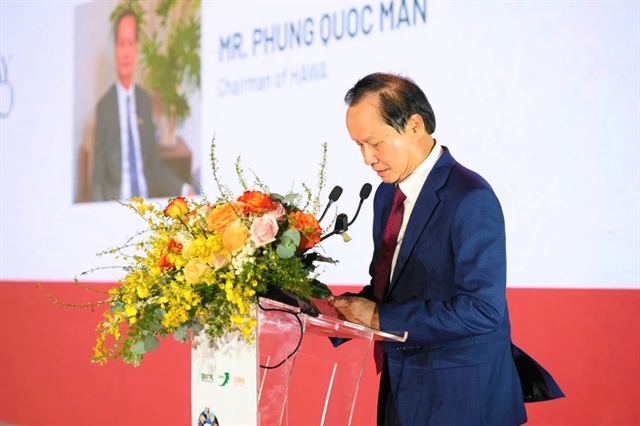
Phùng Quốc Mẫn, chairman of the Handicraft and Wood Industry Association of HCM City, speaks at the ancestral worship ceremony of the woodworking and handicraft industry in HCM City last week. — Photo courtesy of HAWA
HCM CITY – The woodworking industry will strive to achieve the export target of US$18 billion for this year, the Handicraft and Wood Industry Association of HCM City has said.
The association along with the Bình Dương Furniture Association (BIFA), and the Đồng Nai Wood and Handicraft Association (DOWA) organised a ceremony in HCM City last week to honour the Ancestors of Carpentry and celebrate the achievements of the woodworking and handicraft industry in 2024.
It was attended by more than 700 delegates representing members and partners.
Phùng Quốc Mẫn, HAWA chairman, said Việt Nam's wood product exports last year were worth a record US$16.3 billion after rising by 20.3 per cent from 2023.
"This is a truly impressive achievement, reflecting the strength and resilience of the industry in overcoming challenges."
Trần Quang Bảo, director of the Forestry Department, told the event that non-wood forestry products were worth another $1.04 billion.
"As a long-standing traditional industry, the woodworking industry not only brings economic value but also plays a crucial role in preserving the national culture and creating products that proudly bear the mark of Việt Nam in the international market."
Vietnamese wood products are now present in over 170 countries, he said.
In 2025 the wood processing and export industry would have both opportunities and challenges, with significant changes expected in international trade policies, especially in major markets like the US, he said.
To achieve the export target of $18 billion, he urged the industry to diversify its markets to avoid over-reliance on a few major ones and leveraging e-commerce platforms.
It also needs to build transparent supply chains, adopt technology in production and management, ensure traceability of wood materials, develop sustainable and eco-friendly products, and foster collaboration and innovation, he said.
"Associations such as HAVW, DOWA and BIFA should continue to be bridges between businesses and regulatory agencies, supporting workforce training and encouraging innovation.”
Unity for collective prosperity
Mẫn said: "In 2025 we will strive together with the wood furniture community to achieve the export target of $18 billion."
The global furniture consumption is worth more than $516 billion a year and exports from Việt Nam are still very modest, meaning that the industry still holds immense potential for growth, he said.
"The US, the largest furniture market in the world, is also witnessing dynamic political movements. These developments may present new opportunities for Việt Nam's wood industry. If leveraged effectively, Việt Nam can establish a stronger and more sustainable position in the global market."
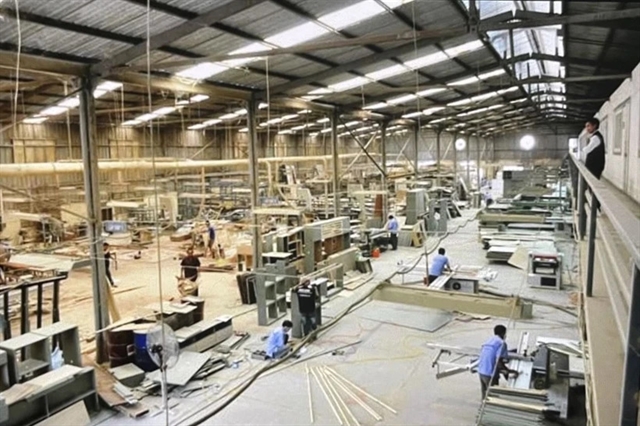
Inside a furniture manufacturing plant in HCM City. — VNA/VNS photo
He also stressed the importance of unity between businesses in the industry to grow together.
"Competition is a driving force for development, but it is crucial to distinguish between healthy and unhealthy competition. Businesses should not 'get in each other's way' but should cooperate to grow together, and build the strength needed to conquer the world markets. Then, all enterprises will benefit."
He said the HAWA executive board has prioritised connectivity between member businesses, enhancement of ties between associations and leveraging the strengths of different regions to achieve shared development.
He referred to the unique regional characteristics of the country’s handicraft and wood industry, saying the north is a raw material supplier with large furniture production areas and distinctive traditional craft villages.
The central region excels in outdoor furniture and serves as a focal point for developing plantation forests, while the south is the heart of wood processing with three major centres, HCM City and Đồng Nai and Bình Dương provinces.
HCM City stands out for creativity, designing, trading, branding, logistics, and finance.
But connecting the three regions to leverage these values remains an unachieved goal, he said.
He stressed the need for establishing connections to enable Việt Nam's handicraft and wood processing industry to create a complete furniture supply chain for the global market.
He also appreciated businesses for making significant efforts to invest in machinery and equipment, fostering creative design and steadily seeking to expand their markets.
Enterprises have also embraced new business models and leveraged e- commerce, enabling direct exports through platforms like Amazon, Wayfair and others, he said.
It is encouraging to see the active support of the Government and relevant authorities, who have joined hands with the wood industry through initiatives such as organising trade promotion programmes domestically and internationally and planning plantation forest resources, he said.
"Thus, the overall picture of the wood industry today can be summarised in one sentence: External conditions are favourable, and internal transformation is underway."
"I firmly believe that with optimism and collaboration and the spirit of unity among all of us, the Vietnamese woodworking and handicraft industry will overcome challenges and achieve remarkable success in 2025." - VNS
Source: VNS
Related News

BANKING / FINANCE / INSURANCE / TAX
REMITTANCES TO HCM CITY RISE NEARLY 40% IN Q3
Remittances to HCM City reached more than US$2.83 billion in the third quarter of this year, up 39.5 per cent from the previous quarter and 3.6 per cent year-on-year. This was the first quarter showing positive annual growth this year, helping narrow the decline in remittance inflows over the first nine months. According to the State Bank of Vietnam (SBV)’s Regional Branch 2, remittances transferred to HCM City through credit institutions and economic organisations totalled $2.835 billion in Q3, an increase of more than $802 million from the previous quarter.

TECHNOLOGY
TECH SECTOR GROWTH OPENS UP OPPORTUNITIES FOR VIỆT NAM TO GO GLOBAL
The growth of the electronics, semiconductor and high-tech sectors worldwide is opening up a variety of opportunities for Vietnamese enterprises to integrate more deeply into the global supply chain. However, to become suppliers for these corporations, domestic enterprises must meet rigorous standards regarding quality, technology, productivity and order fulfilment capabilities.
VIETNAM ECONOMY INVESTMENT
FOREIGN INVESTORS SEEKING A SYNCHRONISED MANUFACTURING ECOSYSTEM
Instead of focusing only on land costs and incentives as usual, foreign investors are seeking a synchronised manufacturing ecosystem, from stable power supply and logistics to shared infrastructure and the convenience of completing residence procedures for experts to serve their long-term investment in the country.

MEMBER CORNER / PROMOTIONS
SENTRYSAFE FHW40200 – PROTECT YOUR VALUABLES, ENJOY PEACE OF MIND!
Looking for a reliable solution to protect your important documents, cash, and valuables from fire and water damage? Genuine SENTRYSAFE - Reliable protection for your valuables and peace of mind! Contact Sen Wai Vietnam for more information and personalized product recommendations.
PROPERTY / INDUSTRIAL ZONE
HCM CITY ATTRACTS US$5.7 BILLION INTO EXPORT PROCESSING AND INDUSTRIAL ZONES
HCM City attracted US$5.7 billion in domestic and foreign investment into its export processing and industrial zones during the first nine months of 2026. The figure exceeded the city's full-year target by 31 per cent, highlighting strong momentum in high-quality industrial investment under Resolution No.10-NQ/TW. Total investment reached 131 per cent of the 2026 target of $4.25 billion and represented a 29 per cent increase compared with the same period in 2025, according to the city's Export Processing and Industrial Zones Authority (HEPZA).
INFRASTRUCTURE / CONSTRUCTION / LOGISTIC / PORT
DONG THAP PROVINCE STEPS UP INDUSTRIAL EXPANSION AND INFRASTRUCTURE CONNECTIVITY
Accelerating public investment, strengthening inter-regional connectivity, and expanding industrial land are helping Dong Thap efficiently bolster competitiveness and drive economic growth. Following the 2025 merger of the former Dong Thap and Tien Giang provinces, the expanded Dong Thap province in the Mekong Delta faces mounting pressure to accelerate infrastructure development and strengthen connectivity among local economic zones, urban areas, industrial parks (IPs), and production centres.
Events Sponsors