Want to be in the loop?
subscribe to
our notification
Business News
PLANS IN PLACE TO BOOST SHIPBUILDING INDUSTRY
Việt Nam's shipbuiding industry aims to capture 0.8 per cent to 0.9 per cent of global output by 2030, focusing on general cargo ships of up to 70,000 tonnes, container ships, LPG carriers, and other service vessels. Domestically, the industry is tasked with meeting the need to renew and expand the national fleet.
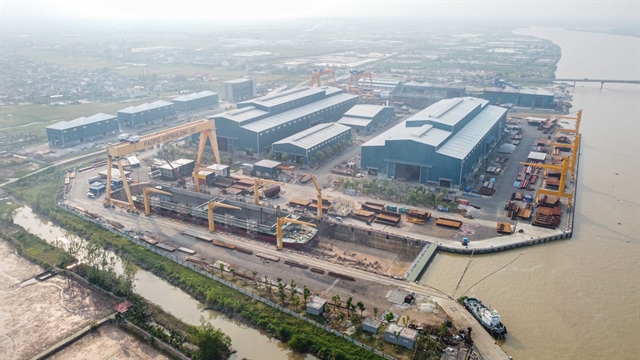
Pacific Shipbuilding JSC factory in Hải Phòng City. VNA/VNS Photo
HÀ NỘI — Việt Nam is setting its sights on strengthening shipbuilding by maximising the use of existing infrastructure and capitalising on its strategic geographical location, according to a new development plan.
The initiative is part of a broader project aimed at enhancing the capacity of domestic shipbuilding enterprises through 2030, with a long-term vision extending to 2050. The proposal has been submitted to the Prime Minister for approval, baodautu.vn reported.
The project builds upon prior planning efforts and is consistent with the policy on restructuring the Shipbuilding Industry Corporation (SBIC). It also aligns with strategies for sustainable marine economic development through 2045 and industrial development through 2035, the online newspaper cited Deputy Minister of Construction Nguyễn Xuân Sang as saying.
A key highlight of the plan is its detailed and phased targets for the shipbuilding industry over the next five to 10 years. By 2030, the SBIC restructuring project is expected to be largely completed, with formerly affiliated enterprises stabilising operations, rebuilding their brands and improving profitability and management capacity.
It also recommends allocating funding and implementing supportive mechanisms to enable defence industrial enterprises to participate in auctions or directly receive key SBIC shipyards located in areas critical to national defence and security, such as Cam Ranh, Hạ Long and Sông Hồng.
An SBIC representative emphasised the importance of drawing up a suitable support policy for domestic enterprises to receive and inherit facilities, assets and human resources from SBIC after bankruptcy.
That would certainly make the most of existing resources, limit the waste of assets, and at the same time maintain the important technical infrastructure foundation for the shipbuilding industry to grow stronger in the next five to 10 years, the representative said.
Clear targets for development
As per the project, Việt Nam's shipbuiding industry aims to capture 0.8 per cent to 0.9 per cent of global output by 2030, focusing on general cargo ships of up to 70,000 tonnes, container ships, LPG carriers and other service vessels. Domestically, the industry is tasked with meeting the need to renew and expand the national fleet.
On the export front, the goal is to produce one million tonnes of vessels for international markets, about 30 per cent of total new output.
Looking further ahead, the project aims to increase the localisation rate of shipbuilding products to 30-40 per cent by 2040, including 10 per cent in materials and equipment, boosting Việt Nam’s share of global shipbuilding output to 1 per cent.
By 2050, the localisation rate is projected to surpass 50 per cent, with 20 per cent in materials and equipment, and the industry is targeting to account for 2 per cent of global shipbuilding output.
As global and domestic demand for new vessels steadily increases, experts say Việt Nam’s shipbuilding industry is well-positioned for significant growth. Currently ranked seventh in the world, Việt Nam holds a 0.61 per cent share of the global shipbuilding market, surpassing established shipbuilders like Finland, which held 0.36 per cent.
With an annual domestic shipbuilding capacity of around 3.5 million tonnes, the country has both the industrial base and strategic geographic advantages to expand its presence on the international stage.
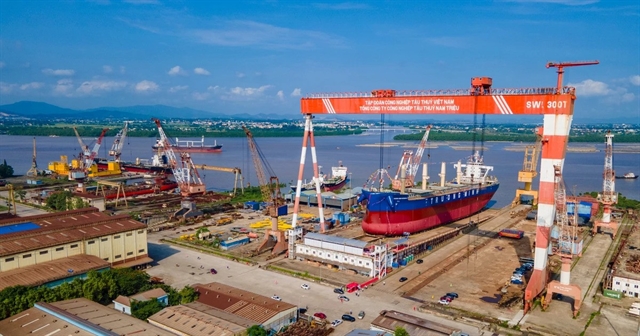
Việt Nam rises as a competitive force in global shipbuilding. Photo VietnamPlus
Industry snapshot: opportunities and challenges
Việt Nam currently has 88 shipbuilding enterprises and 411 inland waterway vessel production facilities. About 120 of these specialise in building and repairing vessels over 1,000 tonnes. The country’s total capacity for new cargo ship construction is approximately 3.5 million tonnes per year, including vessels over 5,000 DWT.
Beyond commercial ships, Việt Nam also produces tugboats, patrol boats, rescue ships, high-speed aluminum-hull vessels, and service ships for both domestic and export markets. With a current global market share of 0.61 per cent, Việt Nam ranks seventh in the world in shipbuilding.
However, challenges remain. The industry is under pressure to adapt to green energy transitions and carbon reduction mandates, insiders said.
Many shipyards lack the infrastructure and capital to produce environmentally friendly vessels, and there is a notable absence of tax incentives or financial support policies to facilitate this transformation.
They added that much of the shipbuilding sector has developed through basic assembly and processing, which limits its ability to create high-value products. Many shipyards operate with outdated infrastructure and technology, undermining their international competitiveness.
A lack of investment in technological upgrades and ship design capabilities has hindered the development of prototype vessels tailored to market demands. These constraints pose a major obstacle to Việt Nam's ambitions to move up the value chain and capture a larger share of the global shipbuilding market.
According to Hoàng Long, head of the Việt Nam Maritime Corporation's Transport Department, the shipbuilding industry is recognised as a priority sector for investment, with various tax and land-use incentives already outlined in national regulations.
Looking ahead, he emphasised the need to revisit and refine existing policies to better align with broader economic development strategies and maritime growth objectives. — VNS
Source: VNS
Related News

MEMBER CORNER / PROMOTIONS
AN ELECTRIFYING NIGHT WITH THE "QUEEN OF DANCE" THU MINH AT THE GRAND HO TRAM!
The stage at The Grand Ballroom is set to catch fire as Vietnam’s undisputed "Queen of Dance," Thu Minh, takes the spotlight. Renowned for her powerhouse vocals, magnetic stage presence, and sultry, high-energy performances, Thu Minh promises an evening of pure musical euphoria. The energy escalates with an exclusive appearance by special guest and The Voice champion, Vu Thao My.

HR / LABOUR/ EMPLOYMENT
HIGH-QUALITY HUMAN RESOURCES NEEDED TO ATTRACT NEW TECH INVESTMENT CAPITAL
Besides infrastructure, Việt Nam must also rapidly develop a highly skilled workforce to attract investment in AI, semiconductors and advanced manufacturing, experts have said. Don Lam, CEO and co-founder of investment management company VinaCapital, said that global technology investors were increasingly looking at the readiness of the entire ecosystem, with high-quality human resources a decisive factor.

HR / LABOUR/ EMPLOYMENT
HIRING OUTLOOK STRENGTHENS IN Q4 AS SKILLS SHORTAGES PERSIST
Hiring intentions among employers in Việt Nam strengthened in the fourth quarter, with 52 per cent of surveyed companies planning to increase headcount between October and December, according to a ManpowerGroup survey released this week. Việt Nam's hiring outlook was stronger than the Asia Pacific and Middle East (APME) regional average of 33 per cent and the global average of 29 per cent, ranking third in the region and 11th globally among 42 markets surveyed.

BANKING / FINANCE / INSURANCE / TAX
LARGE BANKS FORECAST TO GAIN HIGHER PROFITABILITY IN H2 2026
The return on average assets (ROAA) of the banking sector will likely remain stable at around 1.5 per cent in the second half of 2026, but profitability divergence among banks will increase, with large banks outperforming peers on stronger margins and diversified earnings, analysts forecast. In a recent report on the banking sector, analysts from the Vietnam Investors Service Rating said the sector’s ROAA rose by 10 basis points quarter-on-quarter to 1.51 per cent in the first half of this year, driven by net interest margin (NIM) improvements at some State-owned banks and large private banks.
GARMENT / TEXTILE
VIỆT NAM'S FOOTWEAR, BAG EXPORTS TO US TOP $8 BILLION IN EIGHT MONTHS
Việt Nam's exports of footwear and handbags to the US exceeded US$8 billion in the first eight months of 2026, as the US and EU remained the country's biggest markets despite sluggish growth in footwear shipments. Exports from Việt Nam's leather and footwear sector reached more than $2.45 billion in August, down 9 per cent from July but up 3 per cent from a year earlier, according to preliminary statistics.
VIETNAM ECONOMY INVESTMENT
LÂM ĐỒNG TARGETS DIGITAL ECONOMY TO ACCOUNT FOR 30 PER CENT OF GRDP BY 2030
Lâm Đồng Province aims to raise the digital economy’s contribution to around 30 per cent of its gross regional domestic product (GRDP) by 2030, as part of a five-year plan to develop digital economy and society issued recently. Under Plan No. 15358/KH-UBND, the province targets more than 60 per cent of small- and medium-sized enterprises (SMEs) to adopt digital technologies by 2030 while increasing the value of cashless payments to 30 times its GRDP.
Events Sponsors






















