Want to be in the loop?
subscribe to
our notification
Business News
PER CAPITA INCOME CLIMBS 9.3% IN 2025
Average per capita income in 2025 was estimated at VND5.9 million (approximately US$225) per month, marking a 9.3 percent increase from 2024, according to preliminary findings of the Household Living Standards Survey 2025 conducted by the National Statistics Office (NSO).
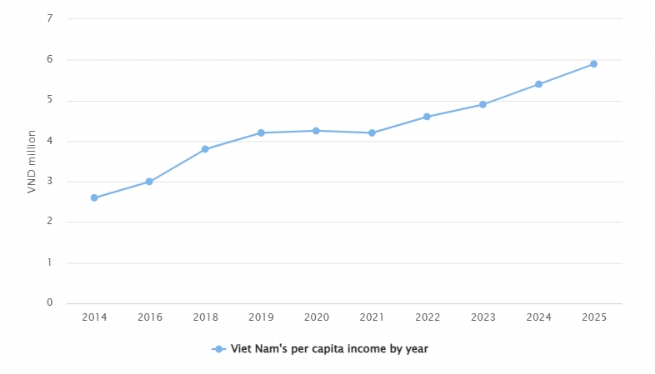
Part of the income growth stemmed from State payments to public officials and employees who retired or resigned under the restructuring of the political system's organizational apparatus.
NSO Director Nguyen Thi Huong noted that Viet Nam's income structure is becoming more progressive and sustainable, as wages and wage-like earnings account for an increasing share of total household income.
Besides rising incomes, household living standards remained stable throughout 2025. Household income showed a more positive and steady pattern compared to 2024. Survey results indicated that 31.3 percent of households reported higher income, 65 percent saw no change, while only 2.8 percent experienced a decline, and 0.9 percent were uncertain.
The NSO attributed income growth and stable living conditions to several factors.
Improved production and business performance across all three economic sectors helped generate jobs and boost earnings for workers and households.
Social security policies and programs were implemented promptly and effectively, positively affecting living standards. These included continued allowances and support for people who rendered services to the nation, the poor, disadvantaged groups and social protection beneficiaries.
Emergency relief and post-disaster assistance were also delivered in a timely manner, with total support reaching VND92.4 trillion, an increase of VND22.6 trillion, or 32.4 percent, compared to 2024.
The nationwide program to eliminate temporary and dilapidated houses was highlighted as a key initiative. In addition, average worker income rose by 8.9% year-on-year, employment remained stable, and the unemployment rate stayed low and improved compared to 2024, reflecting a more positive labor market and higher household earnings.
Policies targeting public officials, employees, workers and the armed forces in the context of streamlining the political system also contributed to income growth and the creation of new livelihoods for part of the population. Ongoing support for free health insurance and medical examination cards for eligible groups further helped ease healthcare-related financial pressures.
Nevertheless, the NSO noted that a small proportion of households continued to face difficulties. Among the 2.8 percent of households reporting lower income in 2025, the main causes were job loss or temporary work suspension (37.5 percent), reduced production or business scale (24.1 percent), rising input costs (21.2 percent) and declining product prices (19.5 percent).
Natural disasters, including floods, storms and droughts, continued to damage housing and livelihoods, increasing vulnerability, particularly in rural, mountainous and coastal areas.
To sustain income growth and further improve living standards in 2026, the NSO recommended that the Government and local authorities continue to effectively implement social security programs, enhance job quality and employment opportunities, ensure timely support for vulnerable groups, and strengthen disaster preparedness and climate change adaptation through early warning systems, safe residential planning and support for livelihood transitions.
Source: VCCI
Related News

BANKING / FINANCE / INSURANCE / TAX
REMITTANCES TO HCM CITY RISE NEARLY 40% IN Q3
Remittances to HCM City reached more than US$2.83 billion in the third quarter of this year, up 39.5 per cent from the previous quarter and 3.6 per cent year-on-year. This was the first quarter showing positive annual growth this year, helping narrow the decline in remittance inflows over the first nine months. According to the State Bank of Vietnam (SBV)’s Regional Branch 2, remittances transferred to HCM City through credit institutions and economic organisations totalled $2.835 billion in Q3, an increase of more than $802 million from the previous quarter.

TECHNOLOGY
TECH SECTOR GROWTH OPENS UP OPPORTUNITIES FOR VIỆT NAM TO GO GLOBAL
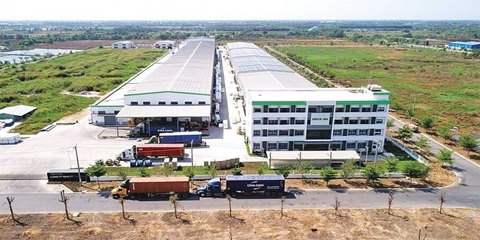
The growth of the electronics, semiconductor and high-tech sectors worldwide is opening up a variety of opportunities for Vietnamese enterprises to integrate more deeply into the global supply chain. However, to become suppliers for these corporations, domestic enterprises must meet rigorous standards regarding quality, technology, productivity and order fulfilment capabilities.
VIETNAM ECONOMY INVESTMENT
FOREIGN INVESTORS SEEKING A SYNCHRONISED MANUFACTURING ECOSYSTEM
Instead of focusing only on land costs and incentives as usual, foreign investors are seeking a synchronised manufacturing ecosystem, from stable power supply and logistics to shared infrastructure and the convenience of completing residence procedures for experts to serve their long-term investment in the country.

MEMBER CORNER / PROMOTIONS
SENTRYSAFE FHW40200 – PROTECT YOUR VALUABLES, ENJOY PEACE OF MIND!
Looking for a reliable solution to protect your important documents, cash, and valuables from fire and water damage? Genuine SENTRYSAFE - Reliable protection for your valuables and peace of mind! Contact Sen Wai Vietnam for more information and personalized product recommendations.
PROPERTY / INDUSTRIAL ZONE
HCM CITY ATTRACTS US$5.7 BILLION INTO EXPORT PROCESSING AND INDUSTRIAL ZONES
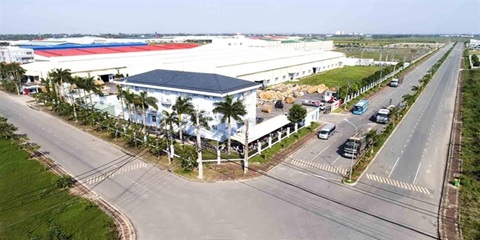
HCM City attracted US$5.7 billion in domestic and foreign investment into its export processing and industrial zones during the first nine months of 2026. The figure exceeded the city's full-year target by 31 per cent, highlighting strong momentum in high-quality industrial investment under Resolution No.10-NQ/TW. Total investment reached 131 per cent of the 2026 target of $4.25 billion and represented a 29 per cent increase compared with the same period in 2025, according to the city's Export Processing and Industrial Zones Authority (HEPZA).
INFRASTRUCTURE / CONSTRUCTION / LOGISTIC / PORT
DONG THAP PROVINCE STEPS UP INDUSTRIAL EXPANSION AND INFRASTRUCTURE CONNECTIVITY
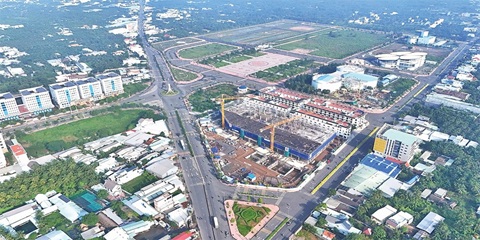
Accelerating public investment, strengthening inter-regional connectivity, and expanding industrial land are helping Dong Thap efficiently bolster competitiveness and drive economic growth. Following the 2025 merger of the former Dong Thap and Tien Giang provinces, the expanded Dong Thap province in the Mekong Delta faces mounting pressure to accelerate infrastructure development and strengthen connectivity among local economic zones, urban areas, industrial parks (IPs), and production centres.
Events Sponsors






















