Want to be in the loop?
subscribe to
our notification
Business News
MORE RATE CUT TO STIMULATE DEMAND
According to the State Bank of Vietnam (SBV), banks are actively offering new soft loan packages to customers. The combined value of this credit package has to date reached VND650 trillion (US$28 billion) with lending rates 1-2% lower than those before the Covid-19 pandemic outbreak. 147,637 customers have borrowed VND553 trillion (US$23.6) since January 23, 2020.
Banks rescheduled repayment terms, reduced interest rates for customers adversely affected by Covid-19, and rearranged repayment terms for 170,746 customers who borrowed VND128.21 trillion; exempted and lowered interest rates and preserved indebtedness categories for 14,372 customers which borrowed VND28,441 billion; and slashed existing interest rates for 318,528 customers with a loan balance of VND980,163 billion. The new interest rates are 0.5-2% lower than the previous rates. Even some credit institutions lowered their lending rates by 2.5-4% lower than those before the outbreak.
Lower rates with more flexible terms
Lending rates offered by commercial banks extended the downward trend in May 2020.
Four state-owned banks (Agribank, Vietcombank, VietinBank and BIDV) has cut their lending rates by 1.5-2% per annum on trillions of Vietnamese dong. Joint Stock Commercial Bank for Foreign Trade of Vietnam (Vietcombank) has accepted a profit decrease by VND2,240 billion to share hardships with corporate borrowers. The lender has simultaneously slashed lending rates from now till September 30, 2020. An outstanding loan of nearly VND113 trillion lent to industries/sectors affected by Covid-19 is imposed preferential interest rates, by 0.5-1.5% lower than common commercial rates. At the same time, Vietcombank will further expand its rate cut by 1-1.5% for existing loans (from April 30 to September 30). This move will cause the lender’s profit to decline by VND300 billion.
Bank for Investment and Development of Vietnam (BIDV) has restructured debts for more than 3,300 customers and exempted and reduced interest rates on existing loans by 0.5-1.2% per annum. BIDV has recently announced a personal credit package of up to VND50 trillion, designed for business operations, effective from May 6, 2020 to September 30, 2020, to replace the previous credit package of VND30 trillion. With this new loan package, customers can enjoy more attractive interest rates with flexible terms, suitable to each business production loan demand. Specifically, customers are entitled to an interest rate of only 6% per annum for loans carrying a maturity term of less than six months and only from 6.5% for loans of 6-12 months.
Vietnam Bank for Agriculture and Rural Development (Agribank) has reduced interest rates for 27,500 customers borrowing VND45,165 billion. Specifically, the lender has exempted interest rates for 500 customers borrowing VND5,165 billion and lowered the interest rate pm VND40 trillion for 27,000 customers.
Vietnam Joint Stock Commercial Bank for Industry and Trade (VietinBank) has also cut interest rates by 2-2.5% for essential fields as compared to commercial rates. Other cases are enjoying a reduction by 0.5-1.5%, depending on the extent of damage they suffered from the epidemic.
Like the four State-owned banks, private lenders also offered soft loans to businesses to expand business operations.
Ho Chi Minh City Development Bank (HDBank) has launched an additional package of VND10,000 billion, with the annualized interest rate 2-4% lower, for individuals and small businesses. Nam A Bank has further reduced the interest rate by 2-2.5% per annum for customers affected by the epidemic. Orient Commercial Joint Stock Bank (OCB) and Construction Bank (CB) has also cut the lending rate by 2% as compared to normal commercial rates. Besides, CB provides free property evaluation and refunds prepaid fees when the loan term reaches three years.
Negative credit growth
Banks also face hardships when companies are in trouble.
According to statistics, credit growth inched up only 1.3% in the first quarter and slipped 0.5% in the first half of April 2020. As of mid-April 2020, the growth of outstanding loans nationwide was only 0.8%.
The sharp decline in credit was attributed to weakened credit demands of companies, not only in Vietnam but in many countries in the world where social distancing measures were exercised, consumption and export dropped, input supplies and output markets shrank. Companies focused on taking loans, repaying debts and had no need to borrow money.
Many banks have offered soft loans to support corporate customers to sustain business operations. However, banks can hardly boost credit growth in the current tough context.
According to statistics, VietinBank’s total assets reached VND1,220 trillion as of the end of March, down 1.46% from the beginning of the year. In particular, outstanding loans declined by 1.25% to VND923.623 trillion. Deposits grew slightly by VND2.9 trillion to VND 895.750 trillion.
In the first three months, Saigonbank’s deposits slipped by 0.8% to VND15,543 billion while its credit growth dipped 2.3% to VND14,215 billion. The lender’s total assets dropped by nearly 11% to VND20,308 billion.
Military Bank (MB) reported that its total assets declined more than 1% to VND406,802 billion in the year to March 2020. Its loans fell by 1.3% to VND244,072 billion while its deposits slumped 12% to VND240,737 billion.
By the end of March 2020, the total assets of the National Bank (NCB) plummeted more than 12% to VND70,458 billion. Its loans to customers shrank by 0.27% to VND37,806.6 billion while its customer deposits rose by 2.4% to VND60,547 billion.
Notably, despite slow credit growth, nonperforming loans (NPL) did not pick up. The State Bank of Vietnam admitted that the NPL ratio certainly increased in any case. The best scenario will occur if the epidemic is controlled at the beginning of the second quarter of 2020, the bad debt ratio will be at 2.9-3.2% by the end of the second quarter and 2.6-3% by the end of 2020.
Therefore, slowing credit growth seriously affects banks’ profitability but they will not increase credit at all costs because there are so many lessons in the past. If they accept unconditional or substandard loans in the current risky context, their system will be placed at risk.
Source: VCCI
Related News

MEMBER CORNER / PROMOTIONS
AN ELECTRIFYING NIGHT WITH THE "QUEEN OF DANCE" THU MINH AT THE GRAND HO TRAM!
The stage at The Grand Ballroom is set to catch fire as Vietnam’s undisputed "Queen of Dance," Thu Minh, takes the spotlight. Renowned for her powerhouse vocals, magnetic stage presence, and sultry, high-energy performances, Thu Minh promises an evening of pure musical euphoria. The energy escalates with an exclusive appearance by special guest and The Voice champion, Vu Thao My.

HR / LABOUR/ EMPLOYMENT
HIGH-QUALITY HUMAN RESOURCES NEEDED TO ATTRACT NEW TECH INVESTMENT CAPITAL
Besides infrastructure, Việt Nam must also rapidly develop a highly skilled workforce to attract investment in AI, semiconductors and advanced manufacturing, experts have said. Don Lam, CEO and co-founder of investment management company VinaCapital, said that global technology investors were increasingly looking at the readiness of the entire ecosystem, with high-quality human resources a decisive factor.

HR / LABOUR/ EMPLOYMENT
HIRING OUTLOOK STRENGTHENS IN Q4 AS SKILLS SHORTAGES PERSIST
Hiring intentions among employers in Việt Nam strengthened in the fourth quarter, with 52 per cent of surveyed companies planning to increase headcount between October and December, according to a ManpowerGroup survey released this week. Việt Nam's hiring outlook was stronger than the Asia Pacific and Middle East (APME) regional average of 33 per cent and the global average of 29 per cent, ranking third in the region and 11th globally among 42 markets surveyed.

BANKING / FINANCE / INSURANCE / TAX
LARGE BANKS FORECAST TO GAIN HIGHER PROFITABILITY IN H2 2026
The return on average assets (ROAA) of the banking sector will likely remain stable at around 1.5 per cent in the second half of 2026, but profitability divergence among banks will increase, with large banks outperforming peers on stronger margins and diversified earnings, analysts forecast. In a recent report on the banking sector, analysts from the Vietnam Investors Service Rating said the sector’s ROAA rose by 10 basis points quarter-on-quarter to 1.51 per cent in the first half of this year, driven by net interest margin (NIM) improvements at some State-owned banks and large private banks.
GARMENT / TEXTILE
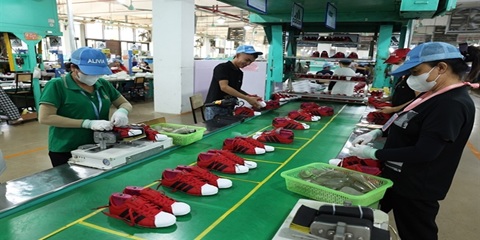
VIỆT NAM'S FOOTWEAR, BAG EXPORTS TO US TOP $8 BILLION IN EIGHT MONTHS
Việt Nam's exports of footwear and handbags to the US exceeded US$8 billion in the first eight months of 2026, as the US and EU remained the country's biggest markets despite sluggish growth in footwear shipments. Exports from Việt Nam's leather and footwear sector reached more than $2.45 billion in August, down 9 per cent from July but up 3 per cent from a year earlier, according to preliminary statistics.

VIETNAM ECONOMY INVESTMENT
LÂM ĐỒNG TARGETS DIGITAL ECONOMY TO ACCOUNT FOR 30 PER CENT OF GRDP BY 2030
Lâm Đồng Province aims to raise the digital economy’s contribution to around 30 per cent of its gross regional domestic product (GRDP) by 2030, as part of a five-year plan to develop digital economy and society issued recently. Under Plan No. 15358/KH-UBND, the province targets more than 60 per cent of small- and medium-sized enterprises (SMEs) to adopt digital technologies by 2030 while increasing the value of cashless payments to 30 times its GRDP.
Events Sponsors






















