Want to be in the loop?
subscribe to
our notification
Business News
MORE OPPORTUNITIES THAN RISKS ON THE STOCK MARKET: EXPERT
Despite worries that Việt Nam’s stock market might correct in the near future after growing dramatically, experts believe that there are more opportunities than risks for investors.
The market benchmark VN-Index on the Hồ Chí Minh Stock Exchange (HoSe) closed Monday at a historic high of 1,405.81 points. The index has soared since the beginning of the year, up nearly 25.5 per cent and continuously hit new highs.
According to Tạ Thanh Bình, Director of Stock Market Development Department under the State Securities Commission of Vietnam (SSC), the market’s rally is normal as it corresponds to the global trend.
“The gain has not only occurred on Việt Nam’s stock market, but most major stock markets in the world have experienced strong increases since early 2021,” Bình said in the “Stock market and forecast” talkshow, hosted by Kinh tế và Dự báo magazine on June 28.
“As of June 15, the US market climbed 12.4 per cent, the UK market rose by 10 per cent, and the French market jumped by 19 per cent. Countries in Asia such as Korea, Thailand and Japan, all posted gains of over 10 – 12 per cent compared to the beginning of the year.”
The stock market moves ahead of the general economy. Therefore, the recent strong rallies of the market show investors' expectations for the recovery of the economy as a whole post-pandemic.
The global market was reinforced by recoveries of big economies like China and US as they have contained the pandemic, helping to strengthen investors’ confidence.
Similarly, the local stock market was also supported by the country’s macro-economy with positive readings in the first five months of this year. Accordingly, export growth was more than 30 per cent, while credit rates remain at low levels.
Cash flow into other assets like real estate or cryptocurrencies had slowed due to policies from the Government to control these sectors, leading to an increase of investment into the stock market, Bình added.
The market liquidity surged recently with some sessions witnessing trading value of more than US$1 billion.
Another factor supporting the market’s rally is listed companies’ good performance during the pandemic. Despite the general picture that many enterprises lost profits or even filed for bankruptcy, listed companies still posted positive results in the first quarter.
“Instead of disruptions like the previous outbreaks, some companies said that they even received more orders in the ongoing fourth wave of COVID-19. They are just short of workers,” Phan Đức Hiếu, deputy director of Central Institute for Economic Management (CIEM), said at the event.
Data showed that listed companies’ revenues and profits grew 10.9 per cent and 66.8 per cent, respectively, in the first quarter.
In addition, the participation of individual investors is also considered the driving force for the bullish market. However this is also a predictable trend in the market, Hiếu said.
“The stock market has attracted more individual investors during the pandemic as many people have to stay at home or lost their jobs, so they want to earn money through stock investment.
“But because they are untrained investors, their orders rely on their instincts, causing uncertainty in the market,” Hiếu added, recommending these investors should attend classes or learn about the market before joining to reduce risks for themselves and the market.
Bullish months ahead
While the market is thriving and local investors jumped in, foreign investors have seemed to be reluctant to step in as they kept net selling. However, the head of the Stock Market Development Department doesn’t see it as a negative signal.
“Foreign investors net sold stocks, but net bought bonds. There was just a change in their portfolios. Moreover, it was just net selling, not withdrawing,” Bình said.
In May, the net selling force from foreign investors was high, but it was just at an average level compared to other markets in the region, she added. “For example, while they net sold $497 million on Việt Nam’s stock market, the number was US$1.1 billion on Thailand’s market, $2.1 billion on Taiwan’s market and $7.97 billion on the Chinese market.”
As the fundamental factors are still intact, Bình is optimistic about the market in the next six months.
“With macro-economic policies, listed companies’ inner strength, the attractiveness of the stock market and cash outflows from real estate and the crypto market, there are more opportunities than risks for investors,” Bình said.
Surging stocks in the previous rallies will certainly correct, but the overall market is still up, she added.
Source: VNS
Related News
MEMBER CORNER / PROMOTIONS
AN ELECTRIFYING NIGHT WITH THE "QUEEN OF DANCE" THU MINH AT THE GRAND HO TRAM!
The stage at The Grand Ballroom is set to catch fire as Vietnam’s undisputed "Queen of Dance," Thu Minh, takes the spotlight. Renowned for her powerhouse vocals, magnetic stage presence, and sultry, high-energy performances, Thu Minh promises an evening of pure musical euphoria. The energy escalates with an exclusive appearance by special guest and The Voice champion, Vu Thao My.

HR / LABOUR/ EMPLOYMENT
HIGH-QUALITY HUMAN RESOURCES NEEDED TO ATTRACT NEW TECH INVESTMENT CAPITAL
Besides infrastructure, Việt Nam must also rapidly develop a highly skilled workforce to attract investment in AI, semiconductors and advanced manufacturing, experts have said. Don Lam, CEO and co-founder of investment management company VinaCapital, said that global technology investors were increasingly looking at the readiness of the entire ecosystem, with high-quality human resources a decisive factor.

HR / LABOUR/ EMPLOYMENT
HIRING OUTLOOK STRENGTHENS IN Q4 AS SKILLS SHORTAGES PERSIST
Hiring intentions among employers in Việt Nam strengthened in the fourth quarter, with 52 per cent of surveyed companies planning to increase headcount between October and December, according to a ManpowerGroup survey released this week. Việt Nam's hiring outlook was stronger than the Asia Pacific and Middle East (APME) regional average of 33 per cent and the global average of 29 per cent, ranking third in the region and 11th globally among 42 markets surveyed.

BANKING / FINANCE / INSURANCE / TAX
LARGE BANKS FORECAST TO GAIN HIGHER PROFITABILITY IN H2 2026
The return on average assets (ROAA) of the banking sector will likely remain stable at around 1.5 per cent in the second half of 2026, but profitability divergence among banks will increase, with large banks outperforming peers on stronger margins and diversified earnings, analysts forecast. In a recent report on the banking sector, analysts from the Vietnam Investors Service Rating said the sector’s ROAA rose by 10 basis points quarter-on-quarter to 1.51 per cent in the first half of this year, driven by net interest margin (NIM) improvements at some State-owned banks and large private banks.
GARMENT / TEXTILE
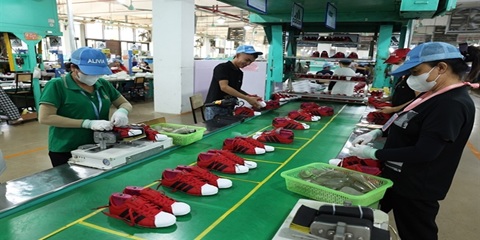
VIỆT NAM'S FOOTWEAR, BAG EXPORTS TO US TOP $8 BILLION IN EIGHT MONTHS
Việt Nam's exports of footwear and handbags to the US exceeded US$8 billion in the first eight months of 2026, as the US and EU remained the country's biggest markets despite sluggish growth in footwear shipments. Exports from Việt Nam's leather and footwear sector reached more than $2.45 billion in August, down 9 per cent from July but up 3 per cent from a year earlier, according to preliminary statistics.

VIETNAM ECONOMY INVESTMENT
LÂM ĐỒNG TARGETS DIGITAL ECONOMY TO ACCOUNT FOR 30 PER CENT OF GRDP BY 2030
Lâm Đồng Province aims to raise the digital economy’s contribution to around 30 per cent of its gross regional domestic product (GRDP) by 2030, as part of a five-year plan to develop digital economy and society issued recently. Under Plan No. 15358/KH-UBND, the province targets more than 60 per cent of small- and medium-sized enterprises (SMEs) to adopt digital technologies by 2030 while increasing the value of cashless payments to 30 times its GRDP.
Events Sponsors






















