Want to be in the loop?
subscribe to
our notification
Business News
MEGA-INDUSTRIAL HUBS TO POWER GROWTH LEAP
Beyond its administrative significance, the recent merger creates a development space that is broader, more sustainable and more comprehensive, and forms cohesive industrial powerhouses which are expected to propel Việt Nam to sustained double-digit growth in the new era.
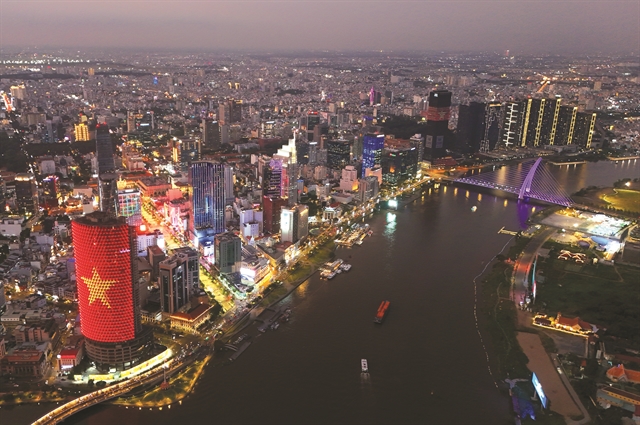
The new HCM City is Việt Nam’s biggest megacity, spanning more than 6,700 sq.m with around 14 million people and a quarter of the country’s GDP. — VNA/VNS Photo Hồng Đạt
HÀ NỘI — Mega industrial hubs are taking shape in Việt Nam following a historic administrative overhaul, at the heart of which are landmark mergers including Bắc Giang with Bắc Ninh in the north and Bình Dương and Bà Rịa – Vũng Tàu with HCM City in the south.
Beyond its administrative significance, the merger creates a development space that is broader, more sustainable and more comprehensive, and forms cohesive industrial powerhouses which are expected to propel Việt Nam to sustained double-digit growth in the new era.
A southern metropolis
Following its merger with Bình Dương and Bà Rịa – Vũng Tàu, HCM City is Việt Nam’s biggest megacity, with a population of around 14 million people and a quarter of the nation’s GDP.
The city is a combination of the country’s financial hub and a manufacturing powerhouse and one of Southeast Asia’s most robust marine and energy infrastructure systems.
“More than just a geographical merger, the unification of the three localities is a convergence of a shared vision and ambition to lay the foundation for a megacity poised to become a powerhouse of finance, production, logistics and innovation on the regional and global stage,” Party General Secretary Tô Lâm said.
Economists at the University of Economics in HCM City pointed out that before the merger, the three localities had fragmented industrial structures with HCM City focusing on light industry, high-tech manufacturing and logistics, Bình Dương specialising in processing and supporting industries while Bà Rịa – Vũng Tàu in heavy industry, petrochemicals and seaport advantages.
Now, the new HCM City has emerged as the country’s largest integrated industrial zone, comprising 61 industrial parks, export processing zones and clusters, producing over 30 per cent of Việt Nam’s total manufacturing output and cumulative foreign direct investment (FDI) surpassing US$90 billion, nearly half of the country’s total.
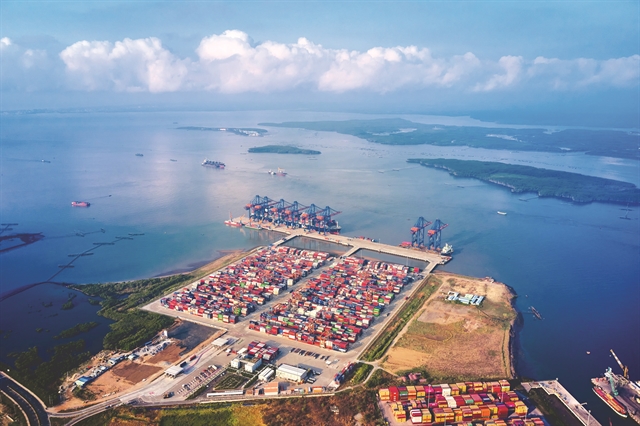
A view of Cái Mép - Thị Vải Port. Its robust marine infrastructure development adds to the strength of HCM City. — VNA/VNS Photo Hồng Đạt
With advantages of Bình Dương’s industrial base and Bà Rịa – Vũng Tàu’s port infrastructure system, the new HCM City will serve as Việt Nam’s gateway to ASEAN and global supply chains, according to Salvatore Banco, head for HCM City and South China at law firm D’Andrea & Partners.
"HCM City’s GRDP is now comparable to major ASEAN cities, and its post-merger potential strengthens its appeal to high-quality foreign capital," he said.
Just one month after the merger, FDI inflow surged 45.7 per cent year-on-year, reaching $6.2 billion as of July, statistics from the municipal Department of Finance indicated. Notably, more than $1 billion flowed into high-tech industries.
The sharp increase in FDI inflow underlined strong investor confidence in HCM City’s business climate despite rising competition for FDI across Asia, department director Nguyễn Công Vinh said.
"However, challenges remain, including high logistics costs, limited land available for industrial development, low automation levels and productivity, and slow digital transformation and green production," Vinh said.
The new HCM City can only cement its role as the southern industrial growth engine if there is a clear functional division among its three component areas with the former city as a hub for R&D, innovation and commercialisation, Bình Dương as a smart manufacturing belt for semiconductors, precision engineering and automation and Bà Rịa-Vũng Tàu as the logistics and heavy industry centre.
Vice Chairman of the HCM City People’s Committee Nguyễn Lộc Hà said high-tech, innovative and next-generation industries would be the growth driver for the southern city in the new era.
“HCMC aims to shift toward smart manufacturing, green industry and the circular economy, upgrading value chains while building an innovation ecosystem connected and aligned with regional development,” he said.
Northern electronics hub
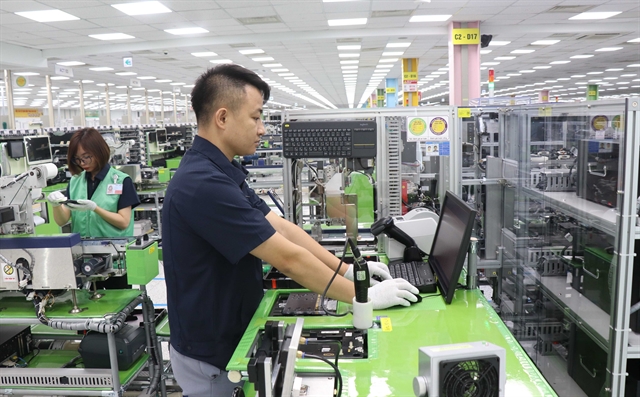
Production at Samsung Electronics Việt Nam in Yên Phong Industrial Park, Bắc Ninh Province. The new province will be a dynamic electronics and high-tech manufacturing hub. — VNA/VNS Photo Thanh Thương
In the north, the new Bắc Ninh Province, covering over 4,700 square kilometres and with a population of more than 3.6 million, is emerging as one of Việt Nam’s most dynamic growth poles.
Its combined economic output reached VNĐ440 trillion ($16.9 billion) in 2024, placing the new province fifth nationwide in terms of GRDP, trailing only HCM City, Hà Nội, Hải Phòng and Đồng Nai.
Bắc Ninh holds a uniquely strategic position as the northeastern gateway to Hà Nội, connecting the growth triangle of Hà Nội, Hải Phòng and Quảng Ninh, lying along two of the country’s most robust economic corridors with good connectivity with surrounding provinces through a network of highways, national roads, railways, and inland waterways that open out to the sea.
Robust infrastructure development also gives the province an advantage, including ring roads No 4 and 5, the Lào Cai–Hải Phòng railway (which passes through the capital) and the planned Hà Nội–Quảng Ninh high-speed rail. Especially, Gia Bình Airport will be upgraded into an international gateway and is set to become the largest airport in northern Việt Nam.
Bắc Ninh and Bắc Giang once formed the unified province of Hà Bắc from 1962 to 1966, before being separated in 1997.
From there, former Bắc Ninh emerged as Việt Nam’s electronics hub and a magnet for FDI with 16 industrial parks and a cumulative FDI surpassing $32 billion as of early 2025.
Bắc Giang rose as a new star of supporting industries with 16 industrial parks, attracting major high-tech projects such as Foxconn Shunsin and Luxshare ICT. Its GRDP growth reached 14.02 per cent in the first quarter of this year, the highest rate nationwide.
Their renewed union creates a mega industrial region with the convergence of scale, technology, workforce and regional connectivity and is poised to deliver more balanced and sustainable growth, consolidating a region already at the forefront of global electronics and high-tech manufacturing.
“The merger of Bắc Giang into Bắc Ninh marks the beginning of a new journey – one of continuity, innovation and breakthrough development within a broader, more sustainable and inclusive development space,” Chairman of the provincial People’s Committee Vương Quốc Tuấn said.
The province had pledged strong political will and accountability in becoming a centrally governed city by 2030, Tuấn added.
In the first eight months of 2025, the new province registered an economic growth rate of 10 per cent, ranking fifth nationwide, and drew in some $16 billion in new investments, placing the province among Việt Nam’s top FDI destinations.
The province targets an average GRDP growth rate of 11-12 per cent per year from now to 2030, per capita GRDP at $9,500-9,700 and a total trade revenue of $1.12 trillion.
To achieve the goals, Tuấn said that Bắc Ninh would focus on planning, infrastructure and urban development.
"The province is also stepping up efforts to attract private investment, improve policies to promote high-tech, green and digital industries to establish itself as Việt Nam’s leading electronics hub," he said.
“Science, technology, innovation and digital transformation are positioned as new growth drivers."
According to Kalungi Clausen, co-founder of Civitas and House of Tech, the mergers signal the dawn of a new era in regional development strategy.
"Integrated provinces enable master plans that transcend outdated administrative boundaries and lay the foundation for interconnected urban centres, industrial parks and regional transport networks," Clausen said. — VNS
Source: VNS
Related News

MEMBER CORNER / PROMOTIONS
AN ELECTRIFYING NIGHT WITH THE "QUEEN OF DANCE" THU MINH AT THE GRAND HO TRAM!
The stage at The Grand Ballroom is set to catch fire as Vietnam’s undisputed "Queen of Dance," Thu Minh, takes the spotlight. Renowned for her powerhouse vocals, magnetic stage presence, and sultry, high-energy performances, Thu Minh promises an evening of pure musical euphoria. The energy escalates with an exclusive appearance by special guest and The Voice champion, Vu Thao My.
HR / LABOUR/ EMPLOYMENT
HIGH-QUALITY HUMAN RESOURCES NEEDED TO ATTRACT NEW TECH INVESTMENT CAPITAL
Besides infrastructure, Việt Nam must also rapidly develop a highly skilled workforce to attract investment in AI, semiconductors and advanced manufacturing, experts have said. Don Lam, CEO and co-founder of investment management company VinaCapital, said that global technology investors were increasingly looking at the readiness of the entire ecosystem, with high-quality human resources a decisive factor.

HR / LABOUR/ EMPLOYMENT
HIRING OUTLOOK STRENGTHENS IN Q4 AS SKILLS SHORTAGES PERSIST
Hiring intentions among employers in Việt Nam strengthened in the fourth quarter, with 52 per cent of surveyed companies planning to increase headcount between October and December, according to a ManpowerGroup survey released this week. Việt Nam's hiring outlook was stronger than the Asia Pacific and Middle East (APME) regional average of 33 per cent and the global average of 29 per cent, ranking third in the region and 11th globally among 42 markets surveyed.

BANKING / FINANCE / INSURANCE / TAX
LARGE BANKS FORECAST TO GAIN HIGHER PROFITABILITY IN H2 2026
The return on average assets (ROAA) of the banking sector will likely remain stable at around 1.5 per cent in the second half of 2026, but profitability divergence among banks will increase, with large banks outperforming peers on stronger margins and diversified earnings, analysts forecast. In a recent report on the banking sector, analysts from the Vietnam Investors Service Rating said the sector’s ROAA rose by 10 basis points quarter-on-quarter to 1.51 per cent in the first half of this year, driven by net interest margin (NIM) improvements at some State-owned banks and large private banks.
GARMENT / TEXTILE
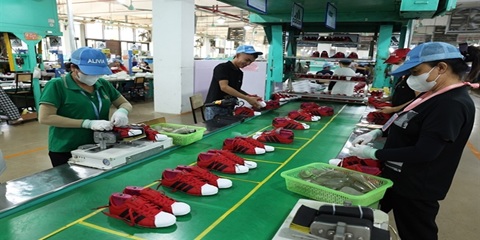
VIỆT NAM'S FOOTWEAR, BAG EXPORTS TO US TOP $8 BILLION IN EIGHT MONTHS
Việt Nam's exports of footwear and handbags to the US exceeded US$8 billion in the first eight months of 2026, as the US and EU remained the country's biggest markets despite sluggish growth in footwear shipments. Exports from Việt Nam's leather and footwear sector reached more than $2.45 billion in August, down 9 per cent from July but up 3 per cent from a year earlier, according to preliminary statistics.
VIETNAM ECONOMY INVESTMENT
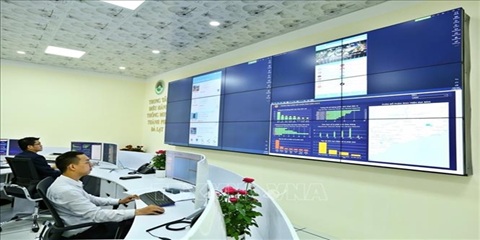
LÂM ĐỒNG TARGETS DIGITAL ECONOMY TO ACCOUNT FOR 30 PER CENT OF GRDP BY 2030
Lâm Đồng Province aims to raise the digital economy’s contribution to around 30 per cent of its gross regional domestic product (GRDP) by 2030, as part of a five-year plan to develop digital economy and society issued recently. Under Plan No. 15358/KH-UBND, the province targets more than 60 per cent of small- and medium-sized enterprises (SMEs) to adopt digital technologies by 2030 while increasing the value of cashless payments to 30 times its GRDP.
Events Sponsors






















